We didn't watch the Presidential Address last night. Did you?
We have caught some excerpts.
We wonder what powers our Republic's President has to order a corporation to create an escrow account administered by a third party. We wonder also what powers our Republic's President has to assign liability for a presidential action--ordering a moratorium on offshore drilling--to a private corporation.
We understood the President to be deeply concerned about due process for terrorist suspects. We suppose we should be heartened that corporations--which by current dogma are not people and so have no rights--are bereft of due-process consideration. An act of war can be criminally prosecuted. A negligence tort is a casus belli. It's so wonderful to have a constitutional law professor in charge of the world.
If someone wanted to write a speech that would subtly reinforce the notion that BHO is at once grandiose in his self-evaluation and clueless about actual issues, we think this speech was probably unsurpassable.
Even Chris "Tingle Up My Leg" Matthews thought this was a stinker. Comparisons to Carter are now taking hold.
Or banana-republic strongmen: see the irrepressible Ben Stein's exceptionally restrained essay offering such.
Wednesday, June 16, 2010

Gaza Convoy: Israel Must Be Perfect
Here's a video, clearly produced with a bias toward Israel but nevertheless offering as vivid a summary as one can imagine as to why Israeli commandos used lethal force after boarding the ships of the so-called Gaza relief convoy.
If even some of this is correct, it reinforces something we've thought for awhile.
Much global reaction to Israel is grounded in old-fashioned antisemitism. Some of it is grounded in fatigue over the intransigence of Middle Eastern conflict. Some is pure contrarianism: the desire to take the side opposite that of one's peers.
But somewhere in the middle of all this is the belief that Israel can somehow preserve its life and limb while at the same time placating its fanatical Islamic opponents if it simply acts with optimal wisdom and discretion. How many pundits after the raid affirmed that Israel ought to monitor shipments into Gaza but carped that the Netanyahu government simply was going too far in doing that?
We think in this respect the Israelis are in large part the victims of their own success. From the Six Day War to the Yom Kippur War to the Entebbe Raid to the airstrike on Saddam's nuclear facility, Israeli intelligence and military forces established an impressive record, much to the relief of the world's democracies who stood on the sidelines while totalitarian regimes did what such regimes do.
Now, to do anything less than picture perfect is for Israel to fail.
We note that Ted Williams struck out 709 times in his major league career.
Tuesday, June 15, 2010
The Embarrassment-a-Minute Campaign of Rand Paul
So what does the latest mala-Paul-ism say about KY GOP Senate candidate Rand Paul? That he's every bit the quixotic, individualist rebel that we would expect him to be.
For those who rely entirely on SWNID not just to interpret the news but also to report it: Dr. Paul has not been certified by the American Board of Ophthalmology, the nationally recognized certifier of eye doctors which certifies over 95% of the nation's ophthalmologists, in over a decade. In protest of that organization's post-1992 policy to require recertification of doctors joining after 1992 but grandfathering in those who received lifetime certification under the pre-1992 rules, Paul formed his own organization to certify eye specialists. He's the prez, his wife is the vice prez, and his wife's father is the secretary.
Paul says that his opponent's raising this issue is an attack on Paul's ability to earn a living.
There's the report. Here's the interpretation.
We figure that this has nothing to do with Paul's ability as an eye doctor. He had no record of problems with the ABO before he formed a rival organization, and he's OK with the KY medical board, so that much is probably enough to indicate to voters that he's not a quack. If he were a bad doctor, he'd have a record of litigation that would already be thoroughly exploited by his political opponents, for they are many.
What he is, however, is, like his father, impressed with his individuality and principled propriety. He didn't respond to an ABO policy with which he disagreed by staying engaged with the organization to change it. He just left and set up a rival organization, one that probably counts as members about as many people as one could get at a typical Libertarian Party fundraiser. For Paul, it's more important to take what he fancies a strong personal stand than to actually change something that exists.
SWNID lives in a world parallel to Paul's, as far as certification goes. Accreditation for IHEs is akin to certification for docs: voluntary organizations of practitioners band together to establish and enforce standards of mutual accountability. Because such ventures are voluntary and cooperative, not all agree to the standards and practices. Some disagree because they know they could never meet the standards; others, out of what seems to be principled--the suspicion that the organization has become misguided.
So in higher ed there exist IHEs that do not seek accreditation. Many gravitate to nonstandard accrediting agencies (called "nonstandard" because they aren't widely recognized, though by coincidence many have extremely lax standards). These are largely the institutions that don't measure up. Others declare their principled intention not to seek accreditation, to avoid the interference and entanglements that they allege such relationships produce.
As a practitioner of higher education, SWNID eschews such isolationism. Presently we can't name a recognized accreditor whose standards are unreasonable or whose pattern of practice interferes with an institution's pursuit of its mission, though we might someday modify that judgment. To the very limited degree that such conditions do or might exist, we believe it more important to belong to the organization and thereby influence its direction than refuse the association in order to posture as particularly possessing personal purity. That's why we routinely warn students not to pursue degrees from unaccredited institutions while quietly urging those who on historic principle eschew accreditation to reevaluate based on the facts and opportunities.
Paul is almost certainly of the postured-principled type, not the hiding-inadequacy type. The issue isn't that he's incompetent; it's that he's full of himself.
So here's what KY voters can expect of Senator Paul: lots of individual declaiming about things that no one else cares about, lots of votes against measures supported by 90-plus Senators, lots of talk about introducing measures that won't even be considered by committees, let alone get voted on (e.g., gold standard and dissolution of the Fed), not one bit of significant legislation co-sponsored, let alone written and shepherded through the deliberately arduous process once celebrated by Schoolhouse Rock in the Dave Frishberg classic "I'm Just a Bill."
In sum, they'll get a Senator who will exceed Jim Bunning for irrelevance. And, it should be noted, Bunning did agree to be inducted into the Baseball Hall of Fame without protesting the questionable standards of that organization that has honored so few shortstops.
But, as the informercials say, there's more. This episode also reveals that Paul has an exceptionally thin skin, resembling BHO in that inglorious respect. So someone calls attention to the fact that he has irregular certification in his profession, and Paul calls it an attack on his ability to earn a living (something to which he seems to be insecurely devoted, as he has pre-announced his intention to stay busy as a practitioner while representing his state in the Senate). Hyperbole is hardly the most effective way to respond publicly to something that is personal, and this is hardly personal at all. It's as if Paul is assuming that his patients wouldn't know the significance of certification were Evil Democrats not drawing attention to it. Again, it's all about him, in that odd combination of libertarianism and narcissism typified by someone else named Rand.
Yes, we know that Paul is strong on fiscal sanity, a most needed perspective these days. The problem is that his political modus operandi is more likely to marginalize fiscal restraint than to promote it. He and his dad may be good at getting elected, but they're demonstrably terrible at influencing governance. Idiosyncrasy is highly counterproductive in the social drama we call politics. Posers don't change reality because they don't deal in it. But they look marvelous while being irrelevant.
Sure-to-Be-Over-Interpreted Local Event
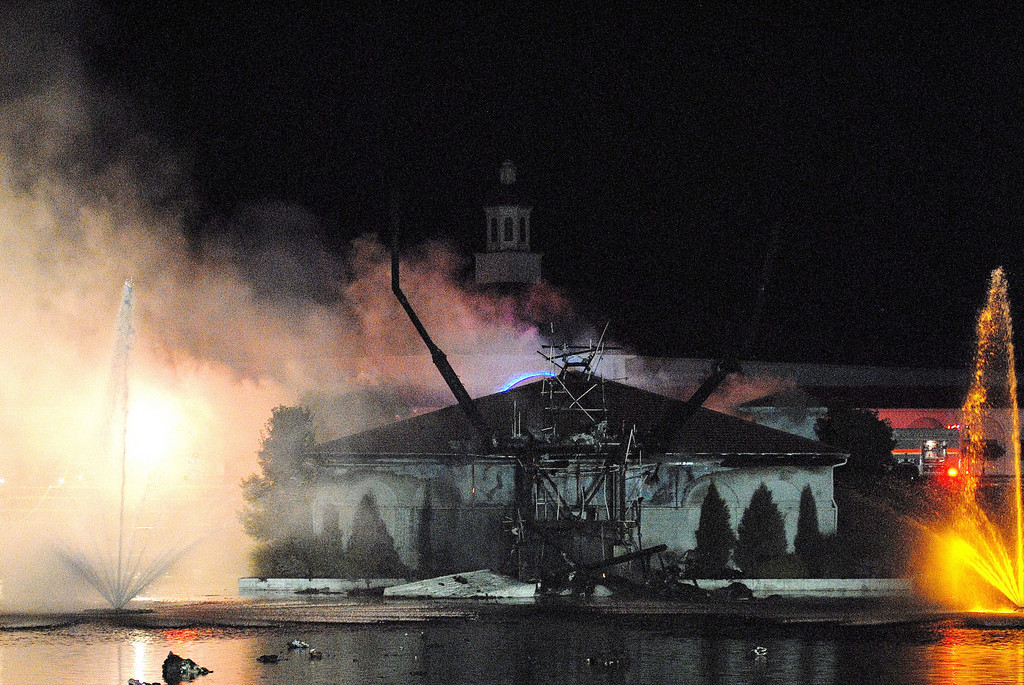
For several years, one of the most frequent search-engine searches leading to SWNID has been an image search for the ginormous Jesus statue at Greater Cincinnati's Solid Rock Church.
Now that image search will assume historical significance. A portentous lightning strike last night ignited the statue, made to last with materials including styrofoam and fiberglass. Today, nothing remains except the steel skeleton. (Click picture for full view: our HTML skilz do not extend to formatting this graphic properly.)
For gentle readers who are also pyros, here's what seems to be the most graphic video of the event:
We refuse to speculate on the significance of this ominous episode, all such speculation sure to follow paths so well worn as to exceed description as hackneyed.
Instead, we offer a prediction: Darlene Bishop, whose surname roughly describes her role as co-pastor of Solid Rock, will begin raising money for a replacement statue, even more outsided and tasteless than the last, immediately.
Now that image search will assume historical significance. A portentous lightning strike last night ignited the statue, made to last with materials including styrofoam and fiberglass. Today, nothing remains except the steel skeleton. (Click picture for full view: our HTML skilz do not extend to formatting this graphic properly.)
For gentle readers who are also pyros, here's what seems to be the most graphic video of the event:
We refuse to speculate on the significance of this ominous episode, all such speculation sure to follow paths so well worn as to exceed description as hackneyed.
Instead, we offer a prediction: Darlene Bishop, whose surname roughly describes her role as co-pastor of Solid Rock, will begin raising money for a replacement statue, even more outsided and tasteless than the last, immediately.
Saturday, June 12, 2010
ObamaCare's Already-Roosting Chickens Squawk, "We Told You So"
BHO: If you like your present healthcare plan, you'll get to keep it.
IBD:
IBD:
Internal White House documents reveal that 51% of employers may have to relinquish their current health care coverage by 2013 due to ObamaCare. That numbers soars to 66% for small-business employers.
The documents — product of a joint project of the Labor Department, the Health and Human Services Department and the IRS — examine the effects new regulations would have on existing, or “grandfathered,” employer-based health care plans.
BHO: Projected savings on Medicare will help to pay for ObamaCare.
President Obama called Saturday for Congress to avert a planned 21 percent pay cut for doctors who see Medicare patients, saying the move, which would cost taxpayers billions of dollars, is necessary to insure the health of older Americans. . . .
With Medicare costs — and the federal deficit — spiraling out of control, how to fix that formula became one of the most contentious questions of last year’s health debate, but the fix did not get incorporated into the landmark health overhaul that Mr. Obama signed into law. The president acknowledged that putting the question off again by simply restoring doctors’ pay for another year is not the answer.
Put differently: not as advertised, but definitely as predicted.
Friday, June 11, 2010
Latest and Best Step to Reduce Fossil-Fuel Dependency
The impressive Megabus now announces the opening of a new hub in the City of Brotherly Love. The highly nimble, highly successful interstate bus company is obviously succeeding in its goal to get people who would otherwise drive to park their cars and enjoy express bus service on a double-decker with WiFi, movies, music and comfort.
We meanwhile update our previous reviews by stating that we now have significant anecdotal testimony from experienced riders that Megabus is offering excellent, even improving service that delights its customers. We affirm our warm recommendation of this service to any and all who consider it.
And we figure that this thoughtful deployment of existing technology is just what we need to continue the trend toward efficiency in the usage of fossil fuels, those substances the use of which seems so to trouble so many earnest folk. Enjoy your windmills, your solar cells, your plug-in cars, your ethanol subsidies. We'll take the bus.
Tuesday, June 08, 2010
Update on Deep Water Drilling
The estimable Robert Samuelson has offered the best view of the BP oil spill that we've seen to date. In it he notes:
For that reason, we applaud loudly the President's lifting of his moratorium on offshore drilling. We sincerely hope that this means the crisis will "go to waste" for those who want to use it to "transform our oil-based economy."
- Offshore drilling had an impressive record of success and safety prior to this event. This includes so-called deep-water drilling.
- The 5000-foot depth of the BP Deepwater Horizon well was deep but hardly the deepest around.
- The well's failure fits well the usual human pattern of complacency bred by success.
For that reason, we applaud loudly the President's lifting of his moratorium on offshore drilling. We sincerely hope that this means the crisis will "go to waste" for those who want to use it to "transform our oil-based economy."
What We Said: "Progressives" Are Out of Touch
If it weren't for complaining that the political left regularly exercises what appears to be willful ignorance of economic reality, we'd have little to blog about.
In today's WSJ, George Mason University economist Daniel Klein codifies as much. Klein summarizes results of a recent survey to assess the grasp of economics found among different political groups. Asked eight questions reflecting basic economics, self-described adherents to various political ideologies missed the following numbers of questions, on average:
N.B. that the questions were given on a five-point Likert scale, and three of five responses were scored correct for each answer. That means that the left did worse than random guessing. It also means that noble, principled Moderates (read: confused and indifferent) are only slightly worse than random guessers.
Go ahead, Lefties: carp about the nature of the questions or the validity of the survey. The rest of us will try to get on with dealing with the grim reality.
In today's WSJ, George Mason University economist Daniel Klein codifies as much. Klein summarizes results of a recent survey to assess the grasp of economics found among different political groups. Asked eight questions reflecting basic economics, self-described adherents to various political ideologies missed the following numbers of questions, on average:
Very conservative, 1.30; Libertarian, 1.38; Conservative, 1.67; Moderate, 3.67; Liberal, 4.69; Progressive/very liberal, 5.26.
N.B. that the questions were given on a five-point Likert scale, and three of five responses were scored correct for each answer. That means that the left did worse than random guessing. It also means that noble, principled Moderates (read: confused and indifferent) are only slightly worse than random guessers.
Go ahead, Lefties: carp about the nature of the questions or the validity of the survey. The rest of us will try to get on with dealing with the grim reality.
Stephen Hawking and the Limits of Genius
There's no doubt that Stephen Hawking is a brilliant physicist. We express SWNIDish doubt that he knows what he's talking about when he moves outside his area of expertise.
Science and Religion Today notes Hawkings's recent remarks to senior mediababe Diane Sawyer on ABC World News (motto: watched in seniors communities throughout America's heartland):
Ah, lots of nuance in that characterization! We'll note that (a) religion is too broad a category to characterize simply, as it comprises mutually exclusive faith systems; (b) various "religions" have varying degrees of reliance on authority; (c) the religion to which we adhere--and the only one we think worth defending--has a rather multifaceted basis and a complex relationship to bald "authority"; (d) the scientific community has its own embarrassing reliance on authority, reflected in our willingness to listen to a physicist's ideas about religion; (e) both the Christian (there, we said it out loud) and scientific communities self correct through the use of observation and reason over time.
But there's more! Hawking continues:
We urge that if from this remark certain words are changed or omitted, the conclusion, "seems most impossible," becomes "seems most intriguing/coherent/awe-inducing." The changes are:
Science and Religion Today notes Hawkings's recent remarks to senior mediababe Diane Sawyer on ABC World News (motto: watched in seniors communities throughout America's heartland):
There is a fundamental difference between religion, which is based on authority, [and] science, which is based on observation and reason. Science will win because it works.
Ah, lots of nuance in that characterization! We'll note that (a) religion is too broad a category to characterize simply, as it comprises mutually exclusive faith systems; (b) various "religions" have varying degrees of reliance on authority; (c) the religion to which we adhere--and the only one we think worth defending--has a rather multifaceted basis and a complex relationship to bald "authority"; (d) the scientific community has its own embarrassing reliance on authority, reflected in our willingness to listen to a physicist's ideas about religion; (e) both the Christian (there, we said it out loud) and scientific communities self correct through the use of observation and reason over time.
But there's more! Hawking continues:
What could define God [is thinking of God] as the embodiment of the laws of nature. However, this is not what most people would think of that God. They made a human-like being with whom one can have a personal relationship. When you look at the vast size of the universe and how insignificant an accidental human life is in it, that seems most impossible.
We urge that if from this remark certain words are changed or omitted, the conclusion, "seems most impossible," becomes "seems most intriguing/coherent/awe-inducing." The changes are:
- "made": change to "understood" or "conceptualized"; there's no reason to assert that all "religion" (again, too broad a category) is entirely of human creation, even if one wants to do the same for glorious "science," and with similar discounting of the validity of conclusions.
- "human-like": change to "personal," so as to eliminate all the problematic aspects of humanity and open the possibility that human personhood is a reflection of the divine and not vice versa (in passing we ask Dr. Hawking whether he is fully content that his self-awareness as a person is sufficiently explained as the consequence of natural selection).
- "accidental": change to "distinctly self-aware," stressing the observable outcome and not assuming the nature of origin, which is the very thing being debated.
Friday, June 04, 2010
"To the Source": Babies, Like Other Humans, Are Natural Hypocrites
Guess what? Babies, shown simple puppet plays depicting good and evil, gravitate to the good puppets. Toddlers, shown the same plays, often try to punish the bad puppets.
The indispensable ToTheSource reports on research demonstrating this outcome, strongly suggesting an inherent moral sense in our youngsters--and ourselves.
Meanwhile, parents continue to observe that their children are profoundly selfish. The same child who wants to punish the bad puppet also acts like the bad puppet at least some of the time.
That, gentle readers, is the human condition in a nutshell: aspiring to the good but failing miserably to achieve it much of the time. Thus also the Christian Scriptures describe the human experience from the first chapters to the last.
This is why we affirm all who declare the church full of hypocrites. All humans are hypocrites, including especially those who proclaim themselves bad to avoid the charge of hypocrisy for failing to be good, as these hypocritically deny their occasional impulses, sometimes acted upon, for the good. Churches are full of hypocrites because if they're full of anything, they're full of humans.
Apply these truths generously all around.
Thursday, June 03, 2010
Another Presidential Address We'll Never Hear
My fellow Americans:
I speak to you tonight about the disastrous oil spill in the Gulf of Mexico. As your President, I want to explain as clearly as I can why this spill happened, why it has proved so difficult to contain, and how this event must shape our future energy policies and approach to government and private enterprise.
First, why did the spill happen? Some have argued that BP and other oil companies are too greedy for profit and so take unconscionable risks with the safety of our environment. Those critics fail to realize the enormous liability that BP will now suffer for the damage it has done to the economy of the Gulf. Anyone who has followed BP's stock price since the spill knows that BP would have done everything it could to prevent an event like this, had BP known exactly how to do that. Oil companies know that they will pay out ruinous damages for events like these. That threat to their profits is the most powerful motivation available to restrain the foolishness that greed can engender.
Some have argued that the well was in water too deep for drilling to be practical. Those people have a point: we have many places we can drill that are much less likely to create an environmental hazard like this. That's why I am issuing an executive order to open drilling on the Atlantic and Pacific Coasts and in the Alaskan Wildlife Refuge. Those fields offer much easier, safer drilling with less possibility of environmental impact. Perhaps such drilling will allow us to be more careful about drilling in deep water opposite states that are supportive of the oil industry.
However, the truth is that we have a national interest in deep-water drilling. If we are not to rely entirely on dictatorships for our supply of oil, we need enhanced domestic supply. But how can we drill in deep waters when the risks to the environment are so high?
The answer is that we must learn how to drill more effectively, just as we must learn how to manage oil spills more effectively. In this respect, oil drilling is just like every other human endeavor: we learn by trial and error.
Even now, while oil continues to spill into the Gulf, we know more about how to respond to such spills than we knew before this disaster happened. We are learning from this episode just as we learned better techniques for extinguishing oil well fires after Saddam Hussein left Kuwait's oil fields ablaze in his retreat in the first Gulf War. We are learning just as we did with Exxon Valdiz spill or the iconic Santa Barbara oil spill. We are learning just as we did after the two horrible Space Shuttle disasters, just as we did after Pearl Harbor and Bull Run and Bunker Hill, just as humankind consistently learns by making mistakes.
Some say that we don't need to learn anything from this episode except that oil is bad for us. They insist that we must move as quickly as possible from a fossil-fuel economy to a green-energy economy. But I must warn that green energy is not so green. Oil drilling alters the but a tiny fraction of the earth's surface, while green technologies--solar, wind, biofuels, and the like--will require millions of acres to produce what a few oil wells can offer. We will continue to support research into the development of alternative energy sources and to encourage energy conservation with tax incentives, building codes and the like. But let's be honest: fifty years from now, we will still be relying significantly on fossil fuels.
This is my answer to those who argue that federal regulation failed to prevent this spill because regulation was too lax. But let's remember that government regulators are not omniscient. They only know what the present state of knowledge is, and seldom do they know it better than those who work in the industry or who train its engineers in our universities. For those who complain about the close relationship between industry and regulators, I ask what they offer as an alternative. Only experts in the technology of an industry can regulate it. The only source of experts is the industry itself. Do we want our best and brightest engineers working for Washington or working to get the oil out of the ground effectively? Obviously we need a blend of both, and that's exactly what our "revolving door" between government and industry provides.
But still, these experts are human. They make mistakes--out of ignorance, sometimes out of carelessness, sometimes out of mendacity. We will investigate carefully this disaster's causes carefully, not to scapegoat but first to learn how to avoid such events in the future and second to hold to account those whose negligence, if indeed any were negligent, makes them civilly liable or criminally culpable.
But we won't redress some imagined "out of control" industry with more burdensome federal regulation. We may call government employees "public servants," but they are just as fallible as those in private industry--and just as inclined to the pride and selfishness that lead to bad decisions even about those things that we do understand. Anyone who's filled out a tax form understands what I mean.
So in sum, we will not back down from our goal to increase America's domestic oil production. In fact, we are doubling down on that commitment. Further, we are committed to learning everything that we can from this awful event so that in the future mistakes like this will be less likely and less costly. But we will not let this setback deter us from what is right and sensible for our country's future.
Allow me to make a comparison to another recent event. Wednesday night Detroit Tiger Armando Galarraga pitched a perfect game. That is, it would have been a perfect game had umpire Jim Joyce not blown the call of the final out. Joyce himself has admitted the mistake, and Major League Baseball may yet allow Galarraga's feat to enter the record books.
What do we do with a mistake like Joyce's? Should baseball eliminate umpires? Should all calls be reviewed by instant replay, or just those that affect things that go in the record books? We can debate those questions, but it's clear that Major League Baseball and Jim Joyce both have a tremendous opportunity to learn from this event, a one-of-a-kind event to be sure, but one that can inform many more common events that happen on the field.
That's exactly the way we must view the Gulf oil spill. This is a disaster far worse than a blown call in baseball. But it need not--indeed it cannot--deter us from exploring the seas for oil. When this is over, and it will be over soon, we'll know far more about deep-sea drilling and oil-spill management than we did when we began. And we will be able to move forward with more confidence, not less.
Wednesday, May 26, 2010
Chris Christie Talks the Talk
As Rand Paul makes conservatives and Republicans look like out-of-touch ideologues, Chris Christie is saying what we've been thinking for a long, long time. Here's an account of an exchange from a public appearance of Christie's:
How soon can we run this guy on a national ticket?
Wow! No esoteric appeals to out-of-touch constitutional theories, no messing around with stuff that folks don't get, just to-the-point declarations of obvious fact.
Governor Christie on Tuesday told a borough teacher to find another job if she did not feel she was compensated enough as he defended his state budget cuts and promoted a plan to cap annual growth in property tax collections. . . .Borough teacher Rita Wilson, a Kearny resident, argued that if she were paid $3 an hour for the 30 children in her class, she’d be earning $83,000, and she makes nothing near that.
"You’re getting more than that if you include the cost of your benefits," Christie interrupted.
When Wilson, who has a master’s degree, said she was not being compensated for her education and experience, Christie said:
"Well, you know then that you don’t have to do it." Some in the audience applauded.
Christie said he would not have had to impose cuts to education if the teachers union had agreed to his call for a one-year salary freeze and a 1.5 percent increase in employee benefit contributions.
"Your union said that is the greatest assault on public education in the history of the state," Christie said. "That’s why the union has no credibility, stupid statements like that."
How soon can we run this guy on a national ticket?
Sunday, May 23, 2010
Streetcar Named Expire
Cincinnati has demonstrated some sense.
Two thirds of those polled by our local newspaper voice disapproval of plans to spend gazillions for a streetcar that will carry inebriated UC students to a wider variety of bars than they can presently reach on foot.
Cincinnati's public transportation problem is not that it lacks public transportation modes. It's that it lacks the density of population and concentration of jobs to support a robust public transportation network.
And for a city that, like most, can't afford the princely and princessly pensions it promised to its civil servants, spending large numbers of dollars for that most inflexible of public transportation modes hardly seems timely.
Saturday, May 22, 2010
The Saving Grace in the War on Terror
Fox News reports that a key al Qaida figure has blown himself up "messing with a bomb." This comes after the various comical failures of plots to destroy airliners, Manhattan tourists and such.
Say what you will about the competency (previous administration) or focus (present administration) of government to fight terrorism, what protects the public best from terrorism is the unshakable truth that terrorists is stupid.
Say what you will about the competency (previous administration) or focus (present administration) of government to fight terrorism, what protects the public best from terrorism is the unshakable truth that terrorists is stupid.
Friday, May 21, 2010
Local Pundit Gets Local Airtime
In the world of local news, being available before the deadline can get you on the air.
More on Paul's Confusion
Esteemed political thinker Rand Paul says that BHO's criticism of British Petroleum sounds "really un-American."
Paul is aligned with a group that calls itself the Tea Party, honoring an event in American history in which Colonial patriots boarded a ship in Boston Harbor and threw its cargo of tea into the water, protesting the French government's imposition of taxes on its American colonies without those colonies citizens being represented in the French Parliament.
Meanwhile, the Americans and the British have always been BFFs.
We promise not make this blog's subject matter all Paul. That would be appalling. But we are hard pressed to resist making obvious jokes when the man supplies a straight line a day.
Why Rs Must Prevail in November 2010
The American Spectator's Jay Homnick, analyzing the awful relationship between the Chief Executive and the Congress and the press, explains why the electoral tide is turning and must complete its turn in November:
As SWNID says often: words to live by.
The press overplayed its hand. It has thoroughly abdicated its role in questioning government when Democrats are in office. The same press crew that challenged Bush on the economy when there was 4.6% unemployment now reports as wonderful the fact that unemployment when [sic] up from 9.7 to 9.9 in April. This proves more people are optimistic enough about the future to re-enter the job market! Imagine if we hit 11 or 12, we will have to send a ticker-tape parade down Wall Street.This tells the independent voter there is no longer a contest between Democrat and Republican. There is a contest between charismatic leaders surrounded by naïve sycophants versus practical leaders surrounded by skeptical interrogators. The independent has to vote Republican not because he buys the ideology but merely because he thinks it healthy to have a guy who is challenged rather than venerated.
Those last two sentences constitute today's memory verse for gentle readers, so we repeat them: "There is a contest between charismatic leaders surrounded by naïve sycophants versus practical leaders surrounded by skeptical interrogators. The independent has to vote Republican not because he buys the ideology but merely because he thinks it healthy to have a guy who is challenged rather than venerated. "
As SWNID says often: words to live by.
Paulism Meltdown Sets Political Record
We console our libertarian gentle readers with those most comforting of words: we told you so.
Rand Paul was triumphant in victory on Tuesday. On Thursday, he handed his opponents victory in November.
There are certain things in politics that one simply doesn't do. One is question the legality or applicability of the Civil Rights Acts of 1964. Once upon a time, one could have interesting discussions in public about whether such acts should extend to the regulation of private, commercial transactions. Those discussions are now widely regarded as disturbing--as those who want to hold them are widely regarded as disturbed.
Hey, once upon a time you could have interesting public discussions about slavery and property rights and restitution to slaveowners for emancipation. Try that one on for size sometime soon.
Rand Paul is officially a real-life Borat-from-Bowling-Green. Except no one's laughing. Maybe it's the lack of an interesting accent.
We anticipate the defiant rejoinder: Paul will still win in November. Fair enough. But if he does, Republicans are nationally stuck with the label "racist" for at least another generation, condemning them to a demographic disadvantage that will paralyze political discourse and condemn the Republic to social-democratic stagnation.
The GOP lost yesterday, and they'll need to work extra hard and fast and smart to limit the damage to one Senate election. We say it's time to defenestrate Paul, risk alienating Paulites for a season, let the Ds have the tainted KY seat, and go national with redoubled efforts to retool as a Contract-for-America-style smaller-government, freer-enterprise party pronto. Starting with a purge of the old-hand leadership for some insurgents (there are loads of keen minds in the party's second string--Ryan, Cantor, Daniels, Christie, Thune--all with curb appeal that shames the McConnells and Boehners of this world who can't think their way through the present opportunities) certainly commends itself. An announcement Monday after a round of condemnations of Paulism on the Sunday talk shows would be most excellent.
We quote the eminent social philosopher Forrest Gump, or his momma, to be precise: "Stupid is as stupid does."
Thursday, May 20, 2010
Taking Bill Maher to Church
Faith is not the enemy of thought. The lazy and unethical way many of us have been taught to practice religion is.
That's from the Kansas City Star's Jason Whitlock, who offers this worthwhile bromide near the end of his verbal dismembering of political ranter Bill Maher, always a purveyor of opinion but now mostly a purveyor of doctrinaire antireligious opinion.
Whitlock, a liberal and fan of Maher's, nicely notes that labeling all religious belief delusional is more delusional than most religious belief.
Note well Whitlock's litany of moral accomplishments of religious people. Then note that in theswe stories of accomplishment the religion in question is almost universally the one with an incarnate god who willingly dies and rises for the sake of undeserving people.
That's the other thing that needs to be said to Mr. Maher and others. The burning question is not the place of "religion" in the world. It's really the place of Christianity in the world. Bad versions of Christianity bear a more-than-superficial resemblance to various religious and irreligious phenomena, all of them bad too. Christianity that's properly Christian bears little resemblance to anything else--in what makes it properly Christian.
The Nation: Socialism Another Casualty of the Recession
Q: What's black and white and red all over? A: The Nation.
Now here's proof that the Great Recession is an extreme right-wing plot to destroy the left and so take over the world for fascism. The Politico reports that venerable lefty rag The Nation is in desperate financial straits, even enlisting journalists to send fundraising letters for help in offsetting its million-dollar deficit.
Our last experience with The Nation in print was while riding the CTA's 22 bus north on Clark Street through the city's tonier residential districts to our cheap, obscure hotel in a more modest quarter. There we watched a well-turned out, genteel, elderly lady turn its pulp pages--laden with graphics strongly reminiscent of so-called "socialist realism" but notably unburdened with advertising, save appeals from the ACLU and The Nation itself for charitable gifts, including especially estate gifts. We recall thinking that the fine lady's gloves certainly cost more than several years' subscription to her reading material, while her hat and coat would certainly exceed the value of certain autos in the SWNIDish fleet.
Doubtless the subscriber whom we saw decamp from the bus near a Lincoln Park high-rise condo building could fund the journal's seven-figure deficit without much trouble. Whether relying on the charity of the top 1% indefinitely is a feasible business plan for an avowedly socialist publication is still questionable.
Subscribe to:
Posts (Atom)