"All the news that's fit to print" indeed!
The NY Times offers an article on the Gospel of Judas that, like most articles appearing recently on the subject, advances the notion that the book is largely about an alternative understanding of the passion narrative, one in which Jesus conspires with Judas to bring about his death. The Times article prominently notes a quotation from near the end of the manuscript, where Jesus says to Judas, "But you will exceed all of them. For you will sacrifice the man that clothes me."
Apparently, however, the Times reporters haven't actually read the entire translation of the manuscript, or didn't care to note that this quotation, suggesting the very thing that they mention, actually plays a role in a much larger thrust to the book. Specifically, the Gospel of Judas seeks to discredit the rest of the twelve disciples as corrupt, immoral and deceptive, and to advance the notion that Judas, alone among the twelve, was entrusted by Jesus with the secret spiritual knowledge that leads to enlightenment and salvation.
Oddly enough, it is this very kind of rhetorical move that the Times article is alluding to when it says that the Gospel of Judas illustrates the diversity and conflict among early Christians. On this, we must provide some scholarly background to the discussion.
Historically Christians have always talked about orthodoxy and heresy in the early years of their movement. They understood the primary historical sources (the NT and the early church fathers) to indicate that there was plenty of alternative interpretation of Christian thought at every stage of their history. However, they understood that these were not just competing ideas with relative equality. Rather, they understood that one set of ideas, one theology, one doctrine, had an authentic pedigree. It had been taught from the beginning--with development and elaboration, but still from the beginning--by those most closely associated with Jesus. It was preserved in the church's continuous teaching, memory and experience, and more particularly it was preserved, they came to assert, in a set of books that had been regarded as having special authority from the time of their appearance (i.e. what we call the books of the New Testament).
More recently, however, much scholarly discussion has taken the line of the very important German scholar, Walter Bauer. Bauer [insert clever remarks about 24 and CTU here] is best known as the author of the most important lexicon of New Testament Greek, but he may be most influential as the author of Orthodoxy and Heresy in Earliest Christianity. In this work, Bauer synthesized a view of early Christianity in tune with modernity. He saw the movement as a collection of competing ideologies. These competed with all the political tools to overcome the others and become predominant. The group that won--and winning finally meant getting the Roman emperor on their side--wrote the history, styling themselves authentic and "orthodox" and the others "heretical."
That perspective is reflected, of course, in the Times article. And it is the source of much uninformed angst among believers, who accept the analysis without understanding its roots.
What is to be said in response to Bauer and the Times? Well, one must examine the primary sources with a view to the question of priority. Which has the better claim to have come first, the "orthodox" Gospels or the "heretical" ones?
Let's take the Gospel of Mark as an example of the first kind. Mark narrates a story that recounts events purporting to take us from John the Baptist to Jesus' resurrection (perhaps minus resurrection appearances, which are nevertheless assumed). The entirety of the story comes together to portray Jesus as a powerful worker of wonders and an impressive, albeit mysterious teacher, who goes willingly to his death, surrendering himself to his enemies with a deliberateness that bespeaks a belief that he dies in fulfillment of God's will. It is a complete story, offering an "apology for the cross" (Robert Gundry) that contrasts the power of Jesus the miracle worker and teacher with his death to underline that he is not taken by forces greater than himself but dies willingly.
By contrast, the Gospel of Judas narrates almost nothing. It consists largely of mysterious, visionary, allegorical teachings of Jesus in exchange with Judas, who is singled out as the one who liberates Jesus from the "clothing" of his body by handing him over to death. It mentions the twelve prominently but does not discuss who they are or how they came to be. It says nothing of Jesus' works of power, and it doesn't even narrate his death.
In other words, it takes for granted that the reader knows Jesus as a powerful figure, one who called twelve disciples, and as one who dies by crucifixion after being handed over by Judas to the "scribes." Without that prior knowledge, its reader couldn't make heads or tails of it.
So, the historian asks, which came first, a story like the Gospel of Mark's, or a story like the Gospel of Judas'? The answer is obvious enough.
This, of course, is an observation decisively in favor of the traditional way of understanding diversity in early Christianity as opposed to Bauer's modernist revisionism. Was there a political struggle between factions in early Christianity? Of course. But there was still an original story of Jesus, an original way of interpreting his life and death and resurrection. Other stories came later. One can choose to follow them, but they don't have the same pedigree, the same claim to connect to the figure of Jesus himself, the same claim to have been believed by his closest followers.
To make the claim that they do connect to Jesus, the followers of Jesus must be discredited and the true teachings of Jesus must be presented as a secret entrusted to someone who has passed them on secretly to a chosen few.
Now, if any of this sounds to you like what Dan Brown did with The DaVinci Code, you're getting the idea.
So in sum, the Gospel of Judas isn't so much about a different view of what Judas did as it is about a wildly different interpretation of everything about Jesus. It displays no signs of a primary narrative of the life of Jesus. Everything about it suggests that it is secondary to the canonical Gospels' accounts of Jesus.
And the media's coverage of the Gospel of Judas is less about the book and more about the way that the book and others like it are used, against all evidence, to suggest that orthodox Christianity is merely the winner of a political struggle. It was that, but it was much, much more. And these books demonstrate that.
Friday, April 07, 2006

Thursday, April 06, 2006
Just in Time for Easter: Gospel of Judas Unveiled
We thank gentle reader and gentle colleague jas for linking us to the announcement of the discovery of an ancient manuscript styling itself "The Gospel of Judas." Details of the find can be found here, but we'll briefly summarize that this early-fourth-century Coptic manuscript, discovered in Egypt and kept in a safety deposit box for sixteen years while its owner sought a buyer, tells the story of Jesus' death as Judas' deliberate liberation of Jesus' imprisoned spirit.
In other words, it is a Gnostic text reflecting with remarkable intensity the dualism of that sect.
The announcement of the manuscript's reconstruction and transcription just happens to come a couple of weeks before Easter, just in time to be covered by the semiannual Nod-to-God articles in the news weeklies and television news magazines.
Funny that.
Update: Check out the impressive presentation of pages from the Gospel of Judas posted by National Geographic. If this doesn't demonstrate that the announcement has been timed and developed for maximum media impact, nothing could.
In other words, it is a Gnostic text reflecting with remarkable intensity the dualism of that sect.
The announcement of the manuscript's reconstruction and transcription just happens to come a couple of weeks before Easter, just in time to be covered by the semiannual Nod-to-God articles in the news weeklies and television news magazines.
Funny that.
Update: Check out the impressive presentation of pages from the Gospel of Judas posted by National Geographic. If this doesn't demonstrate that the announcement has been timed and developed for maximum media impact, nothing could.
Worst Ex-President Becomes Worst Sunday School Teacher
Jimmy Carter has topped his high standard of posturing his own moral superiority.
As reported by John Sugg of Creative Loafing, Carter recounts this recent exchange from one of his celebrated Sunday School classes:
Partisan as we are politically, smug as we are personally, sarcastic as we are rhetorically, SWNID cannot imagine seriously saying to a teenager that one political party holds all the moral high ground on every issue, much less saying it in the context of what is supposed to be biblical instruction. We say without irony or reservation that this may be the most outrageous thing Carter has ever said.
When the party of Jackson, FDR, Truman and JFK has two living ex-Presidents, one the epitome of the moralistic prig and the other the epitome of the amoral hedonist, both self-absorbed to the greatest degree imaginable, one should fear for the health of the body politic.
As reported by John Sugg of Creative Loafing, Carter recounts this recent exchange from one of his celebrated Sunday School classes:
"I was teaching a Sunday school class two weeks ago," he recalls. "A girl, she was about 16 years old from Panama City [Fla.], asked me about the differences between Democrats and Republicans.
"I asked her, 'Are you for peace, or do you want more war?' Then I asked her, 'Do you favor government helping the rich, or should it seek to help the poorest members of society? Do you want to preserve the environment, or do you want to destroy it? Do you believe this nation should engage in torture, or should we condemn it? Do you think each child today should start life responsible for $28,000 in [federal government] debt, or do you think we should be fiscally responsible?'
"I told her that if she answered all of those questions, that she believed in peace, aiding the poor and weak, saving the environment, opposing torture ... then I told her, 'You should be a Democrat.'"
Partisan as we are politically, smug as we are personally, sarcastic as we are rhetorically, SWNID cannot imagine seriously saying to a teenager that one political party holds all the moral high ground on every issue, much less saying it in the context of what is supposed to be biblical instruction. We say without irony or reservation that this may be the most outrageous thing Carter has ever said.
When the party of Jackson, FDR, Truman and JFK has two living ex-Presidents, one the epitome of the moralistic prig and the other the epitome of the amoral hedonist, both self-absorbed to the greatest degree imaginable, one should fear for the health of the body politic.
Wednesday, April 05, 2006
Important News for Youth Ministers
Knowing the demographics of our gentle readership, we try from time to time to offer links to "news that gentle readers can use." Today we draw attention to a breaking news story on the growing trend toward hazing of youth ministers.
Beware, gentle readers, or you might be next.
Thanks, of course, go to LarkNews.com, a good source for Christian news.
Beware, gentle readers, or you might be next.
Thanks, of course, go to LarkNews.com, a good source for Christian news.
On Immigration: Compassion Coincides with Self-Interest
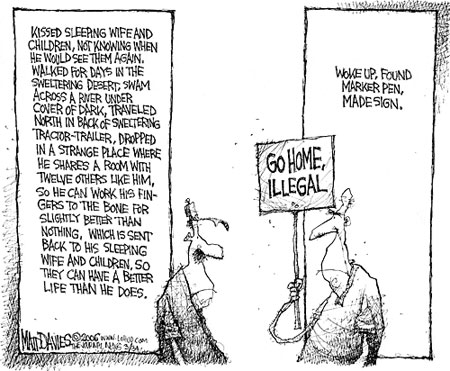
The Washington Post today carries an article describing the refusal by the National Association of Evangelicals to sign on to a declaration on immigration policy issued by other evangelical organizations as "underscoring divisions among conservative Christians over immigration."
Not wanting evangelicals to be divided on anything of significance, we therefore weigh in at last with the SWNID position on the immigration debate, urging and expecting our brothers and sisters who are uncertain on this issue, and especially those who differ, to adopt a position that is Seldom Wrong.
Here it is:
We need a guest worker program, enforcement at points of employment, and a path to citizenship for undocumented immigrants that involves reasonable fines but also grants a recognition of the contribution that workers make to the American economy.
We are always delighted when positions that are in the economic interests of many people, including ourselves, also seem to offer benefits and compassion to people in need. So it is here.
There are people who want to work in the United States because they lack opportunity at home. Their work is needed in the United States, where many menial jobs go unfilled because our high rates of employment and education leave us with few willing to work for what such jobs are worth. Letting willing workers come here to work is of benefit to the worker, whose standard of living is raised, his family, who benefit from his income and potentially from present or future residence in a country with better services, and everyone who is served by the worker's labor.
The situation is a delightful coincidence of self-interest and compassion. So the right response seems straightforward enough.
This response is, of course, not without flaws. Some American workers may potentially be displaced by immigrants. However, the evidence is that such displacement will be rare. The fact seems to be that difficult, unskilled jobs are not taken by Americans because they have either (a) skills that qualify them for better jobs, or (b) social and behavioral problems that make employment impossible.
Anti-immigrationists argue that granting a path to citizenship for those who are here without documents shows disrespect for the rule of law. We would agree, were the laws broken of a serious nature that brought direct harm to victims. However, such is not the case with this country's immigration laws. We should no more permanently bar an illegal immigrant from citizenship than we should permanently bar a speeder from holding a driver's license. All current proposals for a path to citizenship involve fines for illegals, hardly the "amnesty" that opponents decry.
Some say that a guest worker program exercises racism in confining immigrants of color to menial jobs. We say that this is not racism but economic reality: people who lack skills must do unskilled labor if they are to do anything that contributes to the general welfare. But our national experience has been that immigrants of color have in large measure demonstrated admirable effort and reliability in such jobs, and have sought education and greater opportunity for their offspring. The result has been a rising tide of productivity from which all benefit.
Guest worker programs in other countries, notably Germany, have been seen by critics as failures. There is much not to imitate in what has happened in the German Gastarbeiter program, but the problems come not in the program itself but in the difficulty of immigrants integrating into the social fabric of any European country. The United States, a nation of immigrants founded on an ideal, is much different from European countries founded largely on culture, language and ethnic identity. We have our race problems, to be sure, but they aren't Europe's.
The economic reality is that people all over the world are on the move to find opportunity. The social and political reality is that nothing can stop them. And the reality of self-interest is that no thoughtful and adaptable person has anything to fear from immigration.
So ...
Give me your tired, your poor,
Your huddled masses yearning to breathe free,
The wretched refuse of your teeming shore.
Send these, the homeless, tempest-tossed to me.
I lift my lamp beside the golden door.
Rationalist Explanations of Miracles Harder to Believe than Divine Intervention
Colleague Rick C gets the coveted SWNID hat-tip for pointing us to the alarming news that an oceanographer at Florida State University has scientifically demonstrated to his own satisfaction that Jesus didn't walk on the water but floated on a rare piece of ice in the sea of Galilee.
Our response cannot surpass that of the inimitable Scott Ott of scrappleface.com, whom we quote in full:
It has been observed at least since the time of Strauss (the biblical scholar, not the composer) that rationalist explanations for miracles are harder to believe than the miracles themselves. That's no less true today than it was in the middle of the 19th century.
Our response cannot surpass that of the inimitable Scott Ott of scrappleface.com, whom we quote in full:
And finally, a new scientific study out of Florida State University suggests that Jesus of Nazareth might have walked, not on water, but on a rare patch of floating ice in the sea of Galilee. The alleged miracle, which the Bible says happened in the middle of the night more than three miles from shore during a violent wind storm, was likely an April foolÂ’s prank that the clever Messiah pulled on his gullible followers. Next the professor plans to test his theory that the parting of the Red Sea during time of Moses was actually the work of an army of industrious beavers.
It has been observed at least since the time of Strauss (the biblical scholar, not the composer) that rationalist explanations for miracles are harder to believe than the miracles themselves. That's no less true today than it was in the middle of the 19th century.
New Fossil a Problem for Young Earthers
The NY Times offers a helpful, if not altogether informative, report on the discovery of several skeletons that appear to be those of transitional life forms between fish and amphibians. There's enough here to make the claim credible: a swiveling head, limbs in the making, and the like.
So what does this all mean?
Well, it means that a lot of young-earth creationists need to stop saying that there are no transitional forms in the fossil record. There have been before, and this one is a doozy. Even the Times's article cites a creationist web site that makes the now-even-more unsupportable claim that there are no transitional species.
Second, this discovery adds to the reasons that young-earth creationists need to think about becoming old-earth creationists. There's nothing lost theologically, lots gained empirically, and perhaps most importantly, we can get over the idea that to believe Christianity one has to stop believing what one can see for oneself.
Third, anti-theistic evolutionists need to realize the limitations of their discovery. Granted the likelihood that these skeletons are those of life forms that could be termed transitional, we still have no notion of the mechanism that brings about such changes in the patterns of reproduction from one generation to the next. We do not resort to the "God of the gaps" when we posit that something like the present complexity could not arise by chance. Rather, we observe that with every discovery, the gaps become bigger, less likely to be closed without something as big as God in them, and so rationally asking for such a solution.
But this last point won't get discussed. Old-earth creationists and ID proponents (basically the same folk) will get lumped together with the young-earth creationists in the rhetorical blizzard that will follow this discovery. We urge readers to wear warm clothing and carry a compass until the blizzard passes.
So what does this all mean?
Well, it means that a lot of young-earth creationists need to stop saying that there are no transitional forms in the fossil record. There have been before, and this one is a doozy. Even the Times's article cites a creationist web site that makes the now-even-more unsupportable claim that there are no transitional species.
Second, this discovery adds to the reasons that young-earth creationists need to think about becoming old-earth creationists. There's nothing lost theologically, lots gained empirically, and perhaps most importantly, we can get over the idea that to believe Christianity one has to stop believing what one can see for oneself.
Third, anti-theistic evolutionists need to realize the limitations of their discovery. Granted the likelihood that these skeletons are those of life forms that could be termed transitional, we still have no notion of the mechanism that brings about such changes in the patterns of reproduction from one generation to the next. We do not resort to the "God of the gaps" when we posit that something like the present complexity could not arise by chance. Rather, we observe that with every discovery, the gaps become bigger, less likely to be closed without something as big as God in them, and so rationally asking for such a solution.
But this last point won't get discussed. Old-earth creationists and ID proponents (basically the same folk) will get lumped together with the young-earth creationists in the rhetorical blizzard that will follow this discovery. We urge readers to wear warm clothing and carry a compass until the blizzard passes.
Tuesday, April 04, 2006
SWNID Urban Hotel Recommendations
Having just returned from a delightful trip to Chicago for the Higher Learning Commission's Annual Meeting, we feel inspired to share our wisdom as a seasoned, happy and thrifty traveler by offering the first edition of SWNID Travel Tips. Today we detail some of our favorite urban hotels.
Traveling to any great city can be a delightful experience if the traveler takes the time to get away from the most touristy locales and rub elbows with the natives. Nothing makes that easier than staying in obscure, inexpensive hotels. That also makes it possible for those who have taken a vow of poverty, like SWNID, to actually travel.
Of course, some hotels are inexpensive because they're miserable. But some are loads of fun, and comfy for sleeping, too. We detail a few in our experience.
Moving east to west, we begin with our very, very favorite, London's Foreign Mission Club. Founded over a century ago as a hostel for missionaries transitioning through London, the club offers bed and breakfast accommodations to anyone, with discounts for ministers and deeper discounts for missionaries. The accommodations are utterly clean and totally comfortable, the breakfast is tasty, the company at breakfast is a global gathering reminiscent of Isaiah 25, and the neighborhood--one stop beyond King's Cross--is verdant and quiet while still on the threshold of central London. Note that most rooms offer utterly hygienic "shared facilities" (common bath down the hall, a feature common to all but one of these listings), only the slightest of inconveniences.
New York hotels are famous for charging high rates for tiny, shabby rooms. But what would you say to a single room for $75, tastefully decorated, comfortably equipped, and impeccably clean, about a block from Union Square? That's Hotel 17, our favorite Gotham abode. No breakfast here, and the bath is down the hall again, but when you step in from the hallway to bathe or otherwise, you'll wonder if the fixtures weren't just installed and cleaned and have never been used. We haven't stayed there, but just a few blocks uptown is Hotel 31, which we understand is a similarly comfy property for similarly little dough.
Chicago, our favorite American big city, boasts more hotel bargains than many cities its size, at least to those willing to search. Our new fave is the Days Inn Lincoln Park. The hotel is immaculate, tasteful, and remarkably roomy for an urban locale, and the staff is efficient and pleasant. The neighborhood is delightfully funky, with lots of pedestrian traffic going in and out of inexpensive restaurants, coffee houses, convenience stores, and neighborhood bars. Those who think that they must stay in the Loop or Magnificent Mile will relish the chance to be among real Chicagoans, and access to the city center is easy by CTA busses or trains (order a transit pass online before your trip or pick one up at one of several shops in the neighborhood). We do, however, recommend requesting a room away from the bus stop on Clark street; otherwise, ear plugs will be in order. But all in all, this is my kind of hotel in my kind of town.
San Francisco looks set to overtake NY for expensive hotel rooms, but Mr. and Mrs. SWNID this summer enjoyed a delightful and relatively inexpensive stay at the quaint and homey Golden Gate Hotel. Offering rooms at about two-thirds the price of others in the Union Square area, the hotel is the epitome of shabby chic, with Victorian wallpaper and antique photographs in hallways and rooms. Guests eat the best croissants outside of France each morning, sharing tables with strangers for stimulating conversation, and occasionally being visited by the hotel dog or cat. En suite facilities are available, but why not save the money you'd spend on bathrooms and enjoy even more of SF's outstanding cuisine? And don't forget to pre-order your passes for the San Francisco Muni system, the only way to get around and see the sites.
Traveling to any great city can be a delightful experience if the traveler takes the time to get away from the most touristy locales and rub elbows with the natives. Nothing makes that easier than staying in obscure, inexpensive hotels. That also makes it possible for those who have taken a vow of poverty, like SWNID, to actually travel.
Of course, some hotels are inexpensive because they're miserable. But some are loads of fun, and comfy for sleeping, too. We detail a few in our experience.
Moving east to west, we begin with our very, very favorite, London's Foreign Mission Club. Founded over a century ago as a hostel for missionaries transitioning through London, the club offers bed and breakfast accommodations to anyone, with discounts for ministers and deeper discounts for missionaries. The accommodations are utterly clean and totally comfortable, the breakfast is tasty, the company at breakfast is a global gathering reminiscent of Isaiah 25, and the neighborhood--one stop beyond King's Cross--is verdant and quiet while still on the threshold of central London. Note that most rooms offer utterly hygienic "shared facilities" (common bath down the hall, a feature common to all but one of these listings), only the slightest of inconveniences.
New York hotels are famous for charging high rates for tiny, shabby rooms. But what would you say to a single room for $75, tastefully decorated, comfortably equipped, and impeccably clean, about a block from Union Square? That's Hotel 17, our favorite Gotham abode. No breakfast here, and the bath is down the hall again, but when you step in from the hallway to bathe or otherwise, you'll wonder if the fixtures weren't just installed and cleaned and have never been used. We haven't stayed there, but just a few blocks uptown is Hotel 31, which we understand is a similarly comfy property for similarly little dough.
Chicago, our favorite American big city, boasts more hotel bargains than many cities its size, at least to those willing to search. Our new fave is the Days Inn Lincoln Park. The hotel is immaculate, tasteful, and remarkably roomy for an urban locale, and the staff is efficient and pleasant. The neighborhood is delightfully funky, with lots of pedestrian traffic going in and out of inexpensive restaurants, coffee houses, convenience stores, and neighborhood bars. Those who think that they must stay in the Loop or Magnificent Mile will relish the chance to be among real Chicagoans, and access to the city center is easy by CTA busses or trains (order a transit pass online before your trip or pick one up at one of several shops in the neighborhood). We do, however, recommend requesting a room away from the bus stop on Clark street; otherwise, ear plugs will be in order. But all in all, this is my kind of hotel in my kind of town.
San Francisco looks set to overtake NY for expensive hotel rooms, but Mr. and Mrs. SWNID this summer enjoyed a delightful and relatively inexpensive stay at the quaint and homey Golden Gate Hotel. Offering rooms at about two-thirds the price of others in the Union Square area, the hotel is the epitome of shabby chic, with Victorian wallpaper and antique photographs in hallways and rooms. Guests eat the best croissants outside of France each morning, sharing tables with strangers for stimulating conversation, and occasionally being visited by the hotel dog or cat. En suite facilities are available, but why not save the money you'd spend on bathrooms and enjoy even more of SF's outstanding cuisine? And don't forget to pre-order your passes for the San Francisco Muni system, the only way to get around and see the sites.
The Hammer Is Down and Out
Big political news today as SWNID returns to near-constant blogging after a brief respite. Specifically, Tom "The Hammer" Delay (R-Corruption) has withdrawn from his reelection bid.
And not a moment too soon, in the SW opinion of this blogger. Delay may have been a skilled political operative. But the party of Lincoln is nothing without its integrity. Founded on a moral crusade (the limitation and ultimate abolition of slavery), the GOP has only wielded power effectively when it did so from a moral base. It has been best served when it cleansed itself quickly, as it did with the quick resignations House Speakers Gingrich and Livingston (who didn't quite make it to Speaker) in 1998.
Delay has always postured as a religious conservative. That includes today, as he has appeared on ... you guessed it ... Pat Robertson's 700 Club to announce his plans to end his political career. But we use the derogatory and judgmental "postured" deliberately, as we point out yet again that Delay got in trouble because of his connection to Jack Abramoff's corrupt efforts at manipulating Indian gaming licenses. So much for principles.
It will take moves like this for the Rs not just to hold power in November, but to wield it effectively thereafter. We urge other Rs with the hearts of Ds to get out while the gettin' is good, so that real Rs can run and real Ds can stay comfortably in the minority.
And not a moment too soon, in the SW opinion of this blogger. Delay may have been a skilled political operative. But the party of Lincoln is nothing without its integrity. Founded on a moral crusade (the limitation and ultimate abolition of slavery), the GOP has only wielded power effectively when it did so from a moral base. It has been best served when it cleansed itself quickly, as it did with the quick resignations House Speakers Gingrich and Livingston (who didn't quite make it to Speaker) in 1998.
Delay has always postured as a religious conservative. That includes today, as he has appeared on ... you guessed it ... Pat Robertson's 700 Club to announce his plans to end his political career. But we use the derogatory and judgmental "postured" deliberately, as we point out yet again that Delay got in trouble because of his connection to Jack Abramoff's corrupt efforts at manipulating Indian gaming licenses. So much for principles.
It will take moves like this for the Rs not just to hold power in November, but to wield it effectively thereafter. We urge other Rs with the hearts of Ds to get out while the gettin' is good, so that real Rs can run and real Ds can stay comfortably in the minority.
Thursday, March 30, 2006
Kasich Nails Ohio's Political Situation
John Kasich--former Republican congressman, Fox News talking head, adjunct faculty member at Ohio State University's distinguished Fisher College of Business, and throwback to the days that Ohio Republicans had intellectual heft and ethical standards--provides as accurate an assessment of the present state of Ohio's politics as one could imagine.
Ohio's Rs, notes Kasich, are divided and corrupt. But before the Ds make plans to move to Columbus, they must note Kasich's conclusion, which sings loudly a SWNID refrain:
To Kasich's flawless analysis we will add a conjecture--or a call to action, depending on how it is read. Ken Blackwell, as a consummate insider who is also an outside, has the opportunity, if nominated for governor, to recreate the party in a more consistently ethical, genuinely conservative mold. The entire political landscape may look different in November if Blackwell gets on his political bulldozer in September.
Principled, decisive leadership can do amazing things in a short period of time. It can make the moribund vital. Since the Ds have few prospects for reinventing themselves, it's the Rs, with skilled renegade Blackwell, with the chance to get Ohio back on track, to coin a phrase.
Ohio's Rs, notes Kasich, are divided and corrupt. But before the Ds make plans to move to Columbus, they must note Kasich's conclusion, which sings loudly a SWNID refrain:
The biggest advantage going for Republicans, in purely electoral terms, is the ineptness of the Democrats. They have a long tradition of turning sure things into might-have-beens. This, however, is simply not enough. Democratic incompetence has led to Republican domination, which, with no effective opposition, has untethered the GOP from its first principles. In the absence of these, corruption has reigned. The political lens might be clouded and growing darker; but Ohio Republicans need to decide whether or not they want to stand for something.
To Kasich's flawless analysis we will add a conjecture--or a call to action, depending on how it is read. Ken Blackwell, as a consummate insider who is also an outside, has the opportunity, if nominated for governor, to recreate the party in a more consistently ethical, genuinely conservative mold. The entire political landscape may look different in November if Blackwell gets on his political bulldozer in September.
Principled, decisive leadership can do amazing things in a short period of time. It can make the moribund vital. Since the Ds have few prospects for reinventing themselves, it's the Rs, with skilled renegade Blackwell, with the chance to get Ohio back on track, to coin a phrase.
Wednesday, March 29, 2006
Gurwitz on the Deadliness of Pacifism
Columnist Jonathan Gurwitz writes eloquently today on a favored SWNID theme: that pacifism is dangerous to innocent people. As usual, we urge gentle readers to follow the link but offer a quotation, this one from the column's ending:
To turn the other cheek — one's own cheek — is a principled demonstration of Christian pacificism [sic]. To avert one's gaze from evil, to divert the gaze of others and distort their perception of it, is neither principled nor does it advance the cause of real peace.
Taylor Recaptured Before Robertson Opens Mouth
Good news today from Nigeria, where deposed Liberian despot, warlord and arch-criminal Charles Taylor, who disappeared from his home in Nigeria over the weekend, has been recaptured. Taylor had been granted asylum by Nigeria as part of a deal to end the 14-year civil war in Liberia, but the Nigerian government had recently bowed to international pressure to surrender Taylor to an international tribunal to face charges of crimes against humanity.
This good news is augmented by the fact that Taylor was captured before Pat Robertson, his partner in corrupt gold mining operations in Liberia, had the chance to issue yet another embarrassing-to-Christians-everywhere statement of support for the murderous, grafting weasel of an ex-dictator.
And in that light, we thank gentle reader Dave R for directing our attention to the timely and significant "Christians Against Pat Speaking" (CAPS) online petition. We urge gentle readers to follow the link and lend their support to a brotherly exhortation to Mr. Robertson to retire from all public statements and live the rest of his life in benign obscurity. This outcome would deprive SWNID of a favorite blog topic, but we are willing to make the sacrifice for the good of humanity and especially the good of the gospel.
This good news is augmented by the fact that Taylor was captured before Pat Robertson, his partner in corrupt gold mining operations in Liberia, had the chance to issue yet another embarrassing-to-Christians-everywhere statement of support for the murderous, grafting weasel of an ex-dictator.
And in that light, we thank gentle reader Dave R for directing our attention to the timely and significant "Christians Against Pat Speaking" (CAPS) online petition. We urge gentle readers to follow the link and lend their support to a brotherly exhortation to Mr. Robertson to retire from all public statements and live the rest of his life in benign obscurity. This outcome would deprive SWNID of a favorite blog topic, but we are willing to make the sacrifice for the good of humanity and especially the good of the gospel.
Tuesday, March 28, 2006
Abdul Rahman Free, Rest of World Isn't
The good news out of Afghanistan is that Abdul Rahman, the Afghan citizen facing execution for his conversion from Islam to Christianity, has been released. So now Rahman is free, sort of. But the rest of the world is not.
First, Rahman's situation. Court and government officials did not offer reasons for his release. There still exists no clear notion in Afghanistan as to whether the constitutional provision of freedom of religion allows Muslims to convert to Christianity. The Afghan constitution endorses Islamic law, and by some interpretations of the Quran converting from Islam is punishable by death. What might happen if another Afghan makes a complaint against a Christian convert is yet to be seen.
But what could happen to Rahman is easy to see. He went into hiding immediately, avoiding as much as he can the danger of an Islamic assassin killing him to enforce a radical interpretation of Islamic law. We may never know where he seeks asylum, and for him, that's a good thing.
But that leads us to consider the world's situation. The Rahman case makes perfectly obvious that Islamic radicalism now has all the world in the same awful predicament as children facing a gang of bullies at elementary school. Any move that is well within the children's natural rights--eating lunch, playing a game on the playground, sitting on the bus, going to the restroom--may make them the target for intimidation and violence from the bullies. And they can never know what might set the bullies off. So they live in fear, act with timidity, and limit their speech and movements only to what is absolutely necessary, all in the hope that they will not provoke the bullies.
But none of it works. Bullies need victims. They must be feared at all times. So even when not provoked, they will manufacture an offense as a basis for action. "Quit lookin' at me!" [sharp punch to the gut] "What was that for?" "I didn't like the way you were looking at me."
So now the world lives in fear of provoking another Islamic bully session. Don't publish harmless cartoons depicting the Prophet Mohammed, or you might be targeted by the bullies. Don't support the rights of women, or the bullies will come after you. Don't insist on freedom of religion, or the bullies will get you. Don't support the right of Israel to exist as a Jewish state, or the bullies will start a fight with you.
We commend American and European diplomats for securing Rahman's freedom, and we pray for his safety. But let's not lose sight of the issue: in the name of Islam, millions of people are being repressed as brutally as in any twentieth-century totalitarian regime. And altogether, about six billion people live in fear that the Islamic bully will target them.
There are three ways to deal with bullies.
One is to accept their presence and the restraints on freedom that they enforce. This was SWNID's approach in the 1970s, when high school toughs smoking in the boys' room prompted us to limit our intake of fluids so that we could spend an entire school day without using the facilities.
Another is to blame the victim. "Don't do things that provoke him," was the vapid advice given to many a bully's target in our school experience. But what would provoke the bully was entirely unpredictable.
The third is to stand up to the bully. This can mean fighting violence with violence. But it means first the quiet determination to go freely about one's business and when confronted not to back down. Sometimes, though not every time, that can be enough.
Free countries better decide to do the third with utter consistency, or we will see many more Abdul Rahmans.
First, Rahman's situation. Court and government officials did not offer reasons for his release. There still exists no clear notion in Afghanistan as to whether the constitutional provision of freedom of religion allows Muslims to convert to Christianity. The Afghan constitution endorses Islamic law, and by some interpretations of the Quran converting from Islam is punishable by death. What might happen if another Afghan makes a complaint against a Christian convert is yet to be seen.
But what could happen to Rahman is easy to see. He went into hiding immediately, avoiding as much as he can the danger of an Islamic assassin killing him to enforce a radical interpretation of Islamic law. We may never know where he seeks asylum, and for him, that's a good thing.
But that leads us to consider the world's situation. The Rahman case makes perfectly obvious that Islamic radicalism now has all the world in the same awful predicament as children facing a gang of bullies at elementary school. Any move that is well within the children's natural rights--eating lunch, playing a game on the playground, sitting on the bus, going to the restroom--may make them the target for intimidation and violence from the bullies. And they can never know what might set the bullies off. So they live in fear, act with timidity, and limit their speech and movements only to what is absolutely necessary, all in the hope that they will not provoke the bullies.
But none of it works. Bullies need victims. They must be feared at all times. So even when not provoked, they will manufacture an offense as a basis for action. "Quit lookin' at me!" [sharp punch to the gut] "What was that for?" "I didn't like the way you were looking at me."
So now the world lives in fear of provoking another Islamic bully session. Don't publish harmless cartoons depicting the Prophet Mohammed, or you might be targeted by the bullies. Don't support the rights of women, or the bullies will come after you. Don't insist on freedom of religion, or the bullies will get you. Don't support the right of Israel to exist as a Jewish state, or the bullies will start a fight with you.
We commend American and European diplomats for securing Rahman's freedom, and we pray for his safety. But let's not lose sight of the issue: in the name of Islam, millions of people are being repressed as brutally as in any twentieth-century totalitarian regime. And altogether, about six billion people live in fear that the Islamic bully will target them.
There are three ways to deal with bullies.
One is to accept their presence and the restraints on freedom that they enforce. This was SWNID's approach in the 1970s, when high school toughs smoking in the boys' room prompted us to limit our intake of fluids so that we could spend an entire school day without using the facilities.
Another is to blame the victim. "Don't do things that provoke him," was the vapid advice given to many a bully's target in our school experience. But what would provoke the bully was entirely unpredictable.
The third is to stand up to the bully. This can mean fighting violence with violence. But it means first the quiet determination to go freely about one's business and when confronted not to back down. Sometimes, though not every time, that can be enough.
Free countries better decide to do the third with utter consistency, or we will see many more Abdul Rahmans.
Distinctively American Syncretism Still Alive and Well
When its web site disappeared several months ago, SWNID was worried that San Francisco's Church of St. John Coltrane, our nomination for the syncretistic religious institution most distinctly American, had ceased to exist.
But gentle reader Rustypants has directed our bloggish attention to the Washington Post's recent article chronicling the church's ongoing existence as a haven of American improvised music and eclectic, individualistic "spirituality."
If any jazz musician deserves to have a church named for him, it is 'Trane. Besides his utter virtuosity and scathing creativity, he also in his later music expressed a consciousness of things beyond the music and beyond the visible world, most clearly expressed in his epochal album, A Love Supreme. In the Ken Burns series on jazz on PBS, Branford Marsalis said that he wanted that recording playing as he dies. Such expresses the impact of John Coltrane.
Adding to the Coltrane case for sainthood are his overcoming of heroin addiction, his gentle and humble demeanor toward fellow musicians, his eschewing of commercial concerns, and especially his tragic death to liver cancer in middle adulthood.
But let's be honest. Coltrane is one if the half dozen or so most important jazz musicians ever. But he would not rank high on many lists for religious thought. His significance in that area should not be exaggerated.
But neither should it be dismissed.
As a Christian who listens to jazz, SWNID sees 'Trane as an exemplar of the deep need humans have to know God. His music moves me because in it I hear the desperate longing of the human soul that wants a home. When John Coltrane blew, he gave an eloquent offering to the Unknown God, a poignant question mark to which the gospel of Jesus is the exclamation point.
But gentle reader Rustypants has directed our bloggish attention to the Washington Post's recent article chronicling the church's ongoing existence as a haven of American improvised music and eclectic, individualistic "spirituality."
If any jazz musician deserves to have a church named for him, it is 'Trane. Besides his utter virtuosity and scathing creativity, he also in his later music expressed a consciousness of things beyond the music and beyond the visible world, most clearly expressed in his epochal album, A Love Supreme. In the Ken Burns series on jazz on PBS, Branford Marsalis said that he wanted that recording playing as he dies. Such expresses the impact of John Coltrane.
Adding to the Coltrane case for sainthood are his overcoming of heroin addiction, his gentle and humble demeanor toward fellow musicians, his eschewing of commercial concerns, and especially his tragic death to liver cancer in middle adulthood.
But let's be honest. Coltrane is one if the half dozen or so most important jazz musicians ever. But he would not rank high on many lists for religious thought. His significance in that area should not be exaggerated.
But neither should it be dismissed.
As a Christian who listens to jazz, SWNID sees 'Trane as an exemplar of the deep need humans have to know God. His music moves me because in it I hear the desperate longing of the human soul that wants a home. When John Coltrane blew, he gave an eloquent offering to the Unknown God, a poignant question mark to which the gospel of Jesus is the exclamation point.
Monday, March 27, 2006
SWNID Linked on Slate, So Now Can Die Happy
The indispensable Site Meter tells us that folks have found our little blogdom via a link at Slate.
Who knew that there was so much interest in banned laptops at a law school?
We do, however, take great pride, doubtlessly sinful pride, in being linked at what some would style the internet's number one site for opinion, analysis and trends. We shall doubtless add this to our CV (a largely pointless exercise as we are divinely preordained to spend our entire working lives at one job), include it in our Christmas letter, and consider using it as an occasion to retire while still "on top."
So, gentle readers, if we stop posting, blame Slate.
Who knew that there was so much interest in banned laptops at a law school?
We do, however, take great pride, doubtlessly sinful pride, in being linked at what some would style the internet's number one site for opinion, analysis and trends. We shall doubtless add this to our CV (a largely pointless exercise as we are divinely preordained to spend our entire working lives at one job), include it in our Christmas letter, and consider using it as an occasion to retire while still "on top."
So, gentle readers, if we stop posting, blame Slate.
SWNID Announces "Preferences for Travel Accommodations"
In light of the MSM's revelations that Dick Cheney wants Sprite and Fox News in his hotel room, and the extensive revelations of John and Theresa Kerry's travel preferences on the always-subversive smokinggun.com (no tomato products for the husband of the ketchup heiress!), SWNID is proud to announce his own preferences for food and lodging while on the road--or at home, for that matter.
Our requests reflect our sophisticated tastes and wide experience of the world. As we travel, we ask to be provided with:
Or we could go with this list.
Our requests reflect our sophisticated tastes and wide experience of the world. As we travel, we ask to be provided with:
- Plenty of Welch's 100% grape juice and V-8
- Bottled water chilled to 32.5 degrees Fahrenheit, both still and sparkling (French brands acceptable)
- Dry-roasted almonds, cashews, hazel nuts and peanuts (no Brazil nuts!)
- Raisins and craisins (optionally mixed with nuts above)
- Lunches and dinners consisting primarily of fresh vegetables and fruits prepared with minimal added fats, lean meats and fish, absolutely no organ meats or beets
- Breakfasts offering either oatmeal (with raisins, cocoanut and brown sugar, never instant), eggs (soft boiled or omelets), or whole wheat toast with peanut butter (Jif only)
- Late-night access to Popeye's chicken, Chinese carryout, barbecue potato chips, and high-quality local pizza
- TV tuned constantly to 24, The Simpsons, or The Godfather Parts 1-2
- Top-line audio system with a wide selection of classical music and jazz (not smooth, and especially not Kenny G)
- Rooms with outside ventilation and quiet air handlers
- High speed internet access via desktop and wireless
- Thick, solid-foam-rubber-filled pillows
- Egyptian cotton towels and sheets
- Anti-dandruff shampoo
- Magnifying shaving mirror
Or we could go with this list.
Friday, March 24, 2006
Book Announcement, Plus SWNID Shamelessly Begs and Again Explains What We Do Here
Gentle readers know that the satire of this blog is but a shadow of the masterful LarkNews.com. Since the creative demise of the Wittenburg [sic] Door, this insightful publication is the leading source of Christian parody, offering a hilarious monthly sendup of the American evangelical subculture.
And so we are pleased to announce the publication of A Field Guide to Evangelicals and Their Habitat by Joel Kilpatrick, founder of LarkNews.com. Chapters include:
And so we are pleased to announce the publication of A Field Guide to Evangelicals and Their Habitat by Joel Kilpatrick, founder of LarkNews.com. Chapters include:
- What Evangelicals Believe - Plus a Master List of Who Is Going to Hell
- How to Party Like an Evangelical - Ambrosia, Li'l Smokies, and Potluck Fever
- The Diversity of Evangelical Politics - From Right-Wing to Wacko
- How to Talk and Act Like an Evangelical Without Being One
- Evangelical Mating Habits - The Shocking Truth
- Identifying Evangelicals in the Field
- Sighting Evangelicals Overseas
- Planning Your Field Trip to an Evangelical Church
- Decorating Like an Evangelical
SWNID very much looks forward to reading this book. However, we confess to being less than fully willing to part with the $14.95 to purchase it.
So we make the following shameless appeal.
We've been blogging for free for months now. And you've been reading it, and loving it.
Unless you're one of the folks whom we've upset. We apologize to you. Whatever it was, we didn't mean it.*
But if you like what you've been reading here, and if you have a copy of A Field Guide to Evangelicals, and especially if you're going to get one because you read about it here . . .
How about loaning it to us when you're done?
Please indicate your willingness to share with your brother in need in the comments section.
_____________
*Again, to remind readers of our editorial stance: we do satire and sarcasm here, and the person we send up most consistently is the person who writes this drivel. See, we just did it. Only sinners get made fun of here, so that's everyone, including us. So if your feelings were hurt by what you read here once, we fully accept responsibility and offer our apologies. But we also invite you to see what we're trying to do and laugh at yourself as we are at ourselves.
Or as a a brother once said to us, "I've learned to take Christ very seriously and not take myself seriously at all."
Good News, And SWNID Was WRONG Too
At the beginning of the week we drew attention to the plight of Abdul Rahman, the Afghani threatened with execution for having converted to Christianity sixteen years ago. Now we update.
The good news is that CNN reports from "a source with detailed knowledge of the case" that Rahman may be released soon. If so, it will be a fine and blessed event, and we welcome it.
The bigger news is that this blogger may have been wrong. Yes, WRONG. It happens seldom, but it happens.
Specifically we wrote, "Don't expect this to get much coverage in the United States." At the end of the week, we'd say that it has received at least adequate coverage in our republic's MSM.
Of course, maybe we weren't exactly wrong. Maybe the MSM is watching this blog for story ideas.
The good news is that CNN reports from "a source with detailed knowledge of the case" that Rahman may be released soon. If so, it will be a fine and blessed event, and we welcome it.
The bigger news is that this blogger may have been wrong. Yes, WRONG. It happens seldom, but it happens.
Specifically we wrote, "Don't expect this to get much coverage in the United States." At the end of the week, we'd say that it has received at least adequate coverage in our republic's MSM.
Of course, maybe we weren't exactly wrong. Maybe the MSM is watching this blog for story ideas.
Goldberg on Why Invading Is Still Right
The indispensable Jonah Goldberg today provides a timely reminder of recent history, largely forgotten in the incessant drumbeat of "no WMD" and "no ties to al Qaida." His reflections include Bush's recent press conference dust-up with "thespian carbuncle of bile" Helen Thomas and the "revelations" (better, "reminders") contained in Iraqi documents slowly being released to the public.
Here's the guts of the column for those disinclined to follow the link:
Here's the guts of the column for those disinclined to follow the link:
But what these documents--as well as other after-action intelligence gathering--demonstrate is that given what he knew at the time, George W. Bush was right to invade Iraq. We now know that the CIA bureaucracy was simply wrong to insist that "secular" Iraq would never work with Islamist terrorist groups such as Al Qaeda and Abu Sayyaf. We know that Iraq harbored and very likely supported Abdul Rahman Yasin, one of the suspected bomb makers involved in the first World Trade Center attack in 1993.
According to the Pentagon's definitive postmortem on the invasion, some of which was leaked to the New York Times, even many Iraqi generals were stunned to discover that Hussein didn't have WMD. Hussein practiced a strategy that one Republican Guard commander called "deterrence by doubt," in which he hoped to bluff the world into believing he had WMD in order to deter Iran and keep his rep as an Arab strongman with serious mojo.
And that's the point Thomas et al don't want to understand. For reasons that still baffle me, the WMD threat--never the sole reason to invade Iraq--not only became the only argument, it became a thoroughly legalistic one, as if foreign policy has rules of evidence and procedural due process. After 9/11, that kind of foreign policy by lawyers looked ridiculous, and rightly so.
The fact that Hussein turned out to be bluffing about WMD isn't a mark against Bush's decision. If you're a cop and a man pulls out a gun and points it at you, you're within your rights to shoot him, particularly if the man in question is a known criminal who's shot people before. If it turns out afterward that the gun wasn't loaded, that's not the cop's fault.
To this we can only respond, with apologies to Tim Rice and Andrew Lloyd Weber:
Go, go, go, Jonah, you know what they say.
Hang on now, Jonah, you'll make it some day.
Don't give up, Jonah, fight till you drop.
We've read the book and you come at on top.
Thursday, March 23, 2006
Is the Note-Taking Medium the Message?
Gentle and faithful reader Tim asks SWNID to take up the educational question raised by a University of Memphis Law School professor who has banned laptops from her classroom. Per USA Today, Professor June Entman forbade laptops in her academic domain on March 6 with the following rationale:
We actually find ourselves surprised, first of all, that this was the reason for the ban. Most profs who ban the laptop do it because students "multitask" in class: playing games, answering email, instant messaging, writing papers for other classes, etc. Serving a life sentence of lecturing in higher education, we believe that professors who have students who multitask on their classroom laptops will have students doodling, writing notes, reading books, talking or staring out the window if they ban them.
But what Prof. Entman notes is about notes, and we admit to a great deal of sympathy for her point of view. Copious notes are viewed by many students as a sign of good scholarship, on the part of both the student and the professor. The student with lots of notes is to be commended for meticulous attention to detail; the professor, for delivering meticulous detail.
We, however, believe that there is something else that delivers the detail. It is called a textbook, or in law school, a case book. Classroom lectures and discussions, by contrast, are mostly about analysis, the building of generalizations, the testing of hypotheses, the formation of arguments, and the like. Such activities require more engagement than what a student can deliver who is preoccupied with transcribing as much of the lecture as possible.
We do not believe we have succeeded as a lecturer when students write down sentence after sentence of our inspired discourse. Rather, we believe we have succeeded when students stare intently at the front of the room, then turn to a student who raises a question or objection, then formulate a question or objection of their own, then sit back, stroke their chins, and write in their notes a few key words that summarize the insight they've gained through five minutes or so of classroom dialectic. It's a rare event, but most valuable events are.
So, Prof. Entman, you go, girl!
My main concern was they were focusing on trying to transcribe every word that was I saying, rather than thinking and analyzing. The computers interfere with making eye contact. You've got this picket fence between you and the students.
We actually find ourselves surprised, first of all, that this was the reason for the ban. Most profs who ban the laptop do it because students "multitask" in class: playing games, answering email, instant messaging, writing papers for other classes, etc. Serving a life sentence of lecturing in higher education, we believe that professors who have students who multitask on their classroom laptops will have students doodling, writing notes, reading books, talking or staring out the window if they ban them.
But what Prof. Entman notes is about notes, and we admit to a great deal of sympathy for her point of view. Copious notes are viewed by many students as a sign of good scholarship, on the part of both the student and the professor. The student with lots of notes is to be commended for meticulous attention to detail; the professor, for delivering meticulous detail.
We, however, believe that there is something else that delivers the detail. It is called a textbook, or in law school, a case book. Classroom lectures and discussions, by contrast, are mostly about analysis, the building of generalizations, the testing of hypotheses, the formation of arguments, and the like. Such activities require more engagement than what a student can deliver who is preoccupied with transcribing as much of the lecture as possible.
We do not believe we have succeeded as a lecturer when students write down sentence after sentence of our inspired discourse. Rather, we believe we have succeeded when students stare intently at the front of the room, then turn to a student who raises a question or objection, then formulate a question or objection of their own, then sit back, stroke their chins, and write in their notes a few key words that summarize the insight they've gained through five minutes or so of classroom dialectic. It's a rare event, but most valuable events are.
So, Prof. Entman, you go, girl!
Wednesday, March 22, 2006
Personality and Politics, Or Why Social Science Is Sometimes Neither
The Toronto Star today reports on a longitudinal study conducted among preschoolers in Berkeley, California over the last 20 years. The study asserts that preschoolers who 20 years ago were reported by teachers as whiny and insecure have grown to become politically conservative. Confident, resilient, self-reliant kids grew up to become politically liberal.
SWNID, as an amateur social scientist, will not argue that the study was conducted by liberally biased investigators. We will instead suggest the following:
First, whatever might be true of the children in this study, it is not true of other children. We were a confident, resilient, self-reliant preschooler, who became a confident, resilient, self-reliant kindergartener, who became an overconfident, aggressive, dominant elementary student and an oppressively arrogant, nearly blasphemously self-reliant high school student, and insufferably cocksure college and graduate student and now, of course, a Seldom-Wrong-Never-In-Doubt self-proclaimed expert on everything and judge of all.
I have never whined. At least not much. Certainly not as a preschooler. As a preschooler, SWNID bossed the older kids in the neighborhood. Nothing on Fenmore Road happened without our permission.
And I have been consistently politically conservative.
So I present myself as the definitive counter-example to the results of this study: unparalleled in confidence, resilience and self-reliance, and somewhere to the right of Torquemada politically.
Second, we observe that this study was conducted in Berkeley, California, without question one of the most politically atypical spots on the planet. It's hardly surprising that children raised in Berkeley would tend towards liberal political views: they were raised on granola, Woody Guthrie and Mother Jones. To the Trotskyites typical of Berkeley, voting for Al Gore in 2000 instead of Ralph Nader smacked of fascism.
So, let's imagine a child who grows up in the People's Republic of Berkeley and whose childhood is, for unknown reasons, such that he presents whiny behavior to teachers. Years later, he asks himself why his life has been filled with misery. He associates his discontent with his surroundings. He has an epiphany: My life stinks because of all these stupid liberals in Berkeley!
Immediately, he fires his psychoanalyst, registers Republican, subscribes to the National Review, and moves to Idaho, finding happiness.
Or let's imagine this. Preschool teachers in Berkeley in 1984 have just finished leading their classes in a discussion of whole foods and the nuclear freeze. They then are asked by a social scientist to rate students as "self-reliant" or "whiny." They think back to the discussion just before. Many students cooperated with the exercise and responded that they would eat an organic, vegan diet while working for unilateral disarmament.
But a few proved recalcitrant. They insisted that they'd eat processed foods and red meat all their lives, and enjoy it too. They said that they felt safer with a nuclear arsenal keeping the "evil empire" at bay.
These had already been told that they would attend the "re-education camp," formerly known as after-school detention. But they won't conform to the revolutionary agenda.
So how does a teacher at UC Berkeley's early childhood education lab school characterize such an anti-revolutionary, reactionary, petty-bourgeois crumb-cruncher?
"Whiny."
SWNID, as an amateur social scientist, will not argue that the study was conducted by liberally biased investigators. We will instead suggest the following:
First, whatever might be true of the children in this study, it is not true of other children. We were a confident, resilient, self-reliant preschooler, who became a confident, resilient, self-reliant kindergartener, who became an overconfident, aggressive, dominant elementary student and an oppressively arrogant, nearly blasphemously self-reliant high school student, and insufferably cocksure college and graduate student and now, of course, a Seldom-Wrong-Never-In-Doubt self-proclaimed expert on everything and judge of all.
I have never whined. At least not much. Certainly not as a preschooler. As a preschooler, SWNID bossed the older kids in the neighborhood. Nothing on Fenmore Road happened without our permission.
And I have been consistently politically conservative.
So I present myself as the definitive counter-example to the results of this study: unparalleled in confidence, resilience and self-reliance, and somewhere to the right of Torquemada politically.
Second, we observe that this study was conducted in Berkeley, California, without question one of the most politically atypical spots on the planet. It's hardly surprising that children raised in Berkeley would tend towards liberal political views: they were raised on granola, Woody Guthrie and Mother Jones. To the Trotskyites typical of Berkeley, voting for Al Gore in 2000 instead of Ralph Nader smacked of fascism.
So, let's imagine a child who grows up in the People's Republic of Berkeley and whose childhood is, for unknown reasons, such that he presents whiny behavior to teachers. Years later, he asks himself why his life has been filled with misery. He associates his discontent with his surroundings. He has an epiphany: My life stinks because of all these stupid liberals in Berkeley!
Immediately, he fires his psychoanalyst, registers Republican, subscribes to the National Review, and moves to Idaho, finding happiness.
Or let's imagine this. Preschool teachers in Berkeley in 1984 have just finished leading their classes in a discussion of whole foods and the nuclear freeze. They then are asked by a social scientist to rate students as "self-reliant" or "whiny." They think back to the discussion just before. Many students cooperated with the exercise and responded that they would eat an organic, vegan diet while working for unilateral disarmament.
But a few proved recalcitrant. They insisted that they'd eat processed foods and red meat all their lives, and enjoy it too. They said that they felt safer with a nuclear arsenal keeping the "evil empire" at bay.
These had already been told that they would attend the "re-education camp," formerly known as after-school detention. But they won't conform to the revolutionary agenda.
So how does a teacher at UC Berkeley's early childhood education lab school characterize such an anti-revolutionary, reactionary, petty-bourgeois crumb-cruncher?
"Whiny."
Who Wears the Pantsuit in Chappaqua
The always-cheeky NY Daily News reports the following pillow talk:
There's no report on what the former President will receive in return.
After being surprised by her husband's role in the Dubai ports deal, Sen. Hillary Clinton has insisted that Bill Clinton give her "final say" over what he says and does, well-placed sources said.
The former President agreed to give his wife a veto to avoid his habit of making controversial headlines that could hurt her chances of returning to the White House, multiple sources told the Daily News.
"He knows it's Hillary's time now," said an adviser close to both Clintons who expects to play a key role in her likely 2008 presidential campaign.
There's no report on what the former President will receive in return.
The Republic Is Safe . . . For Now
The AP reports a comforting story indicating that one threat to peace and freedom in the United States and the world seems to have been neutralized.
Monday, March 20, 2006
Faulty Reading of the Intel in War Planning
The anniversary of the beginning of the Iraq War has occasioned plenty of retrospective pieces on the Bush administration's justification for the war. Largely and predictably, these have focused on statements about WMD and Al Qaida connections that for the MSM are now patent falsehoods. NPR, for instance, led off with such a story on today's Morning Edition.
Such assertions have more to do with interpretation than with facts alone. The conclusion that Saddam didn't have WMD is based on the fact that no large supplies of WMD have been found in Iraq. Isolated chemical weapons have been located, and various government and military officials have offered accounts, none verified to the public, of weapons being sent to Syria (which, if it has Iraqi WMD, no doubt now figures the costs of their use to be far greater than any benefit). And evidence of Saddam's mothballed WMD programs, awaiting the end of UN supervision to resume production, are clear enough to all. Further, it is clear enough that Saddam consistently cultivated the impression that he was hiding WMD, in effect acting like the person in a bank who holds his hand in his coat pocket and says to the teller that he has a gun (who by law is guilty of armed robbery even if his pocket held only his hand). But "there were no WMD" is the mantra of the MSM.
Likewise we are told that Saddam's alleged connections to al Qaida were nonexistent. Here the key phrase is "operative connection." However, no one would reasonably deny clear evidence that Saddam's Iraq did not provide cooperation and safe haven to terrorists with whom his regime had common cause. Such, however, is assumed not to be a sufficient provocation for war. Hence, "Saddam had no ties to al Qaida" is another MSM mantra.
But enough of all that. Let's requote what the indispensable James Taranto quotes for some real cooking of the intelligence prior to the war:
Such assertions have more to do with interpretation than with facts alone. The conclusion that Saddam didn't have WMD is based on the fact that no large supplies of WMD have been found in Iraq. Isolated chemical weapons have been located, and various government and military officials have offered accounts, none verified to the public, of weapons being sent to Syria (which, if it has Iraqi WMD, no doubt now figures the costs of their use to be far greater than any benefit). And evidence of Saddam's mothballed WMD programs, awaiting the end of UN supervision to resume production, are clear enough to all. Further, it is clear enough that Saddam consistently cultivated the impression that he was hiding WMD, in effect acting like the person in a bank who holds his hand in his coat pocket and says to the teller that he has a gun (who by law is guilty of armed robbery even if his pocket held only his hand). But "there were no WMD" is the mantra of the MSM.
Likewise we are told that Saddam's alleged connections to al Qaida were nonexistent. Here the key phrase is "operative connection." However, no one would reasonably deny clear evidence that Saddam's Iraq did not provide cooperation and safe haven to terrorists with whom his regime had common cause. Such, however, is assumed not to be a sufficient provocation for war. Hence, "Saddam had no ties to al Qaida" is another MSM mantra.
But enough of all that. Let's requote what the indispensable James Taranto quotes for some real cooking of the intelligence prior to the war:
- "In launching a war against Iraq now, the United States may precipitate the very threat that we are intent on preventing--weapons of mass destruction in the hands of terrorists. If Saddam's regime and his very survival are threatened, then his view of his interests may be profoundly altered: He may decide he has nothing to lose by using weapons of mass destruction himself or by sharing them with terrorists. . . . Saddam may well hide his most lethal weapons in mosques, schools and hospitals. If our forces attempt to strike such targets, untold numbers of Iraqi civilians could be killed."--Ted Kennedy, Sept. 27, 2002
- "Not so long ago, prominent German politicians were outdoing each other forecasting worst-case scenarios for the Iraq conflict. The predictions ranged from 'millions of victims of U.S. rockets' to 'millions of Iraqi refugees desperately fleeing the country.' "--San Francisco Chronicle, May 1, 2003
- "It is also likely that in the early stages there will be a large segment of the population requiring treatment for traumatic injuries, either directly conflict-induced or from the resulting devastation. Given the population outlined earlier, as many as 500,000 could require treatment to a greater or lesser degree as a result of direct or indirect injuries."--U.N. report on "likely humanitarian scenarios," Dec. 10, 2002
- "Up to four million people could die in a war on Iraq involving nuclear weapons. A more contained conflict could cause half a million deaths and have a devastating impact on the lives, health and environment of the combatants, Iraqi civilians, and people in neighbouring countries and beyond. It could also damage the global economy and thus indirectly harm the health and well-being of millions more people across the world."--executive summary, "A New Gulf War: The Real Cost," Medact ("a UK-based charity taking action on key global health issues"), Nov. 13, 2002
In the political battle that preceded the military one, it seems that both sides may have used some Weapons of Mass Deception. But from the SWNID perspective, the administration's case still looks like the less hyperbolic one. Taranto cites iraqbodycount.net, a committed antiwar site that as we write puts the total number of Iraqi war dead, civilian and military, between 33,710 and 37,832. Those are big numbers, representing human beings, each of whose lives has incalculable value. War is at least heck, if certain generals are to be believed. However, 38k is closer to zero than a 500k, much closer to zero than to a million, and definitely, with apologies to the Senior Senator from the State of Inebriation, a told* number.
_____________________
*As the inspiration for this expression we offer a tip of the SWNID hat to Edwin Newman, journalist and English stylist, who objected to the common expression "unsung hero" because there is no such thing as a "sung hero." A "sung hero," he observed, sounds like an Italian sandwich in a Chinese restaurant.
Sunday, March 19, 2006
Grim News from Afghanistan
No one said that war solves everything, gentle readers.
The ultra-despotic Taliban may not be in power in Afghanistan anymore, but it's not a paradise yet. Australia's Herald-Sun reports that a man who has allegedly converted from Islam to Christianity in Afghanistan faces trial and possible execution for "abandoning Islam."
Don't expect this to get much coverage in the United States, of course. Our media don't want to cover problems in Iraq or Afghanistan unless they directly impugn the Bush administration's prosecution of the war. Christians being persecuted isn't news, after all.
The ultra-despotic Taliban may not be in power in Afghanistan anymore, but it's not a paradise yet. Australia's Herald-Sun reports that a man who has allegedly converted from Islam to Christianity in Afghanistan faces trial and possible execution for "abandoning Islam."
Don't expect this to get much coverage in the United States, of course. Our media don't want to cover problems in Iraq or Afghanistan unless they directly impugn the Bush administration's prosecution of the war. Christians being persecuted isn't news, after all.
1960s Still Can't Be Resurrected
Per news reports, "thousands" took to the streets today to protest the Iraq War on the third anniversary of its beginning (who can forget Dan Rather's gravid updates on the war, ending with "and now back to basketball," so somberly intoned?). The problem is that the thousands seem to have been but a few hundred or less at each of the many dozens of sites, far fewer than the number who protested the war at the beginning, and far fewer than organizers had told the press to expect.
All this just goes to show that it hasn't been 1968 for, well, about 37 years and three months.
The yearning of the left for a revival of 60s-style protest culture will go unfulfilled for a number of reasons. One is that we will never again see a demographic in this country so skewed to middle-class white teenagers, the products of the baby boom who fueled the antiwar protests. Another is the absence of the draft, which, more than the war itself, was the real source of angst. As long as college students don't need to worry about their own lives being interrupted, they're unlikely to take a day out of spring break revelry to march around the block yelling antiwar slogans.
Of course, the real truth is that the antiwar protests probably had little positive effect anyway. In 1968 both parties nominated candidates with virtually identical positions on the war. By 1972 a true antiwar candidate got a nomination, but he managed to lose the election by a gargantuan margin. The one "victory" of the movement was to persuade Congress in the post-Watergate era to cut off any funding for the South Vietnamese government, consigning it to doom when the North launched its final offensive.
So the effect was there: thousands of South Vietnamese seeking refuge as "boat people" while millions experienced the enslavement of Communist totalitarianism. But who would call it positive?
Unfortunately for the Democrats, this romantic yearning for the idealized 60s continues today to hobble their party's foreign policy, if one can call it that. Aside from Joe Lieberman, no one dare offend the antiwar left. It controls much of the party's money machine, and its voters will stay home or vote for third-party candidates at the least provocation.
Unfortunately for all of us, the 60s antiwar movement continues to influence broader political discussion. By the Ford Administration, Senator Frank Church became the functioning spokesman for the movement. He led in the move to eliminate funding for South Vietnam. But more important for the present, under his leadership the Senate Intelligence Committee initiated the "reforms" that produced the limitations on American intelligence gathering and covert operations that have largely set the stage for today's dysfunctional debate on intelligence gathering versus civil liberties.
We, of course, grant that the protection of civil liberties matters much, even in wartime. However, as long as one side of the issue's debate refuses to believe that there are bad people in the world who can only be restrained by force, and as long as they are more concerned for the theoretical purity of their own government's operations than for its effectiveness in protecting its citizens, we will continue to discuss whether civil liberties are imperiled when the NSA listens to cell phone calls between Khalil in Brooklyn and his Al Qaida contact in Pakistan.
So, leftists, you can keep listening to the classic music of the 60s. But get over your preoccupation with protest movements. It's time to get a haircut and a job.
All this just goes to show that it hasn't been 1968 for, well, about 37 years and three months.
The yearning of the left for a revival of 60s-style protest culture will go unfulfilled for a number of reasons. One is that we will never again see a demographic in this country so skewed to middle-class white teenagers, the products of the baby boom who fueled the antiwar protests. Another is the absence of the draft, which, more than the war itself, was the real source of angst. As long as college students don't need to worry about their own lives being interrupted, they're unlikely to take a day out of spring break revelry to march around the block yelling antiwar slogans.
Of course, the real truth is that the antiwar protests probably had little positive effect anyway. In 1968 both parties nominated candidates with virtually identical positions on the war. By 1972 a true antiwar candidate got a nomination, but he managed to lose the election by a gargantuan margin. The one "victory" of the movement was to persuade Congress in the post-Watergate era to cut off any funding for the South Vietnamese government, consigning it to doom when the North launched its final offensive.
So the effect was there: thousands of South Vietnamese seeking refuge as "boat people" while millions experienced the enslavement of Communist totalitarianism. But who would call it positive?
Unfortunately for the Democrats, this romantic yearning for the idealized 60s continues today to hobble their party's foreign policy, if one can call it that. Aside from Joe Lieberman, no one dare offend the antiwar left. It controls much of the party's money machine, and its voters will stay home or vote for third-party candidates at the least provocation.
Unfortunately for all of us, the 60s antiwar movement continues to influence broader political discussion. By the Ford Administration, Senator Frank Church became the functioning spokesman for the movement. He led in the move to eliminate funding for South Vietnam. But more important for the present, under his leadership the Senate Intelligence Committee initiated the "reforms" that produced the limitations on American intelligence gathering and covert operations that have largely set the stage for today's dysfunctional debate on intelligence gathering versus civil liberties.
We, of course, grant that the protection of civil liberties matters much, even in wartime. However, as long as one side of the issue's debate refuses to believe that there are bad people in the world who can only be restrained by force, and as long as they are more concerned for the theoretical purity of their own government's operations than for its effectiveness in protecting its citizens, we will continue to discuss whether civil liberties are imperiled when the NSA listens to cell phone calls between Khalil in Brooklyn and his Al Qaida contact in Pakistan.
So, leftists, you can keep listening to the classic music of the 60s. But get over your preoccupation with protest movements. It's time to get a haircut and a job.
Friday, March 17, 2006
Gang War, Not Civil War
Ralph Peters at the NY Post continues to be a realistic and sober voice on the situation in Iraq. Today he offers the following analogy:
Peters notes that different steps at the beginning of the war--sending in more troops, being prepared to impose the rule of law immediately--might have squelched the present mess. We're actually skeptical about that, unless those steps included extensive Arabic language and culture lessons for 350,000 American troops prior to the invasion.
There's a SWNID aphorism involved here: Those who make no mistakes aren't spreading themselves thin enough. Waiting to do things absolutely right generally means waiting forever. Utopian plans never yield utopia.
But what's important now is not what should have been done in light of what's happening now. A wise, animated, Buddhist baboon once said, "It doesn't matter; it's in the past." What matters is what should be done now in light of what's happening now. What's happening is gang warfare. What should be done is to continue to build the Iraqi military and police so that they can, over time, make it so dangerous to be a bad guy in Iraq that few will try.
He who bears the sword bears it not in vain.
As Operation Swarmer corners terrorists and insurgents north of Baghdad, the bloodshed elsewhere remains far below the civil-war level. Rogue Iraqis are turning on each other. You're seeing gangland violence on amphetamines.
Think of it as the Mafia shooting it out with the Ku Klux Klan and the IRA. With automatic weapons and car bombs. . . .
The gangs are now at each other's throats. A lot of those bodies turning up aren't innocent democrats. Many are thugs who enraged other thugs. . . .
Iraq doesn't need a Grant or Sherman. It needs an Elliot Ness. On steroids.
Peters notes that different steps at the beginning of the war--sending in more troops, being prepared to impose the rule of law immediately--might have squelched the present mess. We're actually skeptical about that, unless those steps included extensive Arabic language and culture lessons for 350,000 American troops prior to the invasion.
There's a SWNID aphorism involved here: Those who make no mistakes aren't spreading themselves thin enough. Waiting to do things absolutely right generally means waiting forever. Utopian plans never yield utopia.
But what's important now is not what should have been done in light of what's happening now. A wise, animated, Buddhist baboon once said, "It doesn't matter; it's in the past." What matters is what should be done now in light of what's happening now. What's happening is gang warfare. What should be done is to continue to build the Iraqi military and police so that they can, over time, make it so dangerous to be a bad guy in Iraq that few will try.
He who bears the sword bears it not in vain.
Thursday, March 16, 2006
Ignatius Affirms SWNID Analysis: Iraq in Crisis Moves Forward with Leadership
David Ignatius, un-looney liberal columnist for the Washington Post, today notes that things are looking up in Iraq. Specifically, he cites the efforts to form a national unity government that have moved forward under the midwifery of American Ambassador to Iraq Zalmay Khalilzad. To quote Ignatius:
With characteristic humility we point out, to borrow a phrase, we told you so.[Khalilzad] said of this week's gatherings: "These are the best meetings of Iraqis I've seen since I've been here."
The U.S. ambassador's upbeat account is believable because it is echoed by Iraqi political leaders. Adel Abdul Mahdi, Iraq's vice president and a representative of Hakim and his powerful Shiite party known as the Supreme Council for the Islamic Revolution in Iraq, told me Wednesday: "We have a common understanding on major issues -- on the need for consensus and on a national security commission. What makes me confident is that I think we are building up a sense of understanding among different communities." He said the message of the new government must be: "No one is outside of the law, whether the Badr Organization [the Supreme Council's militia], the Mahdi Army or the insurgency."
Photoshop Is Truer Than Truth
We offer a tip of the SWNID chapeau to the unknown creator of this delightful rendition of the heart and soul of our republic's loyal opposition party.

Wednesday, March 15, 2006
Dionne, Demographics, And Why Political Stereotypes Are True
E. J. Dionne is not in step with SWNID's seldom-wrong ideology, but he does have the sense to take facts into account periodically. In today's Washington Post, he does that very thing, citing a paper by a cadre of leading political scientists on our two-party, polarized republic. Remarkably enough, it makes sense of some political stereotypes by careful analysis of demographics and voting patterns.
Here's how:
Here's how:
- The wealthy Republican stereotype is belied by the observation that blue states tend to be richer than red states. However, it is supported by the observation that in red states, gaps in income tend to be larger overall, and the wealthier in those states tend to be the most consistent Republican voters and supporters.
- The elitist Democrat stereotype is belied by the observation that higher income brackets nationally tend to vote Republican. But it is supported by the observation that many of the most visible and generous Democrat boosters are in homogeneous subcultural enclaves in blue states (NYC, Boston, SF, LA, Seattle/Redmond), in which states party preferences tend not to correlate with wealth.
The result is that both sides represent their polarization as a class war: the Ds say the Rs are rich oppressors looking to give themselves a free pass; the Rs say the Ds are wealthy coastal elitists who don't give a flying fig for the values of the heartland.
Dionne, of course, implies that the Ds are more truly populist than the Rs. We, of course, disagree, but not because we think the Rs are deliberately populist.
No, conservative political ideology is populist because in the long run it offers the best chance for the most people to live decent, orderly lives with a reasonable degree of prosperity. Conservatives are indifferent to the liberals' favorite complaint, the "widening gap between rich and poor." Conservatives care little that the few have an exponentially greater pile of stuff than the many. They care whether the many have the means and opportunity to contribute to the general well being through productive labor and entrepreneurship and so provide for their own needs reliably and with dignity.
Economic theory and history argue powerfully that free-market capitalism, not redistributive governmental programs, offers the best chance of that outcome. The only place for informed debate is the level of economic regulation necessary to maximize the outcome.
This observation takes us back to the demographics. The study Dionne cites doesn't go here, and we have nothing except our own seldom-wrong impressions to support the upcoming assertion, but that never stopped us before.
Here it is: the difference in voting patterns among the wealthier people of red states versus blue states has much to do with when and how they acquired their wealth.
- Red-state rich folk tend to be closer to the original and common experience of obtaining wealth. They are more often first-generation entrepreneurs who have built their own startup businesses into modest successes (N.B. that "wealthy" in this instance refers to incomes over $100k/year). They're new-money people. They adhere to conservative ideology not to catch a further break for further wealth but because they see conservative ideology as demonstrated and ratified by their own success in the free market.
- Blue-state rich folk, however, tend more often to be removed from the original or normal experience of obtaining wealth. Some are heirs. Some are entertainers. Some are seeking the acceptance and approval of the former categories. They're old-money people, or old-money wannabes. For them, wealth is really "fortune," winning "life's lottery" (was it Joe Biden who said that?) through exceptional talent or luck. Most others can't possibly expect to do the same. And from their lofty height, they can't imagine that a life of labor for a wage has any dignity or joy to it at all. So they are persuaded that redistribution of wealth is all that can raise the standards of the unwashed masses.
These are, of course, stereotypes as well. But as Dionne demonstrates, there's a reason for stereotypes. We're waiting for someone to correlate voting patterns not just with how much money the voter has, or even with where the voter lives, but with how and when the voter got the money.
Monday, March 13, 2006
More Contrarian Election Handicapping
Today's opinion pages contain several tasty bits of congressional and presidential election prognosticating from experts whom SWNID respects.
First, Michael Barone, always distinguished by basing his views on data rather than buzz, offers that the Ds will have an exceedingly hard time recapturing the House in '06. He notes the following on the way to that conclusion:
First, Michael Barone, always distinguished by basing his views on data rather than buzz, offers that the Ds will have an exceedingly hard time recapturing the House in '06. He notes the following on the way to that conclusion:
- There's no perceptible political realignment among the electorate (groups formerly aligned with one party shifting to the other) as there was in 1974 and 1994.
- The statistical odds are against the Ds, who lack enough targeted seats to get past the post by historical standards.
- The Ds lack a sufficient number of strong candidates to seriously challenge Republican control
We believe that the last point is most telling. As long as elections are between two candidates, the party that wants to win had better have a good candidate. When the best the Ds can do is the likes of the brittle tort lawyer from tony Indian Hill, Paul Hackett, who is seen as some kind of national Democrat hero for having lost an election against a weak Republican nonincumbent, they continue to look highly Whiggish.
Second, Jay Cost, co-blogger of the utterly indispensable RealClearPolitics enumerates the following reasons why the Ds will not fulfill predictions of triumph in November:
- Democratic Party failure cannot be ascribed to a failure to unify because of a failure of leadership, as the Ds have not been unified since assuming majority-party status in the 1932 and yet still managed to win a lot of elections. Hence, the expectation of a unifying national platform is unrealistic.
- Republican disunity offers no real opportunity for Ds, as the Rs are still more unified than the Ds have been since William Jennings Bryan was the D standardbearer.
- Negative poll numbers about the country being on the "right track" don't help the Ds, either, who showed in 2004 that capitalizing on discontent is not their strong suit right now.
- Negative poll numbers on Congress don't help the Ds, as voters generally vote on their congressman, not the whole lot of them, in congressional elections.
- Likewise, Bush's negatives don't help the Ds, as his name is not actually on the ballot in November.
- Party-preference polls don't mean much either, as Ds always lead those. In Cost's impeccable analysis, that situation goes like this:
In America, your average respondent will say, “Yeah, I want the Democrats!” in May, even in October. He will get to the ballot box in November, only recognize one name on the House ballot, recall that he likes that fellow, and vote for his Republican incumbent.
On the presidential side, Peter Brown, pollster for Quinnipac University, notes that Giuliani phenomenon and counsels a grain of salt. His reasoning for caution is the conventional and still-open question as to whether the Republican primaries, which tend to be dominated by social conservatives, will be friendly to Rudy.
What Brown doesn't consider is the dearth of socially conservative candidates who offer alternatives. Senator Bill Frist is doomed because of the title in front of his name: he will forever be seen as an ineffectual compromiser because of his role as Senate Majority Leader. Mitt Romney may not seem all that conservative to the right wing of the party, and his Mormonism makes him suspect to many as well. We believe that Romney provides a real challenge to Rudy and would be happy for either to lead Lincoln's party to victory in '08. But after Mitt, there's nothing for the right. And he doesn't have the national standing that Rudy has.
Of course, Giuliani doesn't seem to be campaigning yet. But such is the approach of the candidate who has a chance to be nominated by acclamation or demand.
Saturday, March 11, 2006
Mallory's First 100 Days: Incremental Progress
The Cincinnati Enquirer this week published an interview with Cincinnati Mayor and SWNID neighbor Mark Mallory marking his first 100 days in the mayor's office. The full transcript of the interview, notably longer than what was printed in the paper, is available here.
Some points to highlight:
Some points to highlight:
- Despite the fact that it hasn't been high on many political agendas, Mallory is working proactively on Cincinnati's public transportation needs.
- He insists that the crime problem is a police issue but also a community issue and continues to call for community support to fight crime.
- In a notably conservative vein, he calls for greater attention to fatherhood as a way to address social ills.
- And then there was this delightful remark:
Well there's a tremendous amount of pressure on me based on a lot of things - the fact that I am my father's son, the fact that my mother continues to say: "You have to make me proud." You know. It's one thing to hear that at 7 or 8 years old, but you know, I'm the mayor now.
In sum, we believe the results so far vindicate our fervent endorsement. But it's still early.
There's plenty to like in Mallory's collaborative approach where everyone has a say and everyone gets credit. It's bound to bring together the fractious fiefdoms of the metro area. Many other officials, County Commissioner Phil Heimlich not among them, have applauded Mallory's consistent outreach.
Mallory cites Columbus, Ohio Mayor Michael Coleman as a role model. If Cincinnati can begin to mirror the renewal and growth that Columbus has experienced in the last decade, few in the city would complain.
Friday, March 10, 2006
Senate Intelligence Chairman Follows SWNID's Advice
Senator Pat Roberts (R-Rationality), chairman of the Senate Intelligence Committee, explains today in USA Today (hence, he explains very briefly, using little words and short sentences) what the committee is going to do about all that "warrantless wiretapping" that the Bush administration has been doing.
In short, they're doing what SWNID has recommended: exercising reasonable oversight as the legislative branch but not bringing to a halt the President's war powers as they relate to intelligence gathering. Specifically, a subcommittee of seven senators "will provide enhanced oversight and will help ensure that any legislation related to the program is based on fact, not speculation."
Note as well that this approach was worked out quietly between Congress and the Executive, without any public hearings in which Senator Kennedy (D-Glennfiddich) hectored NSA officials.
When following the link to read Roberts's article, don't miss his artful opening remark that the whole program came to public attention because of a criminal act on the part of the person who leaked it.
In short, they're doing what SWNID has recommended: exercising reasonable oversight as the legislative branch but not bringing to a halt the President's war powers as they relate to intelligence gathering. Specifically, a subcommittee of seven senators "will provide enhanced oversight and will help ensure that any legislation related to the program is based on fact, not speculation."
Note as well that this approach was worked out quietly between Congress and the Executive, without any public hearings in which Senator Kennedy (D-Glennfiddich) hectored NSA officials.
When following the link to read Roberts's article, don't miss his artful opening remark that the whole program came to public attention because of a criminal act on the part of the person who leaked it.
Hillary Still DOA, Rudy Still Rules
The NY Daily News, the liberal NY tabloid newspaper, today reports a poll from Sienna college that reaffirms what we've been saying for months: Hillary Clinton will lose the presidential election in 2008.
The specific data: Six in ten New York voters believe she will run, but almost half said that they won't vote for her. That includes three of ten Democrats.
If Hillary can't carry her "home" state decisively, one wonders whether she might join Walter Mondale with the distinction of losing a statewide election in all 50 states.
Meanwhile, Quinnipac shows that Rudy Giuliani is still the most popular candidate, still ahead of MSM favorite Senator John McCain (R-Opportunism). Rudy gets a 63.5 nationally on a scale of 100 on how warmly people feel toward him. Hillary's at 50.7, ahead of only Senators Russ Feingold (D-Utopia) and George Allen (R-Nowhere).
So before gentle readers say, yes, but Rudy won't get through the primaries because Christian conservatives like me won't vote for a pro-choice Republican, we'll quote columnist Howard Fineman from the article linked above:
Obviously the people who were polled read this blog.
The specific data: Six in ten New York voters believe she will run, but almost half said that they won't vote for her. That includes three of ten Democrats.
If Hillary can't carry her "home" state decisively, one wonders whether she might join Walter Mondale with the distinction of losing a statewide election in all 50 states.
Meanwhile, Quinnipac shows that Rudy Giuliani is still the most popular candidate, still ahead of MSM favorite Senator John McCain (R-Opportunism). Rudy gets a 63.5 nationally on a scale of 100 on how warmly people feel toward him. Hillary's at 50.7, ahead of only Senators Russ Feingold (D-Utopia) and George Allen (R-Nowhere).
So before gentle readers say, yes, but Rudy won't get through the primaries because Christian conservatives like me won't vote for a pro-choice Republican, we'll quote columnist Howard Fineman from the article linked above:
A few weeks ago in Florida, [Giuliani] did the drop-by of all drop-bys as the "surprise guest" at the annual convention of the Global Pastors Network. He wowed them with his energy and his revival-style witness to his faith in Jesus. Ralph Reed, a godfather of religious conservatives, thinks Giuliani's charisma may help him overcome his social-issues liberalism in the Bible belt.This is probably why the Quinnipac poll finds that Rudy "gets a higher rating from self-identified white evangelical voters who either don't know or don't care that he favors abortion and gay rights."
"He can take control of a room better than any politician I've seen," said Reed. The key moment with the pastors was in the private holding room, where he spent quality time among their leaders. Giuliani told them that the key to his final decision on whether to run would be whether he thought he could raise enough cash. But he didn't sound as if he had much doubt.
Obviously the people who were polled read this blog.
Dubai Ports: Good News for Rs in 11-06
The massive Republican revolt against the Dubai ports deal is being heralded by many in the MSM as the first sign of the impending Democrat surge leading to a change in the control of Congress this November. But like most prognostications of the MSM, and all about which this blogger prognosticates the opposite, this will not come to pass in this way.
John Podhoretz, at the opinion-rich NY Post, knows why. The Rs saved W on this as they did with Harriet Miers. So the Ds can't claim partisan advantage. More than that, it's March. Barely. And the election is in ... April? No, wait ... November!
So here's how the Congressional debate will go when Americans start paying attention after having thrown out their jack o'lanterns.
D: My Republican opponent can't be trusted with national security. Just look at the deal that the President approved to allow Arabs to run US ports.
(Voters: What is he talking about?)
R: Actually, I voted against that deal in committee. So did all but two of my Republican colleagues. We don't hesitate to differ with the President, whose overall work in this area I applaud, when we think he's wrong.
(Voters: I think I can trust the incumbent Republican. He sounds sensible. The Democrat sounds like a politician.)
John Podhoretz, at the opinion-rich NY Post, knows why. The Rs saved W on this as they did with Harriet Miers. So the Ds can't claim partisan advantage. More than that, it's March. Barely. And the election is in ... April? No, wait ... November!
So here's how the Congressional debate will go when Americans start paying attention after having thrown out their jack o'lanterns.
D: My Republican opponent can't be trusted with national security. Just look at the deal that the President approved to allow Arabs to run US ports.
(Voters: What is he talking about?)
R: Actually, I voted against that deal in committee. So did all but two of my Republican colleagues. We don't hesitate to differ with the President, whose overall work in this area I applaud, when we think he's wrong.
(Voters: I think I can trust the incumbent Republican. He sounds sensible. The Democrat sounds like a politician.)
And Now for Something Completely Different: NPR Covers Positive Impact of Christian Missionaries on Social Structures
National Public Radio (motto: "Still longing for Daniel Ortega to return to power") every once in a while manages to cover something out of the ordinary. Today's Morning Edition had one of those occasions.
A regular Morning Edition feature is excerpts from "Storycorps," a Library of Congress project where ordinary people make recordings about their memories for an oral history archive. Today's excerpt featured Joyce Lee interviewing her mother, Hee-Sook Lee, about her experiences as an immigrant to Los Angeles from South Korea. Mrs. Lee recounted that she learned English in Korea in the home of American missionaries, but that she also learned a different way for husbands and wives to interact with each other than the one to which she was accustomed.
Follow the link and listen to the full story, which should be posted today after 10 a.m. EST. Don't just read the summary on the web page: they left out the parts that connect the dots.
A regular Morning Edition feature is excerpts from "Storycorps," a Library of Congress project where ordinary people make recordings about their memories for an oral history archive. Today's excerpt featured Joyce Lee interviewing her mother, Hee-Sook Lee, about her experiences as an immigrant to Los Angeles from South Korea. Mrs. Lee recounted that she learned English in Korea in the home of American missionaries, but that she also learned a different way for husbands and wives to interact with each other than the one to which she was accustomed.
Follow the link and listen to the full story, which should be posted today after 10 a.m. EST. Don't just read the summary on the web page: they left out the parts that connect the dots.
Saturday, March 04, 2006
Blackwell Broo-Ha-Ha Demonstrates Fear, Political Ineptitude of Opponents
Gentle readers in Ohio have doubtless been following this week's political tempest about the posting of Social Security numbers on the web site of Ohio Secretary of State Ken Blackwell.
You haven't? You mean that you don't pay close attention to a gubernatorial election eight months before it happens? Well, what if the primary is only two and a half months away? Really? We just assumed that everyone thinks about electoral politics all the time.
And that revelation is what exposes the ineptitude, born of fear, among Blackwell's opponents on both sides of the political aisle.
The controversy, in sum and employing our signature bullet points, is as follows:
- The Secretary of State in Ohio is responsible for the filing of various business paperwork required under law.
- These forms are matters of public record.
- Legislation therefore requires that they be posted on the internet at the Secretary of State's official web site. Alteration of forms before posting is forbidden.
- Some of these forms allow but do not require the listing of the applicant's SSN.
- Such SSNs are therefore accessible from the web.
- Jim Petro, Ohio Attorney General and Republican primary opponent of Blackwell, has accused the Secretary of State of facilitating identity theft by this legally required posting. He has been joined by various Democrats.
- Blackwell's office has countered that they have no legal means to take the forms off the web or to "redact" their contents.
After two days of hysterical reporting on the issue, the Cincinnati Enquirer today expresses what has become exceedingly rare on its opinion pages: a thoughtful opinion. Noting that Petro, the state AG, has said that Blackwell should have redacted the forms yet offered no legal authority that he possessed to do so, the Enquirer blames the legislature for failing to act.
So that's the story, but let's get to the politics. Petro is looking to tar Blackwell as insensitive and incompetent. Fear of identity theft, he hopes, will drive the Rs to him despite his association with the Taft RINO preserve. Ds, meanwhile, fear a Blackwell candidacy more than the mutation of Asian Bird Influenza, so they'll support anything to defeat him, even if it means helping Petro.
But the whole thing has been handled with such supreme political ineptitude that it will come to nothing. First, it's way too early to expect that anyone will notice or care. Voters are still doing their income taxes and speculating on NCAA tournament bids. This will be over long before anyone thinks about the fact that Ohio even has a governor.
Second, nobody looks good in this. Petro is the AG, and he has done nothing (admittedly like Blackwell) to address this problem except to draw attention to it for political purposes. Dems in the legislature haven't introduced legislation to address it either. Pants are down on all sides.
Despite its likely insignificance, this story may get some big play in the big media outlets. Pundits anxious for a national story in the off-year elections, are portraying Blackwell's candidacy as a bellwether. It is hugely significant, as we have noted before, that the Rs have several strong candidates running for statewide offices who happen to be African-American. Their success will inevitably erode the Ds stranglehold on the African-American vote, to the eternal detriment of their moribund coalition and its bankrupt political philosophy. Eleanor Clift (motto: If only Bill Clinton would return my passionate love!) would love to make Ohio the turning point for the national Ds while disparaging the "handful" of black Rs like Blackwell (memo to Ms. Clift: how many black Ds are running for or serving as governor in our republic?).
But the truth is that this campaign will turn on Blackwell's appeal as a candidate. With his impeccable and utterly consistent conservative principles and long-term cultivation of conservative organizations, he will have a solid conservative base working hard at the grassroots. With two terms as Secretary of State and lots of media coverage along the way, he's got the best name recognition of any candidate in Ohio. At six-foot-five and with a stentorian bass voice, he's an impressive stump speaker. And as a for-real product of Cincinnati's segregated West End, he will appeal to a segment of voters whom the Ds have treated like stepchildren.
India Deal Is a Big Deal
Bush's trip to India looks like it may be the single biggest thing that he will do in his second term. And that's not to denigrate his second term, which is going like most second terms do: a little ragged, a little tired, lots of missteps, but still with a commitment to acting on the core principles of the first term. It's to say that a deal with what needs to be a crucial economic and military ally for the rest of the century is a very big deal.
Note the following:
If nobody messes this deal up in the near future, India and the United States are poised to cooperate in ways that will make Asia safer militarily and richer economically. Remember when the cliche, "Finish your dinner; there are starving children in India"? Well, many in India are still hungry, but today the cliche is, "Work harder; there are outsourcing firms in India ready to take your job."
So where's the media on this. Center-right opinion writers get it. We draw attention to the following:
Indeed, nothing illustrates the MSM's inability to see beyond the bias of its templates than this event. NPR's All Things Considered actually allowed reporter Philip Reeves to say that in response to the Bush visit the "mood" among government officials, the English-language press and the intelligentsia is "euphoric." Reeves went on to say that demonstrators against Bush were largely from Muslim and Communist groups. Yet the web page that archives this report has the bleak heading, "India Deal Could Sour U.S. Relations with Pakistan."
We add the following observation, which is entirely impressionistic. Christianity in India has moved forward with the weakening of traditional cultural strictures that inevitably comes with economic development. So Bush's visit may be significant in yet one more, and in our Seldom Wrong opinion more important, way.
Note the following:
- India is the world's largest democracy and has been for some time.
- India is the second largest Muslim country in the world, a fact seldom reported on this trip.
- India is right next door to the Middle East, America's problem, and to China, America's rival.
- India has a large diaspora in this country, largely still engaged with its homeland in positive ways.
- Shaking off its tragic experiment with socialism (fly, as SWNID did two years ago, to India via Seoul/Inchon and Delhi, observe the quality of the airports and of the cities that surround them, then ask yourself which country suffered from a devastating war and which suffered from a devastating economic experiment, then ask which is worse, war or socialism), India's economy is growing at a breakneck rate of 8% per year, thanks to its people's commitment to education and its government's commitment to liberalizing business regulations.
- India has had nukes for a generation and has never used them.
If nobody messes this deal up in the near future, India and the United States are poised to cooperate in ways that will make Asia safer militarily and richer economically. Remember when the cliche, "Finish your dinner; there are starving children in India"? Well, many in India are still hungry, but today the cliche is, "Work harder; there are outsourcing firms in India ready to take your job."
So where's the media on this. Center-right opinion writers get it. We draw attention to the following:
- The Telegraph, capping a modest summary of the impact of Bush's visit, offers typically restrained but notably warm praise: "After five years in the White House, the 43rd President of the United States continues to surprise us."
- The Wall Street Journal opens with this dry observation: "Critics of the Bush Administration often lament that its policies have alienated America's traditional allies and embittered just about everyone else. Everyone except, apparently, a billion or so Indians."
- Conservative pundit and favorite of Mrs. SWNID Rich Lowry notes how remarkable the whole development is and how unreasonable media coverage has been and will be: "That the U.S. is friends with both India and Pakistan has a lot to do with circumstances (the end of the Cold War and the advent of the War on Terror), but it also speaks to a certain level of Bush-administration diplomatic finesse. The administration won't get any credit for it since it runs counter to the media's favored 'unilateralist behemoth alienates the world' storyline."
Indeed, nothing illustrates the MSM's inability to see beyond the bias of its templates than this event. NPR's All Things Considered actually allowed reporter Philip Reeves to say that in response to the Bush visit the "mood" among government officials, the English-language press and the intelligentsia is "euphoric." Reeves went on to say that demonstrators against Bush were largely from Muslim and Communist groups. Yet the web page that archives this report has the bleak heading, "India Deal Could Sour U.S. Relations with Pakistan."
We add the following observation, which is entirely impressionistic. Christianity in India has moved forward with the weakening of traditional cultural strictures that inevitably comes with economic development. So Bush's visit may be significant in yet one more, and in our Seldom Wrong opinion more important, way.
Friday, March 03, 2006
Best Oscar Predictions
Gentle reader and number one commenter jb in ca directs our attention to the Oscar predictions prognosticated by conservative sledgehammer Ann Coulter. We agree that these are priceless predictions, especially as they have not been unfairly influenced by Ms. Coulter's having seen even one of the nominated movies (gentle readers no doubt know that the Oscars are awarded for various social, economic and political reasons that have nothing to do with the artistic merits of movies). Our favorite quotation:
Ms. Coulter adds a few predictions about what Hollywood will give us next. In line with the theme of Brokeback Mountain, she suggests the following:
The best original screenplay will be "Good Night, and Good Luck" as Hollywood's final tribute to the old Stalinists (Hollywood's version of "The Greatest Generation"). George Clooney has been mau-mauing the awards committee by going around boasting that conservatives have called him a "traitor," although I believe the precise term was "airhead."
Ms. Coulter adds a few predictions about what Hollywood will give us next. In line with the theme of Brokeback Mountain, she suggests the following:
"Westward Homo!"
"The Magnificent, Fabulous Seven"
"Gunfight at the K-Y Corral"
"How West Hollywood Was Won"
Thursday, March 02, 2006
More Bad News for Bush: Patriot Act Passes
After much huffing and puffing about how terrible the Patriot Act is, the Senate has reauthorized it with minor revisions by a vote of 89-10.
Of course, as far as the NY Times is concerned, this is more bad news for Bush. As they frame the issue:
Oh no! A debate! Nine Democrats plus Jim Jeffords will continue to talk about how bad the Patriot Act is. The horror! Bush is finished!
All this consternation kept the Times from reporting in this article what changes were made to the original Patriot Act with this reauthorization. For that, one must look to other sources. The politics, even in a massively decisive vote like this, matter more than the substance to our Newspaper of Record. On the Christian Science Monitor we find that the new bill contains such massive changes as (we cut and paste from the article):
Of course, as far as the NY Times is concerned, this is more bad news for Bush. As they frame the issue:
But reaction to today's vote signaled that the Patriot Act will continue to be debated in the United States long after Congress has approved it. The senators opposing the bill, all Democrats except for the independent James Jeffords of Vermont, argued that the civil rights protections written into the measure were too modest.
Oh no! A debate! Nine Democrats plus Jim Jeffords will continue to talk about how bad the Patriot Act is. The horror! Bush is finished!
All this consternation kept the Times from reporting in this article what changes were made to the original Patriot Act with this reauthorization. For that, one must look to other sources. The politics, even in a massively decisive vote like this, matter more than the substance to our Newspaper of Record. On the Christian Science Monitor we find that the new bill contains such massive changes as (we cut and paste from the article):
- Recipients of court-approved subpoenas for information in terrorist investigations will have the right to challenge the requirement that they not tell anyone about the subpoena.
- In addition, recipients of such subpoenas will no longer be forced to provide the FBI with the name of their lawyer.
- Finally, the civil liberties package clarifies that most general-purpose libraries are not subject to demands made in so-called National Security Letters for information about suspected terrorists.
Whew! We don't know about you, but we now believe that our fragile rights are safe again. Anyone want to make a celebratory trip to the library to check out some books on high explosives?
On the Outrageousness of Hip-Hop as Significant Art
Stanley Crouch writes with about as much insight on as wide a range of topics (from Louis Armstrong to George W. Bush) as anyone alive. Today he assesses the move to exalt popular rap recordings as art that actually describes the situation of African-American people. As Crouch puts it, rap doesn't express the suffering of Black people; it causes it.
But it gets better:
This arrives through a media that has been bamboozled into thinking the expression of "black culture" can be reduced to gold teeth, pistol-waving, hedonism, whorishness, pathological narcissism, misogyny, drop-down pants and illiteracy.
And there's historical perspective:
Put Crouch's column in the SWNID Must-Read Hall of Fame.
But it gets better:
This arrives through a media that has been bamboozled into thinking the expression of "black culture" can be reduced to gold teeth, pistol-waving, hedonism, whorishness, pathological narcissism, misogyny, drop-down pants and illiteracy.
And there's historical perspective:
When Elvis Presley and the early rock 'n' roll bunch appeared, they knew what they were and so did their fans: entertainers followed by teenagers. With the '60s came all of the pretensions and college students, assuming that whatever they liked should get the same credibility as what adults appreciated. We then saw the arrival of rock magazines.
It did not take long for the hustlers in rap to get the drift.
Put Crouch's column in the SWNID Must-Read Hall of Fame.
Wednesday, March 01, 2006
Renegade Reporters Factualize SWNID Prediction
The NY Post has taken on the glorious role of reporting on the fulfillment of a SWNID prediction. Reporter Ralph Peters in Iraq files a dispatch that opens with (emphasis original):
And he continues, explaining the outcome along the lines of our Seldom-Wrong prognostication:
Meanwhile, the LA Times can only maintain a sense of uncertainty, not itsdoctrinairee defeatism, in a report from the delightfully named Max Boot:
Y'know, being this right could go to a guy's head. We might get to the point where we're Never in Doubt.
The reporting out of Baghdad continues to be hysterical and dishonest. There is no civil war in the streets. None. Period.
Terrorism, yes. Civil war, no. Clear enough?
And he continues, explaining the outcome along the lines of our Seldom-Wrong prognostication:
And the people here have been impressed that their government reacted effectively to last week's strife, that their soldiers and police brought order to the streets. The transition is working.
Most Iraqis want better government, better lives — and democracy. It is contagious, after all. Come on over. Talk to them. Watch them risk their lives every day to work with us or with their government to build their own future.
Meanwhile, the LA Times can only maintain a sense of uncertainty, not itsdoctrinairee defeatism, in a report from the delightfully named Max Boot:
As we drove through town, I saw Iraqi army and police checkpoints everywhere. Not only are more security personnel in the field, but they are also not running away from a fight, as they did in 2004. Fisher told me that when insurgents recently attacked a police checkpoint, the cops chased them down and arrested them. This combination of toughness (withstanding attack) and restraint (bringing back the attackers alive) augurs well for the future of Iraq.
Nor is this an isolated example. A few days later, while visiting the Green Zone in Baghdad, I was briefed on the progress being made in standing up Iraqi forces. A year ago, only three Iraqi battalions controlled their own "battle-space." Today, the total is up to 40 battalions and counting. Those units have achieved impressive results in some rough neighborhoods. As I discovered firsthand, it is now safe to travel down Route Irish between the Green Zone and Baghdad airport — once the most dangerous road in the world.
Y'know, being this right could go to a guy's head. We might get to the point where we're Never in Doubt.
Subscribe to:
Posts (Atom)