For those who didn't see BHO's State of the Union, we offer the following quick guide.
Who's Bad in the Union: Wall Street, banks, insurance companies, oil companies, investment managers, those who make more than $250k/year, lobbyists, the Senate, America's Most Powerful Interests, CEOs, politicians (!), TV pundits, BHO himself.
Who's Good in and out of the Union: Main Street, working families, the House of Representatives, small businesses, China, Germany, India, BHO himself.
Who's Not So Bad after All: Dubya, who got blamed for nothing except massive deficits and the awful state of the economy, less than the blame heaped on him by any Democrat since Grover Cleveland. Bush even got indirect credit for a couple of things, like starting the financial bailout that helped Obama keep the economy afloat, though Bush is still miserably to blame for the resulting deficits.
What Didn't Happen Rhetorically: Red-meat populism, the on-the-one-hand/on-the-other-hand false choice. We register huge relief not to have heard multiple references to "fighting" for this or that, and amazement that BHO can hold forth for an hour without his favorite illogical trick. That was change we can believe in.
What Did Happen Rhetorically: Declaring the intention to "clear things up" or "set the record straight" and then offering an epic whopper (saying health care wasn't to score a big legislative victory in his first year, claiming that the deficits are someone else's fault).
Reaganism Omitted to Excellent Effect: All those sappy references to Heroic Citizens seated in the balcony. Maybe that overworked device will now slip into the annals of forgotten sentimentality.
Stuff SWNID Loves: eliminating capital gains taxes on small businesses, more nuclear power, more offshore drilling, more exports.
Same Old Stuff SWNID Hates: Calling "clean energy" projects "infrastructure," slopping up commitments to free trade with calls for "enforcement" that are nothing more than protectionist pledges to organized labor, referring to "overwhelming scientific evidence" for global warming when "predominant grant-supported interpretation of conflicting evidence" is more in order, talking about financial reform (as in regulation) without talking about monetary policy (as in interest rates having been too low for too long) or housing policy (as in Fannie Mae and Freddie Mac having driven much of the housing bubble), suggesting that more tuition subsidies will create more college educated people and not simply higher tuition rates and more dropouts, privileging "public service" over private employment as if people who work for a profit don't serve the public.
Most Self-Defeating Observation Likely to Be Overlooked: Noting that health care and tuition have risen at record rates, then promising to subsidize them even more. A reminder to all, yet again: if you subsidize something, it will cost more.
Biggest Deal Likely to Be Overlooked: The favorable mention of a trade deal with Colombia. Finally, BHO may get something right in Latin America.
Biggest Distinction to Be Remembered: When a D talks about cutting taxes, it's always for behaviors that the D wants to encourage. When an R talks about cutting taxes, it's generally for everybody. If 95% of Americans got a tax cut, did you get yours? We certainly didn't get ours. Maybe he was referring to the way that our lowered incomes also lowered our taxes.
Stellar Moments of Political Hypocrisy: Talking about a freeze on discretionary spending "next year" after having raised it by more than 20% this year, insisting on bipartisanship by telling Ds to go forward with their massive majority and scolding Rs for saying no, saying "I'm not interested in relitigating the past" after having blamed the entire fiscal mess on Dubya, claiming credit for ending the Iraq War that was won with a surge that BHO opposed.
Challenge to Which SWNID Will Rise: Asking people to name a better approach to solving America's healthcare problems than what is in the works. We'll give two answers that leave a lot of ground in the middle for further discussion: Wyden-Bennett and what Dubya proposed back in 2005. Sorry, BHO, but we're wise to that trick of pretending that your solution is the only solution on offer.
Lamest Moment: Claiming that a bill on healthcare is "close." Beat that horse one more time, Mr. President: it might not be dead!
Moment of Silence: Discussion of the auto bailout and the exit strategy therefrom.
Singular Moments of Narcissism: Ending the speech with the stirring declaration "We don't quit," then ending it again with "I don't quit." Well, maybe that was a swipe at Sarah Palin.
And Some Notes on the TV Images: We didn't see much of Hillary, who normally is the focus of every third reaction shot (UPDATE: Hillary was abroad on State Dept. business). Who got the incredible idea to put Al Franken right behind the Joint Chiefs? The generalissimos must have spent the evening waiting for the supposedly hilarious Franken to given them a wedgie. But maybe he was preoccupied with the bankruptcy of Air America. NBC ran a commercial for Allstate after the speech, which just reminded us all that David Palmer was a President of whom we could all be proud.
Wednesday, January 27, 2010

Saturday, January 23, 2010
Get the Background: Documentary on the Haitian Revolution
For those who want some perspective on Haitian history, here's a handy video documentary, YouTubed in six parts, that narrates the Haitian revolution.
Wednesday, January 20, 2010
Whence and Whither Haiti?
WSJ's Mary Anastasia O'Grady is consistently insightful in her analysis of politics and economics in the Americas south of what we commonly call America. Here's her take, very much worth heeding, on why Haiti is a mess and what it now does and doesn't need.
Tuesday, January 19, 2010
The Republic Is Saved!
Say it over and over again: Scott Brown (R-Massachusetts)! Number 41 saves the Republic from ObamaCare.
And we take bad all the nasty things we've ever said about Jim Webb.
What's best is that we won't have to wait for half a dozen Supreme Court rulings to finish this abomination. An election in the Navy Blue State did it just fine.
And we take bad all the nasty things we've ever said about Jim Webb.
What's best is that we won't have to wait for half a dozen Supreme Court rulings to finish this abomination. An election in the Navy Blue State did it just fine.
Monday, January 18, 2010
T-Shirt Scholarship

St. John's College is one of our Republic's most distinctive educational institutions. With campuses in Maryland and New Mexico, St. John's provides a liberal arts education not just grounded in the classics but obsessed with them. The epicenter of the "great books" curriculum, St. John's offers no majors. Students begin in the Greek and Latin classics, work their way through the Middle Ages and Renaissance and finally into the early Modern period. Every student takes the same classes. Every instructor teaches across the curriculum, in all disciplines. Students take two years of Greek, followed by two years of French.
So an enterprising group of students recently produced t-shirts emblazoned with an Attic Greek sentence proclaiming, "If you can read this, you are over-educated."
Except, as the Santa Fe Reporter reports, they got the accent marks all wrong. This observation came from Thomas G. Palaima, a professor of classics at the University of Texas at Austin and a MacArthur Fellow.
We have so many observations we'd like to make about this, we must restrain ourself. But here are a few:
- This situation arises in part because the Greek accent system is on the one hand moderately complex and on the other hand unnecessary to master for students who are simply trying to read ancient texts with reasonable accuracy and facility.
- This situation is eerily parallel to a frequent occurrence in the SWNIDish experience. To wit: an earnest student comes to us begging that we share a Greek phrase that means something or other, hoping to print the phrase not on a t-shirt but permanently on the student's own skin, a crude practice known as "tattooing." Too often, such efforts come to a sad end, as the student or the tattoo "artist" garble the phrase into a bit of nonsense.
- Professor Palaima, per the Santa Fe Reporter, laments the erosion of respect for learning of which he sees this t-shirt as an epitome. Meant to lionize learning, in fact it bowdlerizes it, as the overconfident students failed to check their accenture with a seasoned scholar among the faculty. This, per Palaima, is the kind of anti-elitism exemplified by such cultural phenomena as Sarah Palin.
Saturday, January 16, 2010
More Theological Wisdom on Haiti
Noted theologian Danny Glover explains the cause of the Haitian earthquake. Listen patiently to the end of this clip for the surprising truth:
As those of a certain generation will recall, "It's not nice to fool Mother Nature."
Nothing seems to provoke amazingly idiotic public statements so much as humanitarian crises.
As those of a certain generation will recall, "It's not nice to fool Mother Nature."
Nothing seems to provoke amazingly idiotic public statements so much as humanitarian crises.
Friday, January 15, 2010
Another Firsthand Report from Haiti
Another of our network of correspondents provides this dispatch, relayed by an American mother concerning her son, a volunteer in Haiti providing assistance prior to the earthquake (we've omitted the name for privacy's sake):
[The young man] is in FL en route to Ryder Trauma Center. He has multiple injuries to arm, elbow, hand and ribs from digging himself out of the collapsed Montana Hotel. He is in good spirits. Thank you God for keeping this info from me until now. I would have totally freaked out. The news said that only 100 out of 300 survived the hotel collapse.
Thursday, January 14, 2010
Another Firsthand Report from Haiti
Here's a message sent late Wednesday from Salonique Adolphe. Salonique is based on Gonaives, at the edge of the earthquake's reach, but he is in touch with Port-au-Prince and connected to many there.
Greetings my dear brothers and sisters,
I want to thank all of you who were praying for us while we were undertaking the scary task of looking for people, assessing the situation and distribute, little as it was, water and crackers to the people.
First praise be to God because we found Bea, my sister in a bus headed to Gonaives while we were leaving L'Estere. What we did was we stop all buses we met who were headed to Gonaives. We were fortunate to find her in the third one we met. Thanks to all of you who prayed. She is safe. No visible hurt. No harm.
We paid her fair and she continued her way to Gonaives and we continued our way to Port-au-Prince. The addresses that were able to have access to, we found all except two. They were in class at their college when the earthquake hit, and they are among the missing.
I have seen some terrible situation and circumstances in my life: I remember how things were when Baby Doc (Jean Claude Duvalier) left the country, I remember minor earthquake that we had, especially in 94, I remember Hurricane Jeanne in 2004 and most recently Hurricanes Hanna and Ike in 2008, but one can put all those terrible events together and one would still be far from being in the situation where Port-au-Prince, thus Haiti is in today.
I mean dead bodies are all over. Port-au-Prince is an open grave yard. All the dead are laid on the ground in the streets. The most fortunate ones are covered with a white sheet, the rest who knows? It is a very concervative number to talk about 100,000 deaths. Destroyed vehicles. Destroyed houses, many, many houses are destroyed. It is heart wrenching. Those who hurt face a critical situation as there is no hospital who can receive more people to take care of them. In some instances, there are no medication. I had with me a bag full of medical supplies that my wife Gine gave me to give to whomever, we gave them to Red Cross. They were very happy to receive them and we were very happy to give it to them. Thanks to brother Dennis Smith. Now there the 2 millions people who need counselling, who need comfort, encouragement. I wish I could have here a thousand of my sister Regina Green to help them out. Getting healing for the physical pain is one thing, but get healing from the emotional pain, the trauma is not for tomorrow. Please pray for these people.
On our way to Port-au-Prince, we bought a good amound of bags of water and bottled water, crackers to distribute. We did it and everything went smoothly in spite of the fear we had when we were getting ready to distribute. Manno and Fevrier came with the bright idea of just bring them to the tents and give each pack to one person to share. It went smoothly. We praise God for that.
I was desvastated also when I saw Wall International Guest House. The first building is completely gone and they lost some dear souls. Please pray for Veniel and his wife and his co workers as they are trying to help many in this situation.
On our way back, my car broke down right before we entered Cabaret which used to be called Cabaret. Manno said there is nothing we could do for it without specific tools and time and setting; We had to leave it at the compound of the soldiers of Minustah who promise they will be watching over it. We then board a tap tap, from the tap tap to the very high top of a bus, because there was no place inside.
My friends in spite the wind we made it home safely. We praise God for that and we thank you for praying for us.
But arriving here, I met with two very bad news: Sister Robinson and her daugther, her unique child, died in Port-au-Prince as a result of the earthquake. Living Water family hits very bad. The second bad news is one of our student at the highschool was in Port-au-Prince at the moment of the earthquake and a wall fell on her. She is still alive, but they say she will not be able to survive it because it was too terrible. Pray for those two families.
More on Haiti's "Pact with the Devil"
Why do the most outrageous statements involve half truths?
Pat Robertson's latest outrage--attributing Haiti's perennial misery to a 220-year-old "pact with the devil"--dimly reflects a reality.
But first, some questions:
But enough. To the half truth.
It is entirely fair, in the SWNIDish view, to refer to Haiti's situation as Satanic darkness. We are not alone in drawing the conclusion that Haiti is a basket case socially and economically largely because of a cycle of degradation fueled by the culture of voodoo, teaching that where advantage can be taken of another, the taking of advantage is the assertion of spiritual power and so right and good. Couple this with the legacy of an especially cruel regime of slavery, and Haiti exists in a distinct, if not unique, situation of tragic, nearly intractable poverty. We again direct gentle readers to the seminal work of former State Department official Lawrence E. Henderson, whose analysis has convinced us and many of our Haitian friends.
If there is a Haitian "pact with Satan," it is not somehow magical and mystical. It is mostly the same pact that cruel, selfish humans make daily. Haiti is at the extreme end of the scale of effects of such diabolical dealing, but we make a smug mistake to think that the Haitian situation is somehow different in its essence from our own.
Just as Haiti is a product of a distinct set of historical circumstances, so is our Republic. The prosperity we enjoy is hardly a reward for exceptional righteousness. Rather, it is the consequence of generations of culture that internalized a portion of the wisdom of the Reformation and the political thought that it generated in the early Enlightenment: that human beings have natural rights and a natural proclivity toward selfishness and the aggrandizement of power, and so civic and political institutions must protect those rights and restrain that selfishness for the common good. Thus, an earthquake of similar magnitude in Northridge, California, had few of the terrible effects that the Haitian quake has wrought, as the opinionists at WSJ observed today. Our legacy of good governance has yielded prosperity that allows protective building codes that mitigate such disasters.
Nevertheless, none of us is beyond the reach of tragedy, pain and death. Their seemingly random attacks are the awful reminders that break through our delusions to tell us that because life is short, it is also urgent. When we realize that such urgency must drive us to find God, we have received the very message that we could never hear without such events. And the great irony is that the message we then find--or that finds us--tells us that tragedy and death do not have the final word.
We first visited Haiti in the early 1990s, as usual, to teach a group of people something from the New Testament. Our syllabus was 1-2 Peter; our locale, the Cite Soleil slum. About twenty residents came daily, many missing the chance to work and earn a little money for food.
Early in the week, a member of the class asked me--through my interpreter, Avenel Clersaint--"How can we say that God is taking care of us when we Haitians suffer so much?"
Flummoxed by the frank question, SWNID stumbled verbally. Mr. Clersaint responded, "Let me answer him. This is a Haitian thing." He then proceeded to give an impassioned, articulate response in Haitian Creole, of which I understood not a word. The student seemed more than satisfied and replied briefly.
"Avenel, what did you say?" was the SWNIDish response.
"I told him that God had taken care of him. Though he hasn't had work for over two years, he and his family have had food to eat. That's God's care for him."
"What did he say back to you?"
"He wants you to ask the American Christians to pray for Christians in Haiti because we face so many temptations."
Pray that way, as well as for God's work to alleviate the present suffering of Haiti.* Give to that end as well. But let us also take heed for ourselves.
_________________
*Avenel and his family are indeed among the safe in the Port-au-Prince area.
Pat Robertson's latest outrage--attributing Haiti's perennial misery to a 220-year-old "pact with the devil"--dimly reflects a reality.
But first, some questions:
- What in Mr. Robertson's understanding of history leads him to believe that anyone would need a pact with the devil to defeat the French?
- What in Mr. Robertson's understanding of theology leads him to believe that the French, who ran Haiti as a particularly brutal slave colony, somehow had not by their enslavement of humans made a pact with the devil?
- In light of the well-known historical fact that the Haitian revolution against the French seriously frightened slaveholders in the United States, provoking even more brutality in their own practice of chattel slavery, how does Mr. Robertson see his own country as unsullied by diabolical pacts?
- Is Mr. Robertson a latter-day Manichean, who imagines one class of people who inherently belong to the darkness and another who belong to the light? Has he abandoned the notion that we have all seen that the fruit was desirable and taken it and shared it? that we all have hearts set on evil continually? that we have all sought to build a tower to make a name for ourselves? that we were all dead in our trespasses and sins? that unless we repent, we will all likewise perish?
- As Mr. Robertson calls for a massive turning to God among the Haitians, does he deny the turning to God in Haiti that is the fruit of generations of Christian missionaries and Haitian Christians themselves? We ask whether he, as we do, knows an impressive array of Haitian Christians--bright, educated, dedicated, selfless, courageous--who set aside the pursuit of their own safety and security to bring the Good News to their oppressed, distressed countrymen. If not, we ask why he hasn't been paying attention.
But enough. To the half truth.
It is entirely fair, in the SWNIDish view, to refer to Haiti's situation as Satanic darkness. We are not alone in drawing the conclusion that Haiti is a basket case socially and economically largely because of a cycle of degradation fueled by the culture of voodoo, teaching that where advantage can be taken of another, the taking of advantage is the assertion of spiritual power and so right and good. Couple this with the legacy of an especially cruel regime of slavery, and Haiti exists in a distinct, if not unique, situation of tragic, nearly intractable poverty. We again direct gentle readers to the seminal work of former State Department official Lawrence E. Henderson, whose analysis has convinced us and many of our Haitian friends.
If there is a Haitian "pact with Satan," it is not somehow magical and mystical. It is mostly the same pact that cruel, selfish humans make daily. Haiti is at the extreme end of the scale of effects of such diabolical dealing, but we make a smug mistake to think that the Haitian situation is somehow different in its essence from our own.
Just as Haiti is a product of a distinct set of historical circumstances, so is our Republic. The prosperity we enjoy is hardly a reward for exceptional righteousness. Rather, it is the consequence of generations of culture that internalized a portion of the wisdom of the Reformation and the political thought that it generated in the early Enlightenment: that human beings have natural rights and a natural proclivity toward selfishness and the aggrandizement of power, and so civic and political institutions must protect those rights and restrain that selfishness for the common good. Thus, an earthquake of similar magnitude in Northridge, California, had few of the terrible effects that the Haitian quake has wrought, as the opinionists at WSJ observed today. Our legacy of good governance has yielded prosperity that allows protective building codes that mitigate such disasters.
Nevertheless, none of us is beyond the reach of tragedy, pain and death. Their seemingly random attacks are the awful reminders that break through our delusions to tell us that because life is short, it is also urgent. When we realize that such urgency must drive us to find God, we have received the very message that we could never hear without such events. And the great irony is that the message we then find--or that finds us--tells us that tragedy and death do not have the final word.
We first visited Haiti in the early 1990s, as usual, to teach a group of people something from the New Testament. Our syllabus was 1-2 Peter; our locale, the Cite Soleil slum. About twenty residents came daily, many missing the chance to work and earn a little money for food.
Early in the week, a member of the class asked me--through my interpreter, Avenel Clersaint--"How can we say that God is taking care of us when we Haitians suffer so much?"
Flummoxed by the frank question, SWNID stumbled verbally. Mr. Clersaint responded, "Let me answer him. This is a Haitian thing." He then proceeded to give an impassioned, articulate response in Haitian Creole, of which I understood not a word. The student seemed more than satisfied and replied briefly.
"Avenel, what did you say?" was the SWNIDish response.
"I told him that God had taken care of him. Though he hasn't had work for over two years, he and his family have had food to eat. That's God's care for him."
"What did he say back to you?"
"He wants you to ask the American Christians to pray for Christians in Haiti because we face so many temptations."
Pray that way, as well as for God's work to alleviate the present suffering of Haiti.* Give to that end as well. But let us also take heed for ourselves.
_________________
*Avenel and his family are indeed among the safe in the Port-au-Prince area.
Wednesday, January 13, 2010
Robertson Back as Most Embarrassing Christian
Why is Haiti always in such a mess? Is it bad governance? A culture corrupted by the values of voodoo? Mismanagement of natural resources? All of the above?
No, says Pat Robertson. Haiti made a binding, irrevocable pact with the devil some generations ago.
Apparently all Haitians did this for all time, affecting all Haitians forever. Except, apparently, those who have emigrated.
And this is what Mr. Robertson does to assure the public that he should receive their relief donations.
Please stop anyone you know from ever listening to this man again, let alone sending him money.
P.S. Mr. Robertson, Haiti achieved independence from France in the time of Napoleon Bonaparte, not Napoleon III.
No, says Pat Robertson. Haiti made a binding, irrevocable pact with the devil some generations ago.
Apparently all Haitians did this for all time, affecting all Haitians forever. Except, apparently, those who have emigrated.
And this is what Mr. Robertson does to assure the public that he should receive their relief donations.
Please stop anyone you know from ever listening to this man again, let alone sending him money.
P.S. Mr. Robertson, Haiti achieved independence from France in the time of Napoleon Bonaparte, not Napoleon III.
Firsthand Update from Haiti
Here's a recent email from Leon D'Orleans, an extraordinary minister and leader in Port-au-Prince, Haiti. We've edited nothing, and it needs no comment.
Hello my friends,
I finally get connected.
The 7.0 earthquake hit Haiti very badly. Lots of building are collapsed; others are damaged beyond repair. No body knows for sure how many people died. The situation is not yet over.
I was at Blanchard when the major event ( hit ) took place. It was very scary to say the least. The damages done in some of the construction works are in most cases beyond repair. I also visited Cite Soleil after I've seen what's happened in Blanchard.
From what I saw at 5:00 (the quake started at 4:53 and lasted 2 minutes; although, from time to time ,even now as I'm typing it continues to reappear for few seconds on different occasions) the Medical Clinic and the Church at Blanchard seemed to be OK , the school has major cracks in front of the building by Gladys's office and on the second floor by the library. I saw several cracks around the foundation which looks like the earth is split around the foundation of the buildings . Thank God we encountered no deaths so fare in our compounds. Part of the wall in Blanchard suffered some damages but not major.
In Cite Soleil, we have lots of damages done to several of our buildings. The entire walls of the compound is collapsed, the back of the medical build is down. I saw water coming out of the ground due to several splits that were on the ground. The front of the church has some damages done to it but the building is functional. Other buildings, such as the first school building we built has some damages done to it. The worst damages I saw in Cite Soleil are the wall and the Medical building.
I didn't have time to visit neither Repatriate or Ibo Beach. I plan to do that later on today when I think it's safe enough to drive. I heard that the quake might last until 6:00 a.m. I doubt it seriously if the roads would be safe enough to drive. I saw lots of debris as I was driving back home from Cite Soleil. I couldn't drive my car all the way home. Traffic was unbelievable and definitely indescribable. I left my car on the airport road and walked home. My wife was happy to see me. Cell phones weren't working; she could get in touch with me to know how I was.
Our house so far is safe except for few blocs that felt from a shade that I built when I had the generator. I couldn't get to my office because the bookshelves are all over and blocked the doors. I couldn't get inside the office. My wife, Andremene, Nadege and I are all fine.
My mother- in - law's house is beyond repair but everyone is safe.
Most people including my wife decided to spent the night sleeping on the street away from any danger from any houses or walls. Several millions of people are doing the same for that's what is recommended and made sense.
That's all I could share with you for the time being; expect to hear more from me later on today after I gathered more information.
Please keep Haiti and its people in your prayers.
In the service of the King of Kings.
Leon & Jacky
Response to Haitian Earthquake: Give to IDES
Dust is literally settling in Haiti, and we expect that daylight and satellites will begin to reveal to the outside world the epic tragedy of the Port-au-Prince earthquake.
What to do? The US military, that most pilloried of global institutions, will doubtless be the main deliverer of short-term relief. They've got the logistics to get food, water, medical care, and temporary shelter to the most people in the least time.
Rebuilding for recovery will be done privately, and away from the limelight. That's where SWNIDish citizens ought to be involved.
We heartily recommend donations to International Disaster Emergency Services (IDES).* IDES will channel donations through Christian missionaries in Haiti, all of whom know their communities and culture well and can make the donations go a long, long way for the people most in need.
______________
*In the interests of full disclosure, we remind gentle readers that we are a board member of IDES, for which we receive no tangible compensation but a boatload of personal satisfaction.
What to do? The US military, that most pilloried of global institutions, will doubtless be the main deliverer of short-term relief. They've got the logistics to get food, water, medical care, and temporary shelter to the most people in the least time.
Rebuilding for recovery will be done privately, and away from the limelight. That's where SWNIDish citizens ought to be involved.
We heartily recommend donations to International Disaster Emergency Services (IDES).* IDES will channel donations through Christian missionaries in Haiti, all of whom know their communities and culture well and can make the donations go a long, long way for the people most in need.
______________
*In the interests of full disclosure, we remind gentle readers that we are a board member of IDES, for which we receive no tangible compensation but a boatload of personal satisfaction.
ObamaCare Deathwatch
Democratic Brahman Charles Rangel says that the nonconference noncommittee deliberations to arrive at a final healthcare revolution are in serious trouble, so expect no bill until February.
By February, this issue will be frozen to death. History, it seems, is calling differently than some understood it to be calling.
Time to get working on economically sensible, incrementally staged reform that will restore the economic decision making of patients.
By February, this issue will be frozen to death. History, it seems, is calling differently than some understood it to be calling.
Time to get working on economically sensible, incrementally staged reform that will restore the economic decision making of patients.
Tuesday, January 12, 2010
Which Is Most Likely?
Some items possibly in the news soon:
Word is that Senate Dems are considering delaying the swearing in of a Senator Brown until ObamaCare gets out of its nonconference noncommittee for a final vote. If so, we believe that Joe Lieberman will again flex his independent muscles and vote against cloture, thereby foiling the undemocratic move of the Democrats and sending ObamaCare back to ICU.
All this makes the MA special election the biggest thing since Bush v. Gore, as it could create a single Senate vote as momentous as Edmund G. Ross's.
Finally, something interesting.
Now back to our hermit's cave.
- Sarah Palin is signed by the Fox Network as a judge for American Idol.
- Simon Cowell leaves American Idol to run for Governor of Alaska.
- NBC invites SWNID to host a talk show at 10 p.m. weeknights.
- Republican Scott Brown is elected by the People's Republic of Taxachusetts to the "Kennedy seat" of the US Senate, thereby ending the Democrats ephemeral supermajority and scuttling ObamaCare.
Word is that Senate Dems are considering delaying the swearing in of a Senator Brown until ObamaCare gets out of its nonconference noncommittee for a final vote. If so, we believe that Joe Lieberman will again flex his independent muscles and vote against cloture, thereby foiling the undemocratic move of the Democrats and sending ObamaCare back to ICU.
All this makes the MA special election the biggest thing since Bush v. Gore, as it could create a single Senate vote as momentous as Edmund G. Ross's.
Finally, something interesting.
Now back to our hermit's cave.
Thursday, December 17, 2009
Poll: Americans Nostalgic for Good Old Days of Dubya
Bloomberg reports interesting polling data today.
Americans approve of Obama's surge in Afghanistan. His approval numbers on the Afghan War are up to 52% from 42% a year ago. Not bad for a drawn-out, foreign war.
Meanwhile, disapproval of the healthcare initiative stands at 47%, versus 32% who approve.
In sum, America likes BHO when he follows Dubya's approach and dislikes it when he does what Dubya didn't do. That's tough for a guy who continues to campaign against his predecessor.
Americans approve of Obama's surge in Afghanistan. His approval numbers on the Afghan War are up to 52% from 42% a year ago. Not bad for a drawn-out, foreign war.
Meanwhile, disapproval of the healthcare initiative stands at 47%, versus 32% who approve.
In sum, America likes BHO when he follows Dubya's approach and dislikes it when he does what Dubya didn't do. That's tough for a guy who continues to campaign against his predecessor.
Copenhagen Reality
Those who say that global warmism is not intrinsically connected to faux-socialist totalitarianism have a lot of explaining to do.
Aussie reporter Andrew Bolt notes that Copenhagen Summit delegates accorded thunderous applause to one Hugo Chavez, lately the tyrant of Venezuela, for such chestnuts as
Aussie reporter Andrew Bolt notes that Copenhagen Summit delegates accorded thunderous applause to one Hugo Chavez, lately the tyrant of Venezuela, for such chestnuts as
[O]ur revolution seeks to help all people…socialism, the other ghost that is probably wandering around this room, that’s the way to save the planet, capitalism is the road to hell....let’s fight against capitalism and make it obey us.Nice reality check there.
Wednesday, December 16, 2009
At Last: Real Writers Call Out BHO's Fave Rhetorical Moves
Reason's Jacob Sullam is the first we've seen in a real publication to point out Obama's favorite rhetorical trope, the false-false choice. Along the way, he also notes Obama's penchant for the phrase "there are those who say . . ." to introduce something that no one really says, and to introduce his own assertions with "let me be just clear," a clause that regularly introduces a statement that is a clear as it is counter-factual.
Good. Let's hope others start drawing attention to this tired stuff.
Good. Let's hope others start drawing attention to this tired stuff.
Tuesday, December 15, 2009
From Gitmo to Thomson
The administration's anticipated announcement that is at last, as promised, closing the Guantanamo Bay terrorist detention center and moving the detained terrorists to the former Thomson Correctional Center will satisfy the President's restive leftist base.
It will not, however, do what it's advertised to do, namely, to take from Al Qaida a recruitment tool.
As long as alleged terrorists are detained without trial, as they should be and will be, and as long as those detainees can advance the notion that they're being abused, which they have done and will do, and as long as many in the West champion the detainees as victims, as they have done and will do, a few of the world's billions will make the romantically unrealistic decision to join the anti-American jihad, as they have done. Moving detainees from Cuba to Illinois, where the weather is worse in winter, hardly seems to make a difference that even a jihadist could recognize.
For those keeping score, once again the left has registered its preference for symbolism over substance.
It will not, however, do what it's advertised to do, namely, to take from Al Qaida a recruitment tool.
As long as alleged terrorists are detained without trial, as they should be and will be, and as long as those detainees can advance the notion that they're being abused, which they have done and will do, and as long as many in the West champion the detainees as victims, as they have done and will do, a few of the world's billions will make the romantically unrealistic decision to join the anti-American jihad, as they have done. Moving detainees from Cuba to Illinois, where the weather is worse in winter, hardly seems to make a difference that even a jihadist could recognize.
For those keeping score, once again the left has registered its preference for symbolism over substance.
Oral Roberts, 1918-2009
As announced on the Oral Roberts Ministries web site, evangelist Oral Roberts died today at the age of 91.
Of the various things that might be said about Roberts, we will say this: he is the person most responsible for popularizing what is now derisively called the health-and-wealth gospel. With his concept of "seed faith," Roberts successfully promulgated the idea that those who by faith invest something with God will reap material abundance.
That notion has been around the world multiple times since Roberts first preached it. Today the prosperity gospel is a global, not just American phenomenon, especially powerful in Pentecostal circles but hardly confined to them.
So as Oral Roberts has passed from this life to the life to come, it is worth assessing the future of seed faith and the good news of prosperity. We think that Roberts' distinctive concepts are in for a rough time in the near future. Bad theology yields massive disappointment, and health-and-wealth is bad theology for sure. As it spreads, it also withers.
But we also think it's here to stay. Something deep inside people wants to believe that wealth can be conjured. Roberts' surviving disciples will always have an audience ready to have its ears tickled while hoping to have its pockets filled.
Like pyramid marketing, we will always have the prosperity perversion of the gospel--and its casualties.
Of the various things that might be said about Roberts, we will say this: he is the person most responsible for popularizing what is now derisively called the health-and-wealth gospel. With his concept of "seed faith," Roberts successfully promulgated the idea that those who by faith invest something with God will reap material abundance.
That notion has been around the world multiple times since Roberts first preached it. Today the prosperity gospel is a global, not just American phenomenon, especially powerful in Pentecostal circles but hardly confined to them.
So as Oral Roberts has passed from this life to the life to come, it is worth assessing the future of seed faith and the good news of prosperity. We think that Roberts' distinctive concepts are in for a rough time in the near future. Bad theology yields massive disappointment, and health-and-wealth is bad theology for sure. As it spreads, it also withers.
But we also think it's here to stay. Something deep inside people wants to believe that wealth can be conjured. Roberts' surviving disciples will always have an audience ready to have its ears tickled while hoping to have its pockets filled.
Like pyramid marketing, we will always have the prosperity perversion of the gospel--and its casualties.
Saturday, December 12, 2009
Fanfares and Flourishes for Louise Nippert
Quiet local philanthropist Louise Nippert has given $85 million dollars to support classical music in Cincinnati. Most will got to the Cincinnati Symphony, with some to the Cincinnati Opera and Cincinnati Ballet.
Our cold, reptilian heart is strangely warmed. We'll all be going to symphony concerts for the foreseeable future. That's a very good thing.
Next step for local music: establishing the Blue Wisp Big Band as a foundation-supported jazz repertoire orchestra, like the Lincoln Center Jazz Orchestra. Someone want to ante up for that?
Our cold, reptilian heart is strangely warmed. We'll all be going to symphony concerts for the foreseeable future. That's a very good thing.
Next step for local music: establishing the Blue Wisp Big Band as a foundation-supported jazz repertoire orchestra, like the Lincoln Center Jazz Orchestra. Someone want to ante up for that?
Blair: Without WMD, Still Right to Remove Saddam
Tony Blair yesterday stated flatly that invading Iraq to remove Saddam was right even though Saddam was faking the WMD. Per Reuters:
Thanks, Mr. Blair, for articulating the SWNIDish position for the wider public. We ask everyone again to engage in the exercise of imagining a world in which Saddam was still in power.
Note that this statement could have been made in Oslo by another prominent global leader.
He said in the interview that the threat Saddam posed to the region was uppermost in his mind and the possibility that Iraq had powerful weapons was only one factor behind his decision. Others were Saddam's 12 years of stalling United Nations weapons inspectors and his use of chemical weapons on his own people.
Thanks, Mr. Blair, for articulating the SWNIDish position for the wider public. We ask everyone again to engage in the exercise of imagining a world in which Saddam was still in power.
Note that this statement could have been made in Oslo by another prominent global leader.
Thursday, December 10, 2009
SWNIDishly Parsing Obama's Nobel Speech
In response to overwhelming popular demand, we offer a few words about President Obama's several words in Oslo.
First, we applaud the President for escaping his leftist patrons to articulate a relatively clear notion of just war. His speech was frank about the realities of persistent human violence. We particularly applaud this passage (even if it contains a misplaced semicolon as presented on the White House web site):
Even more than this commonsense observation, Obama stepped out of the left's control to argue for American exceptionalism, at least recently:
Of course, it would take a fool to miss the implied criticism of the Iraq War, in such passages as these:
So the best that one can say about the Iraq War is that it is "winding down." It doesn't rank as "a conflict that America did not seek," or as one that the world recognized was necessary. Never mind the coalition that joined the United States in Iraq. Never mind the UN resolutions authorizing action if Saddam didn't abide by treaties and resolutions. Never mind that the outcome is a nation liberated of one of the most murderous dictators on the world stage.
Of course, if Obama had affirmed the justice of overthrowing Saddam, if he had gone as far as to affirm that wars can be just if they defeat tyrants and liberate the oppressed, he would have undermined every campaign speech he has ever made, include the ones he's delivered since being elected. So he remained complicit in the rationale for the award: Obama is not Bush.
We have other objections to elements of the speech. Obama rightly implies that other nations must take responsibility for global order, that the United States cannot be expected always to clean up the mess. But he offers no compelling vision to motivate that action. Yes, he said that genuine peace involves the "inherent rights and dignity" of individuals. But he gave no ringing call that the world's peoples should vigorously pursue that end. Apparently a call for freedom and justice sounds too much like the rhetoric of his predecessor. Worse, he suggests that nonmilitary actions like sanctions can somehow be made painful enough to force dastardly regimes to become less dastardly. We remain unsure on how trade embargoes will motivate murderous dictators to relinquish power. We do know that sanctions can impoverish the oppressed while the oppressors continue to enrich themselves. Slapping Myanmar's brutal dictatorship with something that hurts probably means more than expelling diplomats and restricting trade.
But most naively, Obama talked, albeit briefly, about a world without nuclear weapons. We excuse the young President if he was not yet interested in international affairs in the 1980s when Baroness Thatcher made the trenchant observation that nuclear weapons cannot be un-invented. Even if they could be effectively banned, if war broke out or even threatened, or if a nation had aggressive ambitions, there would simply be a highly dangerous, unstable race to build weapons first.
And of course, he had to triangulate in the middle of a false choice:
It's like hearing "Free Bird" at a Lynard Skynard concert: no one is leaving until we get the "rejected false choice" trope. Hey Barry, reject a false choice!
Others have noted the inappropriate references to Nixon in China or Reagan negotiating nuclear treaties. Those diplomatic moves were potent precisely because they came from leaders distinguished by their uncompromising confrontation with the bad guys. Obama so far has been noted for wanting to improve America's PR, and despite his premature Nobel, he's been largely ignored. They'll only listen to the soft speaking if you carry a big stick.
Ending on a call to love as the teaching of all the world's religions was nice, if hackneyed. Acknowledging that military force is a grim necessity was excellent, even if muddled. Calling for diplomacy and development was pointless preaching to the choir, and dull preaching at that.
Shall we grade the speech? We shall. It was fluent and clear. It managed to say something important that we fully expected to be ignored. It ungraciously joined the Nobel Committee in giving Dubya a wedgie. It was downright stupid on nukes. It weakly resorted to cliches, especially at its end.
But we are a generous grader who likes to acknowledge what is good more than punish what is wrong. So we would assign a B-, except that it was articulate even in its banalities. So we reward the President with a B.
That's the kind of grade we figure he got at Columbia and Harvard, though no one knows, since Obama, unlike recent Presidential candidates, never released his transcripts.
First, we applaud the President for escaping his leftist patrons to articulate a relatively clear notion of just war. His speech was frank about the realities of persistent human violence. We particularly applaud this passage (even if it contains a misplaced semicolon as presented on the White House web site):
For make no mistake: Evil does exist in the world. A non-violent movement could not have halted Hitler's armies. Negotiations cannot convince al Qaeda's leaders to lay down their arms. To say that force may sometimes be necessary is not a call to cynicism -- it is a recognition of history; the imperfections of man and the limits of reason.
Even more than this commonsense observation, Obama stepped out of the left's control to argue for American exceptionalism, at least recently:
Whatever mistakes we have made, the plain fact is this: The United States of America has helped underwrite global security for more than six decades with the blood of our citizens and the strength of our arms. The service and sacrifice of our men and women in uniform has promoted peace and prosperity from Germany to Korea, and enabled democracy to take hold in places like the Balkans. We have borne this burden not because we seek to impose our will. We have done so out of enlightened self-interest -- because we seek a better future for our children and grandchildren, and we believe that their lives will be better if others' children and grandchildren can live in freedom and prosperity.
Of course, it would take a fool to miss the implied criticism of the Iraq War, in such passages as these:
I am the Commander-in-Chief of the military of a nation in the midst of two wars. One of these wars is winding down. The other is a conflict that America did not seek; one in which we are joined by 42 other countries -- including Norway -- in an effort to defend ourselves and all nations from further attacks. . . .
The world rallied around America after the 9/11 attacks, and continues to support our efforts in Afghanistan, because of the horror of those senseless attacks and the recognized principle of self-defense. Likewise, the world recognized the need to confront Saddam Hussein when he invaded Kuwait -- a consensus that sent a clear message to all about the cost of aggression.
So the best that one can say about the Iraq War is that it is "winding down." It doesn't rank as "a conflict that America did not seek," or as one that the world recognized was necessary. Never mind the coalition that joined the United States in Iraq. Never mind the UN resolutions authorizing action if Saddam didn't abide by treaties and resolutions. Never mind that the outcome is a nation liberated of one of the most murderous dictators on the world stage.
Of course, if Obama had affirmed the justice of overthrowing Saddam, if he had gone as far as to affirm that wars can be just if they defeat tyrants and liberate the oppressed, he would have undermined every campaign speech he has ever made, include the ones he's delivered since being elected. So he remained complicit in the rationale for the award: Obama is not Bush.
We have other objections to elements of the speech. Obama rightly implies that other nations must take responsibility for global order, that the United States cannot be expected always to clean up the mess. But he offers no compelling vision to motivate that action. Yes, he said that genuine peace involves the "inherent rights and dignity" of individuals. But he gave no ringing call that the world's peoples should vigorously pursue that end. Apparently a call for freedom and justice sounds too much like the rhetoric of his predecessor. Worse, he suggests that nonmilitary actions like sanctions can somehow be made painful enough to force dastardly regimes to become less dastardly. We remain unsure on how trade embargoes will motivate murderous dictators to relinquish power. We do know that sanctions can impoverish the oppressed while the oppressors continue to enrich themselves. Slapping Myanmar's brutal dictatorship with something that hurts probably means more than expelling diplomats and restricting trade.
But most naively, Obama talked, albeit briefly, about a world without nuclear weapons. We excuse the young President if he was not yet interested in international affairs in the 1980s when Baroness Thatcher made the trenchant observation that nuclear weapons cannot be un-invented. Even if they could be effectively banned, if war broke out or even threatened, or if a nation had aggressive ambitions, there would simply be a highly dangerous, unstable race to build weapons first.
And of course, he had to triangulate in the middle of a false choice:
[W]ithin America, there has long been a tension between those who describe themselves as realists or idealists -- a tension that suggests a stark choice between the narrow pursuit of interests or an endless campaign to impose our values around the world.
I reject these choices.
It's like hearing "Free Bird" at a Lynard Skynard concert: no one is leaving until we get the "rejected false choice" trope. Hey Barry, reject a false choice!
Others have noted the inappropriate references to Nixon in China or Reagan negotiating nuclear treaties. Those diplomatic moves were potent precisely because they came from leaders distinguished by their uncompromising confrontation with the bad guys. Obama so far has been noted for wanting to improve America's PR, and despite his premature Nobel, he's been largely ignored. They'll only listen to the soft speaking if you carry a big stick.
Ending on a call to love as the teaching of all the world's religions was nice, if hackneyed. Acknowledging that military force is a grim necessity was excellent, even if muddled. Calling for diplomacy and development was pointless preaching to the choir, and dull preaching at that.
Shall we grade the speech? We shall. It was fluent and clear. It managed to say something important that we fully expected to be ignored. It ungraciously joined the Nobel Committee in giving Dubya a wedgie. It was downright stupid on nukes. It weakly resorted to cliches, especially at its end.
But we are a generous grader who likes to acknowledge what is good more than punish what is wrong. So we would assign a B-, except that it was articulate even in its banalities. So we reward the President with a B.
That's the kind of grade we figure he got at Columbia and Harvard, though no one knows, since Obama, unlike recent Presidential candidates, never released his transcripts.
Monday, December 07, 2009
Reid: The Sum of All Fears
And as if on cue, Harry Reid combines in one half-minute both rhetorical tropes recently called out by SWNID:
Senator, you've got this one backwards and inside out. Present Republicans haven't said, "Slow down." They've said, "Do something else entirely, and soon."
The previous Republican President advocated the kinds of reforms that would begin to correct the market distortions that exacerbate healthcare inflation and provide greater insurance coverage. But the Democratic majority in Congress wanted nothing of it, declaring that Bush wanted to "dismantle" our "employer-based healthcare system" (surely one of the greatest debasements in the usage of the term "system" that one can imagine).
Also, Mr. Reid, this issue of extending health insurance, serious as it is, hardly bears comparison to the slavery problem. But if you want to make the comparison, we invite you to bring it on.
You see, soon-to-be ex-Senator, the party that on the present healthcare issue most resembles those who opposed an end to slavery is, well, the party that opposed an end to slavery, namely, the Democrats. Your bill is most like the awful compromises that sought to placate stubborn Southerners with ever more elaborate jerry-rigging to effect passage through Congress, not to address real problems with real sense. Rather than go back to the beginning and say that slavery was wrong, Ds sought to preserve it with elaborately reasoned, complex formulae, all of which fell apart because they didn't get at the root of the problem, that slavery was allowed to continue at all.
The root of America's problem today is preferential tax treatment for employer-provided health insurance, compounded by the government's massive over-intervention in the marketplace. It takes 2k pages of legislation for Dems to "reform" what needs simply to be removed, and would have been had Republicans been heeded in the last presidential term.
Our analogy beats yours, soon-to-be-lobbyist Reid.
So there.
Senator, you've got this one backwards and inside out. Present Republicans haven't said, "Slow down." They've said, "Do something else entirely, and soon."
The previous Republican President advocated the kinds of reforms that would begin to correct the market distortions that exacerbate healthcare inflation and provide greater insurance coverage. But the Democratic majority in Congress wanted nothing of it, declaring that Bush wanted to "dismantle" our "employer-based healthcare system" (surely one of the greatest debasements in the usage of the term "system" that one can imagine).
Also, Mr. Reid, this issue of extending health insurance, serious as it is, hardly bears comparison to the slavery problem. But if you want to make the comparison, we invite you to bring it on.
You see, soon-to-be ex-Senator, the party that on the present healthcare issue most resembles those who opposed an end to slavery is, well, the party that opposed an end to slavery, namely, the Democrats. Your bill is most like the awful compromises that sought to placate stubborn Southerners with ever more elaborate jerry-rigging to effect passage through Congress, not to address real problems with real sense. Rather than go back to the beginning and say that slavery was wrong, Ds sought to preserve it with elaborately reasoned, complex formulae, all of which fell apart because they didn't get at the root of the problem, that slavery was allowed to continue at all.
The root of America's problem today is preferential tax treatment for employer-provided health insurance, compounded by the government's massive over-intervention in the marketplace. It takes 2k pages of legislation for Dems to "reform" what needs simply to be removed, and would have been had Republicans been heeded in the last presidential term.
Our analogy beats yours, soon-to-be-lobbyist Reid.
So there.
Panic Is the Enemy of Clear Thinking, But an Excellent Sales Tactic
We are deeply resentful of all those who attempt to sell us something on the basis of false urgency, as in the following:
"This price is only good if you act today."
"Someone in the parts department wants this car, but the sales manager said you can have it if you match his price."
"This is the last one in stock, and I don't know if we will get any more."
Many such statements are factually false. Every such statement is an attempt to panic the buyer into a decision without gathering all the facts, including especially the relative merits and prices of comparable products from other sellers.
And these are exactly the tactics of last resort in politics, presently on display in the issues that have occupied much of this blog lately, namely global warming and healthcare reform.
For the former, note the Guardian's opinion piece which declares:
Wow! Let's applaud the geniuses who managed to schedule the Copenhagen summit at the precise fortnight, amidst millennia, in which the fateful decision must be made! But mark your calendars: the winter solstice of 2009 marks The End of the World as We Know It.
And on healthcare, Sen. Diane Feinstein is saying what nearly every Democrat seems to be saying these days:
Thanks, Senator! Even when you're willing to admit that no one in the parts department actually wants to buy that car, you're still hounding me with questions about how we can make the deal today. Apparently you think we're too much of a fool not to realize that a problem that's been brewing slowly for decades can stand some time for deliberation.
By contrast with such huckster tactics, we endorse instead the celebrated principle of the celebrated Stephen Sample, retiring president of the University of Southern California and author of the celebrated Contrarian's Guide to Leadership, which he styles "thinking gray":
So we urge all thoughtful Americans to "think gray" by demanding that politicians debate these issues through 2010 and so make the upcoming elections a referendum on them. Lefties, if you're so right, what have you got to lose? Won't time make all the more obvious the needs which you insist drive your solutions?
Interestingly, federal law demands that any sale made in an individual's home may be canceled by the buyer within 72 hours. Our nanny-state Congressmen once acknowledged the duplicity of pressure tactics and gave consumers a statutory cooling-off period enabling them to get the pressurizing salesman out of the house so that they can do some thinking and comparing.
We simply ask for the same consideration with something much bigger.
"This price is only good if you act today."
"Someone in the parts department wants this car, but the sales manager said you can have it if you match his price."
"This is the last one in stock, and I don't know if we will get any more."
Many such statements are factually false. Every such statement is an attempt to panic the buyer into a decision without gathering all the facts, including especially the relative merits and prices of comparable products from other sellers.
And these are exactly the tactics of last resort in politics, presently on display in the issues that have occupied much of this blog lately, namely global warming and healthcare reform.
For the former, note the Guardian's opinion piece which declares:
Climate change has been caused over centuries, has consequences that will endure for all time and our prospects of taming it will be determined in the next 14 days.
Wow! Let's applaud the geniuses who managed to schedule the Copenhagen summit at the precise fortnight, amidst millennia, in which the fateful decision must be made! But mark your calendars: the winter solstice of 2009 marks The End of the World as We Know It.
And on healthcare, Sen. Diane Feinstein is saying what nearly every Democrat seems to be saying these days:
If we miss this opportunity to pass this bill, it's lost. . . . This is the opportunity for health care reform. Some people say, well, we should do it next year, there are too many things. Y'know, there's an element of truth to that. But this is it. . . . If we don't deliver, we've got a problem.
Thanks, Senator! Even when you're willing to admit that no one in the parts department actually wants to buy that car, you're still hounding me with questions about how we can make the deal today. Apparently you think we're too much of a fool not to realize that a problem that's been brewing slowly for decades can stand some time for deliberation.
By contrast with such huckster tactics, we endorse instead the celebrated principle of the celebrated Stephen Sample, retiring president of the University of Southern California and author of the celebrated Contrarian's Guide to Leadership, which he styles "thinking gray":
Wise leaders can 'think gray." Most people take a binary approach to life, instantly categorizing things as good or bad, true or false, black or white. Effective leaders study the shades of gray inherent in situations before making decisions. They may put off making a decision until tomorrow, when new information might be available. They suspend judgment--not unlike a judge considering all the facts in a case--before making a final decision.
So we urge all thoughtful Americans to "think gray" by demanding that politicians debate these issues through 2010 and so make the upcoming elections a referendum on them. Lefties, if you're so right, what have you got to lose? Won't time make all the more obvious the needs which you insist drive your solutions?
Interestingly, federal law demands that any sale made in an individual's home may be canceled by the buyer within 72 hours. Our nanny-state Congressmen once acknowledged the duplicity of pressure tactics and gave consumers a statutory cooling-off period enabling them to get the pressurizing salesman out of the house so that they can do some thinking and comparing.
We simply ask for the same consideration with something much bigger.
Saturday, December 05, 2009
Political-Economic Education in Comic-Book Form
Friedrich Hayek's The Road to Serfdom is a classic of political and economic analysis. But who has time to read it?
So, Look Magazine (Motto: We were the first to demonstrate that print media was obsolete!) helpfully presents the contents of the Austrian genius's work in an illustrated brochure.
Note that it is not necessary to see every step of Hayek's scenario as inevitable, simply that one step did indeed lead to another in the rise of totalitarianism and that the same assumptions will have similarly disastrous results whenever they are applied. So his tale is not strictly predictive but cautionary: people aren't smart enough or good enough to plan centrally, so leave them mostly alone.
We gladly accept gentle readers' thanks for drawing attention to this up-to-the-minute resource.
So, Look Magazine (Motto: We were the first to demonstrate that print media was obsolete!) helpfully presents the contents of the Austrian genius's work in an illustrated brochure.
Note that it is not necessary to see every step of Hayek's scenario as inevitable, simply that one step did indeed lead to another in the rise of totalitarianism and that the same assumptions will have similarly disastrous results whenever they are applied. So his tale is not strictly predictive but cautionary: people aren't smart enough or good enough to plan centrally, so leave them mostly alone.
We gladly accept gentle readers' thanks for drawing attention to this up-to-the-minute resource.
Baucus, Clinton in Love: How Ds Differ from Rs, Mostly
Hillary Clinton has a crush on the British Foreign Secretary.
Max Baucus nominated his romantic interest, whom he started dating before his divorce, for US Attorney.
Generally, Republicans get canned when they stray sexually (Gingrich), though the canning can proceed in slo-mo (Sanford). For Democrats, boys will be boys (the other Clinton, every Kennedy ever), and so girls should be girls, too (Rodham-Clinton).
Democrats are the perfect party of free sex. Republicans are the utterly imperfect party of traditional morality.
Vote your conscience.
Max Baucus nominated his romantic interest, whom he started dating before his divorce, for US Attorney.
Generally, Republicans get canned when they stray sexually (Gingrich), though the canning can proceed in slo-mo (Sanford). For Democrats, boys will be boys (the other Clinton, every Kennedy ever), and so girls should be girls, too (Rodham-Clinton).
Democrats are the perfect party of free sex. Republicans are the utterly imperfect party of traditional morality.
Vote your conscience.
Friday, December 04, 2009
A SWNIDish Christmas Gift: The Shop Around the Corner
Thanks to Google video, we offer you, our gentle readers, a gift: the opportunity to view on this blog in its entirety the greatest Christmas movie ever made, Ernst Lubitsch's The Shop Around the Corner.
Pauline Kael called it a nearly perfect movie. We agree. If you don't agree, too bad for you.
Merry Christmas!
Pauline Kael called it a nearly perfect movie. We agree. If you don't agree, too bad for you.
Merry Christmas!
Thursday, December 03, 2009
Blowing Hot Air
Since the revelation of "Climategate" emails, it's impossible to write about global warming without acknowledging at least the perception that the data has been "mishandled." Right?
True, unless you are an opinion columnist for the Guardian.
In that storied organ of the left, Jeffrey Sachs does the impossible. The essence of his column, which doesn't bear reading in detail, is that the time to act is NOW.
Well, it doesn't bear reading except for these parts:
In other words, let's empower the diplomats and bureaucrats at Copenhagen to micromanage the lives of seven billion people. The crisis is here! We need the central planners to get busy to save the world from its awful self!
Recommending response: smirking. Sachs is the equivalent of a French general in 1940 saying the Maginot Line was a good idea.
True, unless you are an opinion columnist for the Guardian.
In that storied organ of the left, Jeffrey Sachs does the impossible. The essence of his column, which doesn't bear reading in detail, is that the time to act is NOW.
Well, it doesn't bear reading except for these parts:
We've debated for years about who should control emissions, by how much, when, and according to binding or non-binding commitments. Yet we can't settle these issues without also getting into the details about the deployment of low-carbon technologies, social behaviours and the quantitative realities of energy systems, transport technologies, food production, water scarcity, and population trends. We will continue to go around in circles until we are much more systematic in bringing scientific and engineering realities to the table. Our negotiations need much greater grounding in our true options and their costs. . . .
Let's start by recognising that most of the human-made crisis emerges from a few pivotal human activities: how and what we grow to eat; how we mobilise and distribute energy; how we transport ourselves and our freight; and how we build our buildings and lay out our cities. Each related sector requires its own intensive strategy – to identify the kind of research and development activities, public infrastructure investments and public policy to accompany a positive price on carbon emissions, through permits or taxes. Countries would have a lot to share – for instance in new technological options – and a lot that would distinguish them, according to geography, resource base, development level, and more.
In other words, let's empower the diplomats and bureaucrats at Copenhagen to micromanage the lives of seven billion people. The crisis is here! We need the central planners to get busy to save the world from its awful self!
Recommending response: smirking. Sachs is the equivalent of a French general in 1940 saying the Maginot Line was a good idea.
Tuesday, December 01, 2009
Department of Bubble Bursting
Were you one of the many who enjoyed Julie and Julia for its pleasant, romantic narrative of young married life in the big city, embellished by French cooking?
Well, here comes a cold dose of reality, courtesy of authoress Julie Powell.
Her latest book is another memoir: Cleaving: A Story of Marriage, Meat, and Obsession. Per a review in today's WSJ, Powell chronicles in the book her apprenticeship with a butcher and her obsessive, sado-masochistic extramarital affair.
For those of us who enjoyed the movie's sweet portrayal of a wife and husband making their way through the vicissitudes of modern marriage with loyalty and patience, the contents of this new book are a bitter reminder of the realism of most Hollywood movies.
We won't venture a guess as to whether Ms. Powell's literary agent or publisher saw this one coming when they inked the deal for multiple books after the first one. What's left to explore after a book that combines such disparately distasteful themes?
Another fantasy destroyed, though we do appreciate the clever ambiguity of the book's title.
Well, here comes a cold dose of reality, courtesy of authoress Julie Powell.
Her latest book is another memoir: Cleaving: A Story of Marriage, Meat, and Obsession. Per a review in today's WSJ, Powell chronicles in the book her apprenticeship with a butcher and her obsessive, sado-masochistic extramarital affair.
For those of us who enjoyed the movie's sweet portrayal of a wife and husband making their way through the vicissitudes of modern marriage with loyalty and patience, the contents of this new book are a bitter reminder of the realism of most Hollywood movies.
We won't venture a guess as to whether Ms. Powell's literary agent or publisher saw this one coming when they inked the deal for multiple books after the first one. What's left to explore after a book that combines such disparately distasteful themes?
Another fantasy destroyed, though we do appreciate the clever ambiguity of the book's title.
Saturday, November 28, 2009
New Exhibit Demonstrating Folly in ObamaCare Follies
Gentle readers are by now familiar with a key SWNIDish objection to healthcare reform as conceived by the present administration: mandating first-dollar coverage for all kinds of treatments from all kinds of providers.
The absurdity of such a mandate is well illustrated by an article by WaPo's William Wan, drawing attention to the insistence that Christian Science "spiritual health care" practices be covered.
Lest gentle readers conclude that the fringe practice is demanded only by fringe folk, we draw attention to Mr. Wan's note that the House bill, recently passed, originally mandated coverage for said practice. It has received public pledges of support from such solons as John Kerry, protective of the considerable number of Christian Science observants in the People's Republic of Massachusetts, and Orrin Hatch, protective of another quaint cult in Utah.
Given the outlines of Christian Science dogma, we're not sure why Christian Scientists can't simply put their faith in the notion that such coverage actually exists and thus make it so.
Debate on this topic is predictably bouncing between two issues: the efficacy of prayer in healing and the rights of religious minorities. Absent is consideration whether the issue exposes the folly of a publicly funded mandate for first-dollar coverage.
For those wanting a summary response, we ask: Why not just let people decide whether they want first-dollar coverage for chiropractors, podiatrists, acupuncturists, spiritual healers, feng shui experts, paranormalists, and horse whisperers? Or even whether they want first-dollar coverage for their internist? And pay for it themselves if they do? It's the top end of health care where the risk lies, not the first dollar.
The dumbness continues.
The absurdity of such a mandate is well illustrated by an article by WaPo's William Wan, drawing attention to the insistence that Christian Science "spiritual health care" practices be covered.
Lest gentle readers conclude that the fringe practice is demanded only by fringe folk, we draw attention to Mr. Wan's note that the House bill, recently passed, originally mandated coverage for said practice. It has received public pledges of support from such solons as John Kerry, protective of the considerable number of Christian Science observants in the People's Republic of Massachusetts, and Orrin Hatch, protective of another quaint cult in Utah.
Given the outlines of Christian Science dogma, we're not sure why Christian Scientists can't simply put their faith in the notion that such coverage actually exists and thus make it so.
Debate on this topic is predictably bouncing between two issues: the efficacy of prayer in healing and the rights of religious minorities. Absent is consideration whether the issue exposes the folly of a publicly funded mandate for first-dollar coverage.
For those wanting a summary response, we ask: Why not just let people decide whether they want first-dollar coverage for chiropractors, podiatrists, acupuncturists, spiritual healers, feng shui experts, paranormalists, and horse whisperers? Or even whether they want first-dollar coverage for their internist? And pay for it themselves if they do? It's the top end of health care where the risk lies, not the first dollar.
The dumbness continues.
Friday, November 27, 2009
What Climate Emails Prove
What can the SWNIDish person learn from the recently unearthed emails exchanged among climate scientists?
Not that all global-warming predictions are fraudulent. Only that some climate scientists were.
But perhaps not much more fraudulent than other scientists, scholars and "experts."
First, the important distinction regarding global warming. There's nothing in these emails to suggest that all data point unambiguously away from the possibility of global warming. Nothing at this stage appears to have disproved the fundamental observation that CO2, methane and other "greenhouse gases" can act to raise temperatures over time. That's true even with the well-known problem that recently temperatures haven't risen. They still could be rising over the long term, and they are demonstrably higher than they were a century ago.
But all the blather about the debate being over and consensus being reached, demanding radical political action yesterday, is now exposed for what it is: the attempt to inflate the certainty of conclusions by suppressing dissent in the scientific community and presenting a self-consciously one-sided view of the evidence.
This, of course, happens all the time in scholarship. Scholars are no less inclined to narcissistic self-promotion and tribal acts of exclusion than are entertainers, politicians, religious-cult leaders or middle-school girls. Donning lab coats or tweed jackets does not make experts less perniciously human.
We offer a case in point from another academic discipline, namely, our own.
The classic puzzle of New Testament studies is the "synoptic problem," the matter of explaining the complex pattern of similarities and differences among the Synoptic Gospels (Matthew, Mark and Luke). For nearly the entire 20th century and continuing into the 21st, the "consensus" solution to this problem is "Markan Priority," the hypothesis that the authors of Matthew and Luke used as their sources the Gospel of Mark, by the hypothesis dubbed the earliest Gospel, and a second, no-longer-extant source, labeled with the algebraic symbol "Q."
Now the problems with this hypothesis have been acknowledged for ages. Briefly, and without sufficient explanation, we would enumerate the verbal agreements of Matthew and Luke against Mark (numbering over 1000 if one counts Matthew's and Luke's coincident omissions from Mark), Luke's "Great Omission" of a chunk of material from the middle of Mark, and the absence of external evidence for the existence of Q.
These problems should at least have made Markan Priority one explanation among many for a problem that remained for scholars unsolved, perhaps intractably so. But such has never been the case. Since the turn of the 19th century to the 20th, if one wanted a smooth path into the scholarly club in New Testament studies (a PhD, publication, tenure in an established institution), the obvious first step was to affirm that Markan Priority was settled.
In the 20th century, every major development in the study of the Gospels has been predicated on Markan Priority. For every article or monograph examining the foundations of the theory, there were probably twenty expounding some hypothesis based on the assumption of it.
Throughout there were skeptics. Some were rank outsiders, like some of the very few evangelical/fundamentalist scholars prior to the entry of evangelical scholarship into the mainstream in the 1970s and beyond. Some were boutique skeptics proffering an alternative hypothesis in small seminars with no discernible impact beyond their little circle.
Two anecdotes will illustrate the situation.
We are well acquainted with a PhD whose thesis on a Synoptic Gospel explicitly took an "agnostic" position on the exact pattern of synoptic relationships. While completely successful in gaining his degree and publication for the work, he was challenged in his oral defense of the thesis by an examiner who asked him why he didn't do the obvious and easy thing, not least because dissent on the hypothesis was to be found only "among a few, fringe people in America." The examiner let stand the skeptic's response that no solid conclusions could be drawn based solely on a hypothesis as difficult to deem certain as Markan Priority.
We are also well acquainted with a PhD whose thesis actually brought fresh evidence to bear on questions of synoptic origins, challenging the certainty of Markan Priority. In the middle stages of that work, presenting his preliminary findings to a seminar in his department, fellow students were not so much impressed with the impact of his new line of inquiry as befuddled by his even thinking to pursue it. "Why do you want to challenge Markan Priority when it has been such a productive hypothesis?" they asked. "Productive" here means, By assuming this, we've all been able to write a lot of stuff that has furthered our discipline and so furthered our careers.
And so it goes. The tribes of academe apply social pressure all the time to get their members to adhere to tribal codes. Degrees, jobs, publication, tenure and grants go to those who adhere to orthodoxies. Experts reinforce one another's positions of expertise by affirming the orthodoxies to one another.
Thereby, experts make themselves rare and valuable while at the same time living in interior and exterior denial about the things that they simply don't know. To admit that certain key conclusions are "underdetermined," inadequately proved by available evidence and perhaps beyond the ability of humanity ever to resolve with real certainty, is to admit limits of expertise that lower the public's esteem for the experts, and perhaps worst of all, their consequent funding. Who wants to invest money in the investigation of a problem for which a clear answer may never be found?
Over time, however, some of these shams come to light. In the last twenty years in New Testament studies, as some big players have expressed skepticism, it has become more possible to question the settledness of the synoptic problem, not coincidentally as methods for studying the Gospels have moved beyond those dependent on a conclusion about synoptic relationships. And last week, some intrepid hackers provided the fly-on-the-wall perspective to demand a do-over on the assessment of climate science.
Where is this likely to go? We expect the global-warmism hard core to proclaim that there's so much at stake in delay, we simply can't wait for certitude to act. Of course, what's certain to be at stake in non-delay--the retardation of economic growth and so the perpetuation of poverty for millions--is entirely more knowable and more certain.
In such a case, the cautionary fable of Chicken Little is timely. Running in a panic induced by over-interpreted evidence is not prudent, even if the lead barnyard animal has tenure.
Not that all global-warming predictions are fraudulent. Only that some climate scientists were.
But perhaps not much more fraudulent than other scientists, scholars and "experts."
First, the important distinction regarding global warming. There's nothing in these emails to suggest that all data point unambiguously away from the possibility of global warming. Nothing at this stage appears to have disproved the fundamental observation that CO2, methane and other "greenhouse gases" can act to raise temperatures over time. That's true even with the well-known problem that recently temperatures haven't risen. They still could be rising over the long term, and they are demonstrably higher than they were a century ago.
But all the blather about the debate being over and consensus being reached, demanding radical political action yesterday, is now exposed for what it is: the attempt to inflate the certainty of conclusions by suppressing dissent in the scientific community and presenting a self-consciously one-sided view of the evidence.
This, of course, happens all the time in scholarship. Scholars are no less inclined to narcissistic self-promotion and tribal acts of exclusion than are entertainers, politicians, religious-cult leaders or middle-school girls. Donning lab coats or tweed jackets does not make experts less perniciously human.
We offer a case in point from another academic discipline, namely, our own.
The classic puzzle of New Testament studies is the "synoptic problem," the matter of explaining the complex pattern of similarities and differences among the Synoptic Gospels (Matthew, Mark and Luke). For nearly the entire 20th century and continuing into the 21st, the "consensus" solution to this problem is "Markan Priority," the hypothesis that the authors of Matthew and Luke used as their sources the Gospel of Mark, by the hypothesis dubbed the earliest Gospel, and a second, no-longer-extant source, labeled with the algebraic symbol "Q."
Now the problems with this hypothesis have been acknowledged for ages. Briefly, and without sufficient explanation, we would enumerate the verbal agreements of Matthew and Luke against Mark (numbering over 1000 if one counts Matthew's and Luke's coincident omissions from Mark), Luke's "Great Omission" of a chunk of material from the middle of Mark, and the absence of external evidence for the existence of Q.
These problems should at least have made Markan Priority one explanation among many for a problem that remained for scholars unsolved, perhaps intractably so. But such has never been the case. Since the turn of the 19th century to the 20th, if one wanted a smooth path into the scholarly club in New Testament studies (a PhD, publication, tenure in an established institution), the obvious first step was to affirm that Markan Priority was settled.
In the 20th century, every major development in the study of the Gospels has been predicated on Markan Priority. For every article or monograph examining the foundations of the theory, there were probably twenty expounding some hypothesis based on the assumption of it.
Throughout there were skeptics. Some were rank outsiders, like some of the very few evangelical/fundamentalist scholars prior to the entry of evangelical scholarship into the mainstream in the 1970s and beyond. Some were boutique skeptics proffering an alternative hypothesis in small seminars with no discernible impact beyond their little circle.
Two anecdotes will illustrate the situation.
We are well acquainted with a PhD whose thesis on a Synoptic Gospel explicitly took an "agnostic" position on the exact pattern of synoptic relationships. While completely successful in gaining his degree and publication for the work, he was challenged in his oral defense of the thesis by an examiner who asked him why he didn't do the obvious and easy thing, not least because dissent on the hypothesis was to be found only "among a few, fringe people in America." The examiner let stand the skeptic's response that no solid conclusions could be drawn based solely on a hypothesis as difficult to deem certain as Markan Priority.
We are also well acquainted with a PhD whose thesis actually brought fresh evidence to bear on questions of synoptic origins, challenging the certainty of Markan Priority. In the middle stages of that work, presenting his preliminary findings to a seminar in his department, fellow students were not so much impressed with the impact of his new line of inquiry as befuddled by his even thinking to pursue it. "Why do you want to challenge Markan Priority when it has been such a productive hypothesis?" they asked. "Productive" here means, By assuming this, we've all been able to write a lot of stuff that has furthered our discipline and so furthered our careers.
And so it goes. The tribes of academe apply social pressure all the time to get their members to adhere to tribal codes. Degrees, jobs, publication, tenure and grants go to those who adhere to orthodoxies. Experts reinforce one another's positions of expertise by affirming the orthodoxies to one another.
Thereby, experts make themselves rare and valuable while at the same time living in interior and exterior denial about the things that they simply don't know. To admit that certain key conclusions are "underdetermined," inadequately proved by available evidence and perhaps beyond the ability of humanity ever to resolve with real certainty, is to admit limits of expertise that lower the public's esteem for the experts, and perhaps worst of all, their consequent funding. Who wants to invest money in the investigation of a problem for which a clear answer may never be found?
Over time, however, some of these shams come to light. In the last twenty years in New Testament studies, as some big players have expressed skepticism, it has become more possible to question the settledness of the synoptic problem, not coincidentally as methods for studying the Gospels have moved beyond those dependent on a conclusion about synoptic relationships. And last week, some intrepid hackers provided the fly-on-the-wall perspective to demand a do-over on the assessment of climate science.
Where is this likely to go? We expect the global-warmism hard core to proclaim that there's so much at stake in delay, we simply can't wait for certitude to act. Of course, what's certain to be at stake in non-delay--the retardation of economic growth and so the perpetuation of poverty for millions--is entirely more knowable and more certain.
In such a case, the cautionary fable of Chicken Little is timely. Running in a panic induced by over-interpreted evidence is not prudent, even if the lead barnyard animal has tenure.
Thursday, November 26, 2009
Invoking Future "History"
Last week, peripatetic Gray Lady columnist Nicholas Kristof presented a rather stale essay arguing that opponents of ObamaCare are on the wrong side of "history." Evidence for such is that their rhetoric resembles that of Social Security's opponents in the 1930s and Medicare in the 1960s.
We leave aside the question whether with hindsight Americans would again design programs (we started to call them "systems" but realized the exaggeration involved) like these, given the reality that both are impossible to sustain financially. Instead, we ask, what does it mean that "history" is on a particular side? As an abstraction for the sum of human experience--that is, the past--how does "history" declare itself on the issues of the present and the future?
Well, Kristof might assert that it does so by showing how ideas in the past have proved successful in the view of many in the present. Hence, ideas resembling those ought to be assumed to be just as prospectively successful in the future. Well, is that indeed the case in every instance? Allowing the debatable proposition that Social Security and Medicare are successful, we ask whether that means all such social-welfare programs ought to be similarly endorsed. Say, Nixon's proposal of guaranteed income for all? Where do the analogies begin and end by which one can pronounce history's verdict on the future? Does history provide no cautionary tales about government initiatives to improve the quality of life?
Let's note another analogy, however. Marxism was (how sweet to use a past-tense predicate with that noxious subject) fond of describing the inevitable movement of history from capitalism to communism and ultimately socialism. To their destruction did individuals ignore the progress of history (note that "history" here means not the past but the coming utopian future, divined by brilliant intellectuals like Karl Marx). We do not accuse Kristof of being a Marxist, so if his publicist is reading this, don't bother accusing us. We simply note that his rhetoric belies the same sloppy thinking: that one can extrapolate a preferred direction of history and insist that everyone get on board with it. If ObamaCare's opponents are to be condemned because their rhetoric recalls that of recalcitrant conservatives of the 1930s and 1960s, Kristof's is to be condemned because it resembles that of Lenin's hordes in the 1910s and 1920s.
But let's take another point. Does "history" always turn out for the good? We are fond of observing that life is better for a lot of people than it once was, but is such movement inevitable? Simply because many governments have provided more social services to their citizens, is progress inevitably in that direction? Are the dystopian futures imagined by Wells, Huxley, Orwell and lesser lights in no way reminders that social welfare experiments may go terribly wrong?
Or let's take a different historical analogy altogether. Were those who opposed Lincoln's Homestead Act (the law whereby the federal government gave western settlers free land), which stressed individual initiative and responsibility, on the wrong side of history? Is that analogy at all instructive about the present debate?
Mr. Kristof, we can indeed imagine a better future after healthcare reform. The reform we imagine is different from Obama's, however. It involves individual insurance, not employer-provided insurance. It insures not the first dollar but the expense that can't be covered by savings or credit, the catastrophic dollar. It puts the economic decisions in the hands of the patient, restoring natural market forces that keep costs in check. It works more like the other stuff in life works. In that respect, it has oodles of history on its side.
Anecdote: friends with a new baby and without first-dollar health insurance coverage noted that in their delivery their obstetrician deliberately did not order tests that would otherwise be routine. The reason? He knew they'd pay out of pocket for them, and he didn't believe such tests were necessary given the costs. Had they carried insurance, he would have ordered the tests instantly. They thanked him profusely. They are all quite healthy, and less poor than they would be otherwise.
What does that historical incident tell us about history, Mr. Kristof?
We leave aside the question whether with hindsight Americans would again design programs (we started to call them "systems" but realized the exaggeration involved) like these, given the reality that both are impossible to sustain financially. Instead, we ask, what does it mean that "history" is on a particular side? As an abstraction for the sum of human experience--that is, the past--how does "history" declare itself on the issues of the present and the future?
Well, Kristof might assert that it does so by showing how ideas in the past have proved successful in the view of many in the present. Hence, ideas resembling those ought to be assumed to be just as prospectively successful in the future. Well, is that indeed the case in every instance? Allowing the debatable proposition that Social Security and Medicare are successful, we ask whether that means all such social-welfare programs ought to be similarly endorsed. Say, Nixon's proposal of guaranteed income for all? Where do the analogies begin and end by which one can pronounce history's verdict on the future? Does history provide no cautionary tales about government initiatives to improve the quality of life?
Let's note another analogy, however. Marxism was (how sweet to use a past-tense predicate with that noxious subject) fond of describing the inevitable movement of history from capitalism to communism and ultimately socialism. To their destruction did individuals ignore the progress of history (note that "history" here means not the past but the coming utopian future, divined by brilliant intellectuals like Karl Marx). We do not accuse Kristof of being a Marxist, so if his publicist is reading this, don't bother accusing us. We simply note that his rhetoric belies the same sloppy thinking: that one can extrapolate a preferred direction of history and insist that everyone get on board with it. If ObamaCare's opponents are to be condemned because their rhetoric recalls that of recalcitrant conservatives of the 1930s and 1960s, Kristof's is to be condemned because it resembles that of Lenin's hordes in the 1910s and 1920s.
But let's take another point. Does "history" always turn out for the good? We are fond of observing that life is better for a lot of people than it once was, but is such movement inevitable? Simply because many governments have provided more social services to their citizens, is progress inevitably in that direction? Are the dystopian futures imagined by Wells, Huxley, Orwell and lesser lights in no way reminders that social welfare experiments may go terribly wrong?
Or let's take a different historical analogy altogether. Were those who opposed Lincoln's Homestead Act (the law whereby the federal government gave western settlers free land), which stressed individual initiative and responsibility, on the wrong side of history? Is that analogy at all instructive about the present debate?
Mr. Kristof, we can indeed imagine a better future after healthcare reform. The reform we imagine is different from Obama's, however. It involves individual insurance, not employer-provided insurance. It insures not the first dollar but the expense that can't be covered by savings or credit, the catastrophic dollar. It puts the economic decisions in the hands of the patient, restoring natural market forces that keep costs in check. It works more like the other stuff in life works. In that respect, it has oodles of history on its side.
Anecdote: friends with a new baby and without first-dollar health insurance coverage noted that in their delivery their obstetrician deliberately did not order tests that would otherwise be routine. The reason? He knew they'd pay out of pocket for them, and he didn't believe such tests were necessary given the costs. Had they carried insurance, he would have ordered the tests instantly. They thanked him profusely. They are all quite healthy, and less poor than they would be otherwise.
What does that historical incident tell us about history, Mr. Kristof?
Obama to Copenhagen: Theater for the Lefty Base
Having been theatrically begged by the environmental hard core to attend the Copenhagen global warming summit, President Obama has theatrically announced that he will indeed attend and will indeed "commit the United States to substantial cuts in greenhouse gas pollution over the next decade" says the AP.
Consider this another in a series of exhibits demonstrating the triumph of style over substance in politics and diplomacy. Nothing will come of this move, for multiple reasons. To be assured of such, one need only note that Obama, limited by the US Constitution, has no ability to deliver on the pledge himself; that the Democratic-controlled Congress can't pass its signature healthcare legislation, let alone cap-and-trade that is sharply opposed by significant elements of its coalition like organized labor; that the previous global-warming summit at Kyoto has become both a touchstone of orthodoxy for global warmism and a prime example of diplomatic failure, with treaty agreements and targets now expressly out of reach; or that the Obama administration, with its fictional tallies of "jobs created or saved" is adept at concocting statistics to measure the success of what it has managed to initiate.
Obama, of course, campaigns. He does not govern. The key to this trip is simply to make the trip. Symbolism is what the Left values most. Caring about problems is more important than actually addressing them. Hope matters more than change.
So this trip simply fits the paradigm. Go to the stylish Scandinavian capital. Deliver the signature speech. Smile and wave for the photo ops. Trash the Evil Bush Administration yet again. Pledge support for the utopian future. Then come home and blame the Republicans for stopping legislation that your own party doesn't really want, as it jets and drives and lights and heats its way to still more relatively inconsequential alteration of the Earth's atmosphere while continuing the theatrical hand-wringing and blame-casting.
Obama's Copenhagen trip is like the annual address given by Republican Presidents to right-to-life folks on the anniversary of Roe v. Wade. It accomplishes nothing for the issue, but it placates those who care about the issue that the President is Their Man.
Consider this another in a series of exhibits demonstrating the triumph of style over substance in politics and diplomacy. Nothing will come of this move, for multiple reasons. To be assured of such, one need only note that Obama, limited by the US Constitution, has no ability to deliver on the pledge himself; that the Democratic-controlled Congress can't pass its signature healthcare legislation, let alone cap-and-trade that is sharply opposed by significant elements of its coalition like organized labor; that the previous global-warming summit at Kyoto has become both a touchstone of orthodoxy for global warmism and a prime example of diplomatic failure, with treaty agreements and targets now expressly out of reach; or that the Obama administration, with its fictional tallies of "jobs created or saved" is adept at concocting statistics to measure the success of what it has managed to initiate.
Obama, of course, campaigns. He does not govern. The key to this trip is simply to make the trip. Symbolism is what the Left values most. Caring about problems is more important than actually addressing them. Hope matters more than change.
So this trip simply fits the paradigm. Go to the stylish Scandinavian capital. Deliver the signature speech. Smile and wave for the photo ops. Trash the Evil Bush Administration yet again. Pledge support for the utopian future. Then come home and blame the Republicans for stopping legislation that your own party doesn't really want, as it jets and drives and lights and heats its way to still more relatively inconsequential alteration of the Earth's atmosphere while continuing the theatrical hand-wringing and blame-casting.
Obama's Copenhagen trip is like the annual address given by Republican Presidents to right-to-life folks on the anniversary of Roe v. Wade. It accomplishes nothing for the issue, but it placates those who care about the issue that the President is Their Man.
Wednesday, November 25, 2009
A SWNIDish Thanksgiving
On the eve of every American's favorite holiday, we offer a list of items, mostly in random order, for which to give thanks SWNIDishly.
We have no doubt whatsoever that we are thankful for the following, and urge you to be thankful for them also:
We have no doubt whatsoever that we are thankful for the following, and urge you to be thankful for them also:
- Joe Lieberman. We like a politician who is old enough and successful enough to speak his mind directly and consequentially. We figure that Lieberman was steeled in contrarian thinking through a lifetime of Jewish observance in a nominally Christian, essentially post-Christian culture. Hooray for Joe's stand on no public option of any kind.
- Dick Cheney. Those old enough to remember the VP debate at Centre College in 2000 will recall that it was billed beforehand as the battle of the solons and hailed afterward as a pinnacle of informed, civil political discourse. Thirty months later, Cheney was evil personified. Lieberman got the same tar and feathers about six months later. Like Lieberman, Cheney didn't care. Now he's a sort of political prophet, calling out the present administration's fecklessness about security matters and, it appears, successfully goading them into taking some kind of reasonable action in Afghanistan.
- The 24-hour news cycle's accelerating of political developments. Thanks to the way that everything political is sliced and diced all the time, folks are modifying their opinions with reckless abandon. That doesn't promote stability, but stability is not a good thing when courses need correcting. The public has now made up its mind about Obama's actual political agenda, faster than one could have imagined it would. We therefore hope for real change in the coming months.
- Moral hazard. We refer to the way that certain rewards and punishments created by authorities can perversely act on individuals to incentivize them to do bad things. Moral hazard is at work when loans are too cheap and easy, incentivizing people to overspend. It's at work when investors can expect to be bailed out by the government, incentivizing stupid risks. It's at work when a third party pays for something, incentivizing overconsumption. We give thanks for it because it becomes so obvious over time, providing repeated cautionary tales that the body politic must reckon constantly with the perversity of human nature. Which leads us to . . .
- Cautionary tales. History provides bushels of examples of what not to do. Don't invade Russia. Don't tax without representation. Don't impose protective tariffs during a recession. Don't believe it when someone says, "Things are totally different now." Etc. Which leads us to . . .
- The 1970s. It was a bad era for just about everything, and it steeled us late boomers for the present. Attention, Generations X, Y, Z, Millennials and whatever other term some pop demographer has applied to the latest group of post-adolescents going through their predictable and constant developmental stages: things are bad, but they've been worse. Not only did my generation have to endure the Munich Olympics Massacre, Watergate, Saigon's fall, Whip Inflation Now, multiple fuel crises, stagflation, the Iran Hostage Crisis, Jimmy Carter, Roselyn Carter, Amy Carter, Billy Carter, Miss Lillian Carter, and KC and the Sunshine Band, we also had to endure our parents' stories about the Great Depression. Which leads us to . . .
- Adaptability. Say what you will about Darwinism, it identifies something that makes us happy. Successful species, like humans, manage to adapt to a changing environment. We are grateful for the dozens of people we know who have not just endured but overcome the kinds of circumstances that--we are told on a daily basis--ought to be dreadfully feared with dreadful fear by all thoughtful individuals. And we therefore castigate those who strive to create a nanny state to protect what they imagine as masses of frozen androids incapable of changing as circumstances change.
- Music educators. Despite constant publicity given to cutbacks on music education in schools, the observable fact is that musicians are getting better and better with every passing year. Popular music has always been mostly dreck, and it remains so today. But looking beyond what is sold to the Philistine masses, we can honestly say that more people play and sing better today than ever before. Many truly amazing musicians live in penury, simply because there are so many of them. That ensures a massive supply of fine sounds for all of us. Furthermore, many who learn music but don't pursue it professionally later testify to the way that their music educations formed them for other things. Behind lots of amazing people are music teachers, whom we invite to take a bow.
- Agricultural sciences. The true "green revolution" continues as folks who study the raising of food continue to discover and propagate innovations that increase yields. Just this week we noted a friend who is busy showing subsistence farmers in east Africa how improved cultivation techniques can increase their yields from 300 kg per hectare to several metric tons per hectare, while vastly reducing wind erosion and overcultivation. And as the production of surplus food has historically been the key to improved social welfare, we figure that the world is getting not just less hungry but more enriched generally.
- The profit motive.The possibility of profits induces selfish humans to do good things for others. Aside from conversion, it's the main force keeping people from simply killing each other. Hooray for capitalism, which has done more to alleviate poverty, sickness and illiteracy than just about anything, including something that we note below.
- Immigration, free trade and global travel. Thanks to these things, our Republic enjoy a surfeit of foods, manufactured goods, arts, sciences, and friendships. Facilitated by these things, the family of Christian faith is expanded so that the people in the East and South considerably outnumber SWNID and SWNIDish neighbors in the north.
- Altruism. Despite the constant disappointment that human nature provides, the human family continues to celebrate those who give of themselves for the sake of others and to aspire to do the same. The motive gives meaning to lives that would otherwise be lived in brutish shortness. Of course, we are confident that the impulse has little do to with the sociological and biological factors imagined by, well, sociobiologists. Rather, we affirm it as a sign that humans bear the image of their Creator, the God who gave his own life for the sake of others. Our altruism doesn't so much make the world substantially better in the big picture, though it definitely does in the small cases. Rather, it points us to the One who does offer what we comprehensively call "salvation."
- The human condition. It's miserable all the time, but that's not all bad. People who imagine that their job, workplace, family, friends, circumstances and prospects are the worst ever need only contemplate the lives of others. Count your blessings indeed, but count the curse and be amazed that people whose lives are like yours can survive and even thrive. Put your misery in perspective, get to know the God whose strength is made perfect in weakness, and find out who in the world you are.
- Bullet points. This typographical invention makes possible essay writing without genuine coherence, a boon to bloggers everywhere.
- Hyperlinks. Like breadcrumbs dropped on the path but never eaten by birds, they let us follow where others have surfed before, providing an endless set of opportunities to absorb the wonders of cyberspace. But when absent, as in this posting, they unburden us from the temptation to linger too long on pointless blather.
Tuesday, November 24, 2009
Palin = Symbol
We assert with relief that Sarah Palin has no future as a political candidate, though she will likely run for the Republican prez nom in 2012, splitting the core Religious Right vote with the slightly less distasteful Mike Huckabee.
We assert with interest that Sarah Palin will remain a potent political symbol for both sides of the spectrum for years to come. She has the power to incite deep hatred on the left and profound affection on the right, even among many conservatives who think that she's incapable of staying afloat in the deep end of the pool.*
As a case in point, we note today's American Thinker contribution from "Robin of Berkeley," a self-styled recovering liberal and a psychotherapist. The anonymous Robin characterizes the left's treatment of Palin as a metaphorical but tangible "wilding," that is, a tactical rape designed to terrorize her and her tribe.
Along the way, the author describes her own revelation as to the true meaning of feminism for her liberal former friends who happened to be male. It was all about having women available to them for unlimited sex, she surmises.
The essay is not for the squeamish. Neither is it for the easily incited. Read it soberly, for the insights, and for the sheer novelty of seeing postmodern tropes being used against the left.
______________
*She also has the power, like Al Gore, to turn her political failure into personal wealth. That's another subject for another time.
We assert with interest that Sarah Palin will remain a potent political symbol for both sides of the spectrum for years to come. She has the power to incite deep hatred on the left and profound affection on the right, even among many conservatives who think that she's incapable of staying afloat in the deep end of the pool.*
As a case in point, we note today's American Thinker contribution from "Robin of Berkeley," a self-styled recovering liberal and a psychotherapist. The anonymous Robin characterizes the left's treatment of Palin as a metaphorical but tangible "wilding," that is, a tactical rape designed to terrorize her and her tribe.
Along the way, the author describes her own revelation as to the true meaning of feminism for her liberal former friends who happened to be male. It was all about having women available to them for unlimited sex, she surmises.
The essay is not for the squeamish. Neither is it for the easily incited. Read it soberly, for the insights, and for the sheer novelty of seeing postmodern tropes being used against the left.
______________
*She also has the power, like Al Gore, to turn her political failure into personal wealth. That's another subject for another time.
So, In Less Than a Year
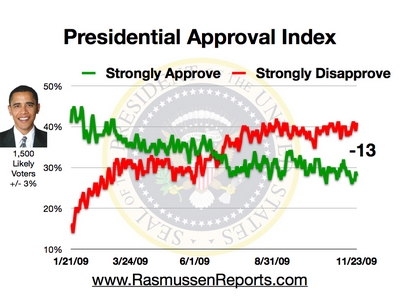
Rasmussen shows that Obama is now in deep disapproval. Strong disapproves are at 41%; strong approves at 28%. The approval index is in double-digit negative territory for nine days in a row.
That plus Joe Lieberman's principled opposition to a "public option" portend ill for ObamaCare. Minus the public option, lefties like Feingold will bolt, and Obama lacks the skill or popularity to keep all 60 Dems in the fold.
So, a little over a year since the election and much less than a year since the inauguration, it's worth remembering that Obama was elected opposing a health-insurance mandate, a point with which he pummeled Hillary in the primaries, and with a pledge to practice post-partisan politics. So much for promises, so much for approval.
Friday, November 20, 2009
Report from China: What BHO Didn't See
WSJ Asia editor Leslie Hook reminds readers of that astute news outlet what President Obama could have visited in China but didn't: a Chinese "house" church.
The article nicely summarizes what the roughly 100 million Chinese Christians face as their loyalties contest those demanded by their very peculiar government. And it notes who is likely to win the contest:
The article nicely summarizes what the roughly 100 million Chinese Christians face as their loyalties contest those demanded by their very peculiar government. And it notes who is likely to win the contest:
But freedom of faith is something not even history's most repressive governments have ever been fully able to snuff out: not the Romans in their suppression of the earliest Christians; not the communists in their efforts to substitute History for God; not Joseph Stalin, Mao Zedong or Kim Il Sung, who attempted to substitute themselves for God. So while Shouwang has no place to meet this coming Sunday, the church will still be there, only more deeply steeled in its faith. This is the side of China—the one Mr. Obama opted not to see—that will ultimately determine its future.
Wednesday, November 18, 2009
Which Lawyer Came to Work Prepared?
If we taught in law school (a personal nightmare), we'd require first-year students to watch this exchange between Attorney General Eric Holder and Senator Lindsey Graham. Then we'd ask, Which attorney would you rather be? What makes that attorney different?
The obvious answers are "Graham," and "He seems to know what he's talking about, while Holder hasn't a clue about things that should be settled."
As in someone thought things through and did his homework, while someone else didn't.
How does the Attorney General of the United States go to a Senate committee hearing, having announced civilian trials for 9/11 conspirators, and not expect to be asked what he'd do with Bin Laden? How does the Justice Department not already have a plan for Bin Laden's disposition when he's captured?
Answers, to be applied multiply and randomly to the questions above: (1) They're making it up as they go. (2) They're focused on satisfying the editorial board of The Nation, not the Congress or the electorate. (3) Despite having campaigned on Bin Laden's noncapture, they have no means or desire to effect his capture.
We really think that Holder looks like he's in over his head in this exchange. Graham is deferential to his niceness, almost as if to say that he's sorry to expose the fact that he's not really up to the job.
We're trying not to imagine the confusion behind the scenes as Justice plays out its civilian show trials while intelligence agencies wonder what they'll have to do with the next bad guy who's captured.
The obvious answers are "Graham," and "He seems to know what he's talking about, while Holder hasn't a clue about things that should be settled."
As in someone thought things through and did his homework, while someone else didn't.
How does the Attorney General of the United States go to a Senate committee hearing, having announced civilian trials for 9/11 conspirators, and not expect to be asked what he'd do with Bin Laden? How does the Justice Department not already have a plan for Bin Laden's disposition when he's captured?
Answers, to be applied multiply and randomly to the questions above: (1) They're making it up as they go. (2) They're focused on satisfying the editorial board of The Nation, not the Congress or the electorate. (3) Despite having campaigned on Bin Laden's noncapture, they have no means or desire to effect his capture.
We really think that Holder looks like he's in over his head in this exchange. Graham is deferential to his niceness, almost as if to say that he's sorry to expose the fact that he's not really up to the job.
We're trying not to imagine the confusion behind the scenes as Justice plays out its civilian show trials while intelligence agencies wonder what they'll have to do with the next bad guy who's captured.
Harvard Med School Chief Articulates SWNIDish Position
We haven't posted much lately because so much of what's in the news is covered by prior pontifications. Today we break silence to note that others are similarly pontificating, and they're closer to actual pontiffs.
Specifically, Dr. Jeffrey S. Flier, who happens to be no less than Dean of Harvard Medical School (a fact with which Dr. Flier opens his article, both obviating the usual biographical note appended at the end and reinforcing the stereotype of Harvard types), opines in today's WSJ that the present state of so-called healthcare reform is deserving of a "failing grade."
For those who expect a stalwart of academe to insist that the current bills aren't trendy-lefty enough, we note the surprise that Flier objects on economic grounds. What the present reforms will do, he argues, is drive prices higher faster than would happen otherwise.
Flier offers nothing of an alternative, but he does hint as he assesses the present:
So the solutions ought to be to reform tax policy to decouple employment and insurance, tax overinsurance, reduce regulation, and reform Medicare and Medicaid away from payment for service. We seem to remember someone trying to do something about such things once.
Despite Flier's throwaway remarks decrying both parties' approaches to the issue, the reality is that his diagnosis would call for the kinds of actions proposed by the Bush administration and instantly torpedoed by Democrats in Congress.
Cost control and quality improvement, Flier says, can't happen when "The true costs of health care are disguised, competition based on price and quality are almost impossible, and patients lose their ability to be the ultimate judges of value."
So the solution would be to put patients in charge of their healthcare dollars, with a financial incentive to save. Just the thing that high-deductible policies with health savings accounts would do. Which is to say the very thing that the present administration and Congress refuses to allow to continue, let alone grow. And the very thing for which Whole Foods CEO John Mackey was nearly crucified for advocating weeks ago.
Flier can't say that, apparently. He must respect the rule that people in his position not support such reactionary, right-wing ideas. But it's clear enough what must be done if his analysis has any merit at all.
We continue to think that the Obama-Pelosi initiative is doomed by its stupidity. We are heartened that some of those most deeply embedded in the institutions of the liberal establishment seem to agree.
Specifically, Dr. Jeffrey S. Flier, who happens to be no less than Dean of Harvard Medical School (a fact with which Dr. Flier opens his article, both obviating the usual biographical note appended at the end and reinforcing the stereotype of Harvard types), opines in today's WSJ that the present state of so-called healthcare reform is deserving of a "failing grade."
For those who expect a stalwart of academe to insist that the current bills aren't trendy-lefty enough, we note the surprise that Flier objects on economic grounds. What the present reforms will do, he argues, is drive prices higher faster than would happen otherwise.
Flier offers nothing of an alternative, but he does hint as he assesses the present:
Tax policy drives employment-based insurance; this begets overinsurance and drives costs upward while creating inequities for the unemployed and self-employed. A regulatory morass limits innovation. And deep flaws in Medicare and Medicaid drive spending without optimizing care.
So the solutions ought to be to reform tax policy to decouple employment and insurance, tax overinsurance, reduce regulation, and reform Medicare and Medicaid away from payment for service. We seem to remember someone trying to do something about such things once.
Despite Flier's throwaway remarks decrying both parties' approaches to the issue, the reality is that his diagnosis would call for the kinds of actions proposed by the Bush administration and instantly torpedoed by Democrats in Congress.
Cost control and quality improvement, Flier says, can't happen when "The true costs of health care are disguised, competition based on price and quality are almost impossible, and patients lose their ability to be the ultimate judges of value."
So the solution would be to put patients in charge of their healthcare dollars, with a financial incentive to save. Just the thing that high-deductible policies with health savings accounts would do. Which is to say the very thing that the present administration and Congress refuses to allow to continue, let alone grow. And the very thing for which Whole Foods CEO John Mackey was nearly crucified for advocating weeks ago.
Flier can't say that, apparently. He must respect the rule that people in his position not support such reactionary, right-wing ideas. But it's clear enough what must be done if his analysis has any merit at all.
We continue to think that the Obama-Pelosi initiative is doomed by its stupidity. We are heartened that some of those most deeply embedded in the institutions of the liberal establishment seem to agree.
Cultural Opportunity Not to Be Missed
Our Fair City's renowned musical assemblage, the Cincinnati Symphony Orchestra, this weekend offers an appealing program at an appealing price.
The program is a newly composed piece followed by two chestnuts, Mozart's Fourth Violin Concerto and Brahms' Second Symphony.
The price is whatever you want to pay. They're recommending $10 per ticket, but they're accepting any amount you name.
Info on obtaining tickets is available here. And here's a little video that introduces the program from the perspective of some of they players:
The program is a newly composed piece followed by two chestnuts, Mozart's Fourth Violin Concerto and Brahms' Second Symphony.
The price is whatever you want to pay. They're recommending $10 per ticket, but they're accepting any amount you name.
Info on obtaining tickets is available here. And here's a little video that introduces the program from the perspective of some of they players:
Monday, November 09, 2009
And It Was Torn Down
On this anniversary of the Berlin Wall's apocalyptic destruction, we link a recording, of Ronald Reagan's remarkable 1987 speech that momentously called for that very event. The speech has been edited into three parts to conform to the time limits imposed by YouTube.
We link this extensive digest as opposed to briefer excerpts of the climactic phrase for a reason. As we look back on the democratic West's victory over Communism in the Cold War, we must reckon that the conflict was concluded successfully when Reagan, Thatcher and Pope John Paul II added to the historic strategy of containment a determination to roll back the oppression of Communist regimes that were both morally evil and politically rotten.
Reagan's delivery is clear, though betraying some fatigue. He muddles the German phrases, though they are received warmly by his audience. But he delivers not just a call to destroy the wall but an assertion of his core political values: that freedom is both right morally and pragmatic economically. The West was strong because freedom makes its citizens strong and prosperous, while the Communist bloc was weak because oppression makes people weak and poor.
That didn't mean confrontation alone. It meant diplomacy, and most of the speech is about possible diplomatic moves. But it was the aim of the diplomacy that never wavered: Reagan proposed diplomacy not simply to keep the peace but to promote liberty. Avoiding hostility was by itself far too small a goal to channel Reagan's idealism.
And so here is the speech, in three parts:
As a coda,we note that WSJ carries today a there-at-the-creation essay by one of Reagan's speechwriters, noting how the President himself championed the inclusion of the four words that Foggy Bottom sought to excise.
We link this extensive digest as opposed to briefer excerpts of the climactic phrase for a reason. As we look back on the democratic West's victory over Communism in the Cold War, we must reckon that the conflict was concluded successfully when Reagan, Thatcher and Pope John Paul II added to the historic strategy of containment a determination to roll back the oppression of Communist regimes that were both morally evil and politically rotten.
Reagan's delivery is clear, though betraying some fatigue. He muddles the German phrases, though they are received warmly by his audience. But he delivers not just a call to destroy the wall but an assertion of his core political values: that freedom is both right morally and pragmatic economically. The West was strong because freedom makes its citizens strong and prosperous, while the Communist bloc was weak because oppression makes people weak and poor.
That didn't mean confrontation alone. It meant diplomacy, and most of the speech is about possible diplomatic moves. But it was the aim of the diplomacy that never wavered: Reagan proposed diplomacy not simply to keep the peace but to promote liberty. Avoiding hostility was by itself far too small a goal to channel Reagan's idealism.
And so here is the speech, in three parts:
As a coda,we note that WSJ carries today a there-at-the-creation essay by one of Reagan's speechwriters, noting how the President himself championed the inclusion of the four words that Foggy Bottom sought to excise.
Tuesday, November 03, 2009
Why Is Tonight Different from All Other Nights?
For a range of conservative punditry on today's extremely off-year elections, we recommend NRO's symposium.
The consensus: conservatives will mostly win, demonstrating the backlash against Big Government and a return to core conservative values.
The advice: Rs need to be conservatives but remain big-tent conservatives.
The likely buzz: mainstream media will either ignore conservative victories or see them as problematic for the GOP, constraining the party from moving left where it ought to be. Such is demonstrable nonsense.
Our meta-punditry: the United States remains an inherently conservative nation that occasionally flirts with the Left. Why? The Left appealingly addresses objectives sought by all people while providing means that semmingly bypass the hard stuff. But after the flirtation, cold reality takes hold and restores the notion that virtuous means are needed to achieve virtuous ends. We have our flirtations, but in the end we come back home.
The consensus: conservatives will mostly win, demonstrating the backlash against Big Government and a return to core conservative values.
The advice: Rs need to be conservatives but remain big-tent conservatives.
The likely buzz: mainstream media will either ignore conservative victories or see them as problematic for the GOP, constraining the party from moving left where it ought to be. Such is demonstrable nonsense.
Our meta-punditry: the United States remains an inherently conservative nation that occasionally flirts with the Left. Why? The Left appealingly addresses objectives sought by all people while providing means that semmingly bypass the hard stuff. But after the flirtation, cold reality takes hold and restores the notion that virtuous means are needed to achieve virtuous ends. We have our flirtations, but in the end we come back home.
Electoral Guide Update
ITEM: We urgently update our previous endorsements to note that CPS school board candidate Chris McDowell does indeed have a web site, located here. Mr. McDowell phoned us to leave the message.
We commend him as a reader of this highly influential blog, even if such reading is prompted only by Google Blog Alerts.
We also urge the League of Women Voters to get its thing together and list all candidates' web sites on their avowedly nonpartisan voters' guide web site.
ITEM: Where does Mayor Mark Mallory dine on Election Day? For breakfast, he dines at the Queensgate Frisch's. Enjoying a meal there with a visiting missionary of significant impact, we spied the mayor making his entrance, later sharing some pleasant, neighborly conversation as we exited. Those who infer from his assignment of a police body guard that the Mayor travels with an entourage are simply goofy. Entering with two associates, he walked through a restaurant where he was clearly accepted as ordinary by the serving staff, altogether unheralded, un guarded and unconcerned.
We commend him as a reader of this highly influential blog, even if such reading is prompted only by Google Blog Alerts.
We also urge the League of Women Voters to get its thing together and list all candidates' web sites on their avowedly nonpartisan voters' guide web site.
ITEM: Where does Mayor Mark Mallory dine on Election Day? For breakfast, he dines at the Queensgate Frisch's. Enjoying a meal there with a visiting missionary of significant impact, we spied the mayor making his entrance, later sharing some pleasant, neighborly conversation as we exited. Those who infer from his assignment of a police body guard that the Mayor travels with an entourage are simply goofy. Entering with two associates, he walked through a restaurant where he was clearly accepted as ordinary by the serving staff, altogether unheralded, un guarded and unconcerned.
Subscribe to:
Posts (Atom)